Indonesian Coelacanth: Sulawesi's Second Living Fossil
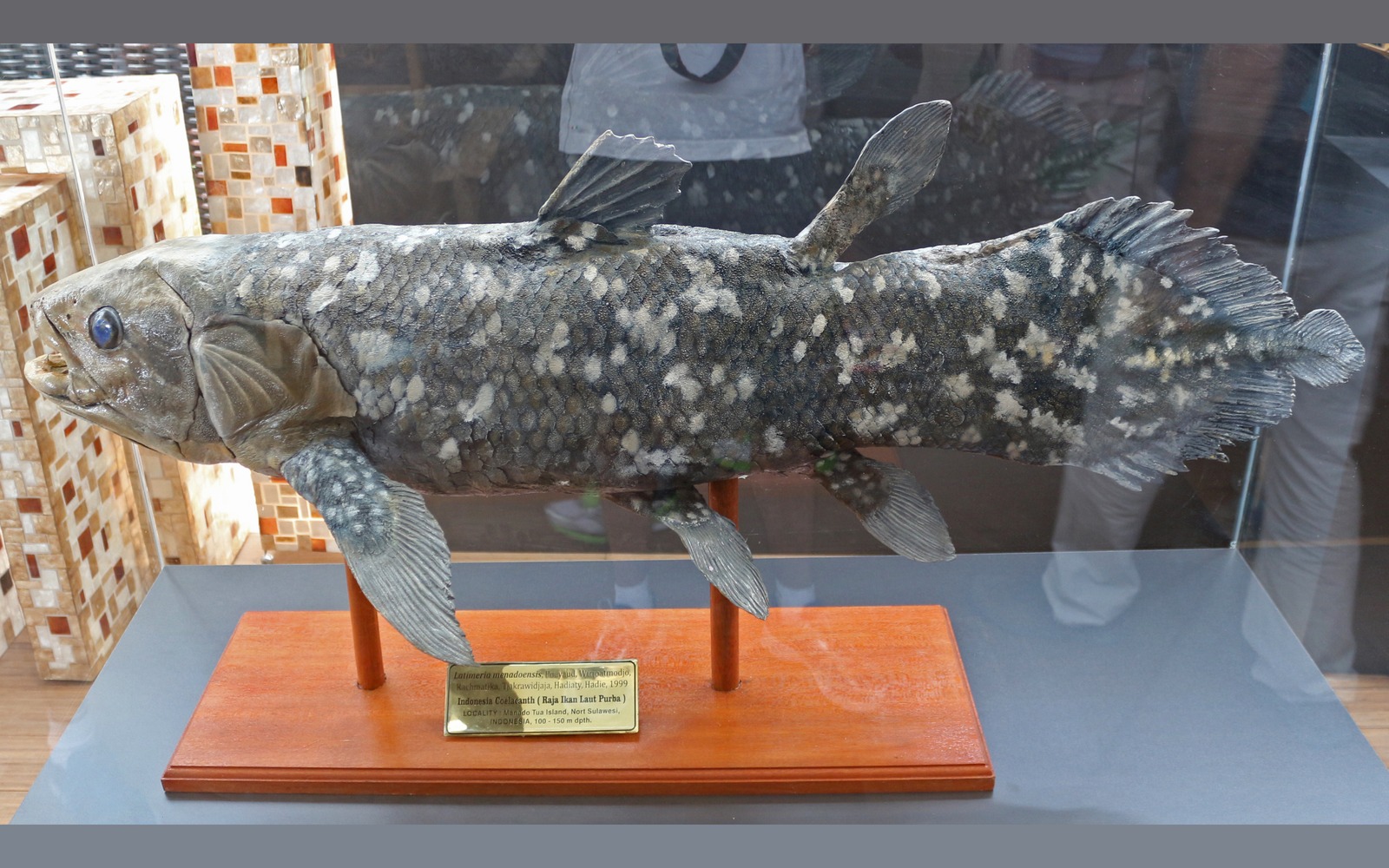
Species deep dive · indonesian coelacanth
Are there two living coelacanth species? Yes. For decades the only known living coelacanth was the West Indian Ocean coelacanth (Latimeria chalumnae), the famous Lazarus fish caught off South Africa in 1938. Then, in a Manado fish market in 1997, scientists met a second living species: the Indonesian coelacanth (Latimeria menadoensis), known locally as raja laut — "king of the sea" (Erdmann et al. 1998). In July 2026, a BRIN–OceanX–NHK survey around Talise Island, North Sulawesi, documented 18 individuals in one campaign, including 11 living in a single underwater cave, and strengthened the push for a dedicated marine sanctuary (BRIN).
From market stall to new species
On 18 September 1997, Arnaz Mehta Erdmann spotted a strange fish being wheeled through the market in Manado, North Sulawesi, while on honeymoon with marine biologist Mark Erdmann. They photographed it, but it was sold before they could keep a specimen. On 30 July 1998, local fishermen caught a second fish alive in a deep shark gill-net off Manado Tua: 124 cm long and 29.2 kg. Locals already had a name for it — raja laut. The find was announced in Nature and later described as a separate species (Erdmann et al. 1998; Kadarusman et al. 2020).
Our West Indian Ocean coelacanth Journal piece covers the African Lazarus-fish story. The Indonesian fish is the Pacific half of that living-fossil pair.
Sulawesi fish, African cousin
Both are lobe-finned "living fossils", but they are not the same animal:
- Colour. Indonesian fish are brown with gold flecks; African fish are usually described as steel blue (Erdmann et al. 1998).
- Size. FishBase lists Indonesian coelacanths to about 1.4 m. The African species is often cited around 2 m (FishBase; NOAA Fisheries).
- Genetics. DNA work puts the split between the two lineages on the order of 30–40 million years ago (Kadarusman et al. 2020).
- Depth. Remote-vehicle surveys off Sulawesi and Biak found Indonesian coelacanths at about 115–220 m, in water of roughly 12–21 °C (Kadarusman et al. 2020).
Habitat in Indonesia stretches farther than the first Manado records. Researchers have confirmed fish from Biak, Papua, to Buol in Central Sulawesi, with further records in North Maluku (BRIN; Kadarusman et al. 2020).
Divers meet raja laut
For years, living Indonesian coelacanths were known only from submersibles and remotely operated vehicles. In October 2024, two technical divers met one at 144 m in North Maluku, took the first diver photographs of the species, and found the same individually spotted fish the next day. Water at that depth was about 19–20 °C, versus 29–30 °C at the surface (Chappuis et al. 2025).
Talise 2026: eighteen fish and a sanctuary push
Talise Island's caves were first surveyed for coelacanths in 2009, when researchers recorded four individuals. The collaborative BRIN, OceanX and NHK expedition returned and documented 18 fish, including 11 in one cave — a landmark count for Indonesian coelacanth research. The same research programme also reported a juvenile of about 26 cm in Amurang Bay, a CT scan revealing 22 eggs in one specimen, and a running total of at least 52 Indonesian individuals identified since work began in 2004 (BRIN).
In July 2026, North Sulawesi's provincial government submitted approval documents to Indonesia's Ministry of Marine Affairs and Fisheries to designate Talise waters as a coelacanth habitat sanctuary. After national designation, researchers and government plan to nominate the site for UNESCO World Heritage status within the Coral Triangle (BRIN).
Conservation status
The IUCN lists Latimeria menadoensis as Vulnerable. International trade is banned under CITES Appendix I (IUCN Red List; FishBase). The main threat is accidental capture in deep-set nets (Erdmann et al. 1998). Coelacanths also breed slowly: the African species may carry its young for about five years, which is why every protected cave matters (Mahé et al. 2021).
How the Indonesian coelacanth plays in Wilder
The Indonesian Coelacanth (Latimeria menadoensis) is an Uncommon Pisces card in the Water element. It costs 4 Energy, with Attack 3 and Health 6, and it has Ambush and Resilient. Flavour text: "Scientists first met it in a fish market. Divers first met it at 144 metres, in 2024." Its African cousin, the West Indian Ocean coelacanth, is a Rare 5-cost 4/7 with Guardian and Resilient.
Wilder is a free browser collectible card game about real animals, and you can play it free in your browser with no signup.
Photo credit
Hero photograph: Claudio Martino (Martin Mystère), "Indonesian coelacanth, Expo 2015" (stuffed Latimeria menadoensis in the Indonesia pavilion, Expo 2015, Milan), Wikimedia Commons, CC BY-SA 4.0. Padded to fit the Field Journal hero.

Questions people ask
How many living coelacanth species are there?
Two. The African West Indian Ocean coelacanth (Latimeria chalumnae) and the Indonesian coelacanth (L. menadoensis), recognised after a 1997 Manado market find and described as a separate species (Erdmann et al. 1998; Kadarusman et al. 2020).
What did the 2026 Talise Island survey find?
Eighteen Indonesian coelacanths around Talise Island, North Sulawesi, including 11 living in one cave. The BRIN–OceanX–NHK work also supports a proposed marine sanctuary for the habitat (BRIN).
What does raja laut mean?
"King of the sea." It is the local name used around Manado for the Indonesian coelacanth, recorded when fishermen brought in the 1998 Manado Tua specimen (Erdmann et al. 1998).
How is the Indonesian coelacanth different from the African one?
Colour, size and DNA. Indonesian fish are brown with gold flecks and grow to about 1.4 m; African fish are usually steel blue and larger, around 2 m. The lineages split roughly 30–40 million years ago (Erdmann et al. 1998; FishBase; Kadarusman et al. 2020).
Is the Indonesian coelacanth endangered?
It is Vulnerable on the IUCN Red List, and international trade is banned under CITES Appendix I. Accidental capture in deep-set nets is the main threat (IUCN; FishBase; Erdmann et al. 1998).
Sources
- Erdmann, Tan & Caldwell (1998) Indonesian 'king of the sea' discovered, Nature 395:335
- Kadarusman et al. (2020) A newly discovered population of Indonesian coelacanth, Scientific Reports
- Chappuis et al. (2025) First scuba observations of Indonesian coelacanth, Scientific Reports
- BRIN (26 Jul 2026): Temuan 18 ikan purba di Pulau Talise
- IUCN Red List: Latimeria menadoensis
- FishBase: Latimeria menadoensis
- NOAA Fisheries: African coelacanth
- Mahé et al. (2021) Five years of gestation in the coelacanth