Texas Brown Tarantula: Why Do the Males Wander in Fall?
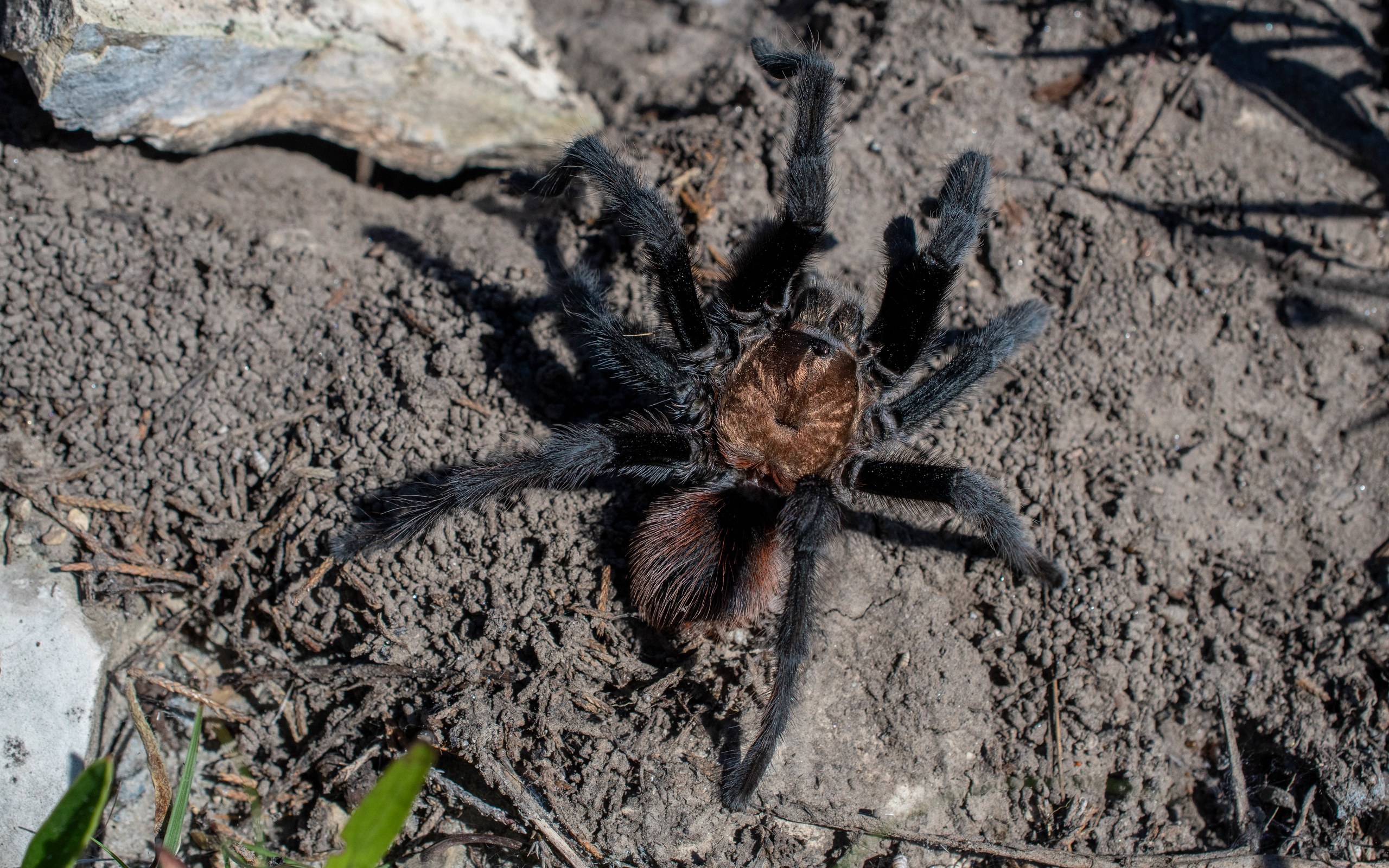
Species deep dive · texas brown tarantula
They're looking for love, and for most of them it's a one-way trip. Almost every tarantula you see crossing a road in late summer or fall is a mature male that has left his burrow for good to search for females. Females stay home (Colorado State University Extension; Missouri Department of Conservation). After spending an estimated 7–10 years growing up underground, a male usually lives only a few more months once he starts wandering (Colorado State University Extension). Females can live for decades.
Here's what the Texas brown tarantula (Aphonopelma hentzi) is doing out there, how far the males go, and whether you need to worry if one strolls past your boots.
A burrow life, then one big trip
The Texas brown tarantula, also called the Missouri or Oklahoma tarantula, is Missouri's largest spider and that state's only native tarantula (Missouri Department of Conservation). It also lives on the prairies of southeastern Colorado (Colorado State University Extension).
For most of its life it is a homebody. It lives in a silk-lined burrow, often an old rodent or reptile tunnel, and comes out at night to grab crickets, beetles and other insects that wander close (Missouri Department of Conservation; Colorado State University Extension). The burrow can go more than 30 cm (1 foot) deep, and late in the season the spider seals the entrance with a solid plug and stays inside until spring (Colorado State University Extension).
Males are estimated to take about 7–10 years to mature, and females need 1–2 years more. At the male's final molt, everything changes: he grows noticeably longer legs, abandons his burrow and sets off to find females (Colorado State University Extension).
When are tarantulas on the move?
It depends on where you are. Mature males have been recorded leaving their burrows anywhere from June to December (Janowski-Bell & Horner 1999). In southeastern Colorado the wandering peaks from late August through September (Colorado State University Extension). In Missouri it's September and October, when males zigzag over rocky glades and across roads (Missouri Department of Conservation, Xplor). In Texas, Texas A&M AgriLife says the movement can run from May to August, triggered by warm weather and rain (Texas A&M AgriLife).
Is it really a migration?
Not in the scientific sense. People often call it the "tarantula migration," but Texas A&M AgriLife entomologist Wizzie Brown says it is not a true migratory event, just males searching for mates (Texas A&M AgriLife).
Researchers at Midwestern State University in Texas tested this by gluing tiny radio transmitters to male Texas brown tarantulas. The males moved in all directions, and the researchers couldn't rule out that their routes were random. Only three individuals showed a significant overall direction. Individual males still covered real distances, up to 1,300 m. The tracked males sheltered by day in thickets and burrows, and seven were found in burrows with what appeared to be mature females, where they stayed 1–3 days before moving on (Janowski-Bell & Horner 1999).
So it's less a march and more a search: each male follows his own winding path from burrow to burrow. Male tarantulas use their pedipalps to follow a female's scent trail. At her burrow, a male taps on the silk around the entrance so the larger female knows he isn't prey (Missouri Department of Conservation, Xplor).
Why the males don't come back
The trip is expensive. In the radio-tracking study most males kept losing body mass and ended up with very small abdomens, and three were found dead (Janowski-Bell & Horner 1999). Colorado State University notes that wandering males normally die within a couple of months, and few survive past November (Colorado State University Extension). Missouri's conservation department says a male dies within a year of mating even if courtship goes well (Missouri Department of Conservation, Xplor).
Out in the open they also run into lizards, birds and coyotes, plus their most famous enemy, the tarantula hawk wasp, which paralyzes a tarantula with its sting and lays an egg on it (Colorado State University Extension).
Females play a much longer game. They rarely go farther than a short hunt from their burrows, can live more than a decade after maturing, and produce an egg sac each year after a successful mating (Colorado State University Extension). Missouri's field guide says females may live for more than 30 years (Missouri Department of Conservation).
Are Texas brown tarantulas dangerous?
No. Their venom has no medical significance for people, and a bite is often compared to a bee sting. Tarantulas are shy and rarely bite unless they're handled roughly (Missouri Department of Conservation; Texas A&M AgriLife). Their main defence is their hair. A threatened tarantula flicks barbed hairs off its abdomen, and these can cause rashes, intense itching and eye injuries (Colorado State University Extension; Texas A&M AgriLife).
The best thing to do with a wandering male is to let him cross. In Missouri it is illegal to collect tarantulas from public land without a permit (Missouri Department of Conservation).
One species, many old names
The Texas brown tarantula used to look like several species. Older guides list a "Colorado chocolate brown," an "Oklahoma brown" and more (Colorado State University Extension). A 2016 revision of US tarantulas, using genomic, anatomical and range data, cut the country's 55 named Aphonopelma species down to 29 and folded eight older names, including Aphonopelma coloradanum, A. echinum and A. waconum, into A. hentzi (Hamilton, Hendrixson & Bond 2016, ZooKeys). So big brown tarantulas once split among those names are now treated as one species.
For a spider whose bite really is dangerous, compare the Sydney funnel-web and the southern black widow.
How the Texas brown tarantula plays in Wilder
The Texas Brown Tarantula (Aphonopelma hentzi) is a Common Arachnida card in the Desert element. It costs 3 Energy, with Attack 2 and Health 4, and it has Venom plus the ability Urticating Hairs (2 Energy: deal 1 damage to an enemy creature), which mirrors the barbed hairs real tarantulas flick at attackers. Flavour text: "It waits beneath the sand for the perfect moment to strike."
Wilder is a free browser collectible card game about real animals, and you can play it free in your browser with no signup.
Photo credit
Hero photograph: Beckyhansis, "Mature aphonopelma hentzi" (a mature male in a threat pose), Wikimedia Commons, CC BY-SA 4.0. Cropped for the Field Journal hero.

Questions people ask
How big is a Texas brown tarantula?
Its body is about 5 cm (2 inches) long in females and about 4 cm (1½ inches) in males, not counting the legs, which makes it Missouri's largest spider (Missouri Department of Conservation). With its legs spread, it's nearly as big as a tea saucer (MDC Xplor).
How many eggs does a female tarantula lay?
Between 100 and 1,000 eggs, wrapped in a silk sac that she keeps in her burrow (MDC Xplor; Texas A&M AgriLife). Colorado State University notes that eggs are typically laid in June and hatch about 50–60 days later (Colorado State University Extension).
Can tarantulas see well?
No. A tarantula has eight eyes, but they can only detect movement and tell light from dark, so it feels its way around with the sensitive hairs on its legs and pedipalps (MDC Xplor).
How did tarantulas end up in Missouri?
They apparently arrived about 8,000 years ago, when Missouri's climate was warmer and drier, like today's desert Southwest. When it turned cooler and wetter about 4,000 years ago, the tarantulas held on in dry, rocky glades, where they still live (Missouri Department of Conservation).
Sources
- Missouri Department of Conservation: Texas Brown Tarantula (field guide)
- Missouri Department of Conservation, Xplor (Sept 2025): Gentle Giants
- Colorado State University Extension: Colorado Tarantulas (Insect of Interest)
- Janowski-Bell & Horner (1999) Movement of the male brown tarantula, Aphonopelma hentzi, using radio telemetry. Journal of Arachnology 27:503–512
- Texas A&M AgriLife: Tarantulas on the move (2024)
- Hamilton, Hendrixson & Bond (2016) Taxonomic revision of the tarantula genus Aphonopelma within the United States. ZooKeys 560:1–340