Black-Footed Ferret: How Many Are Left, and Can Clones Save It?
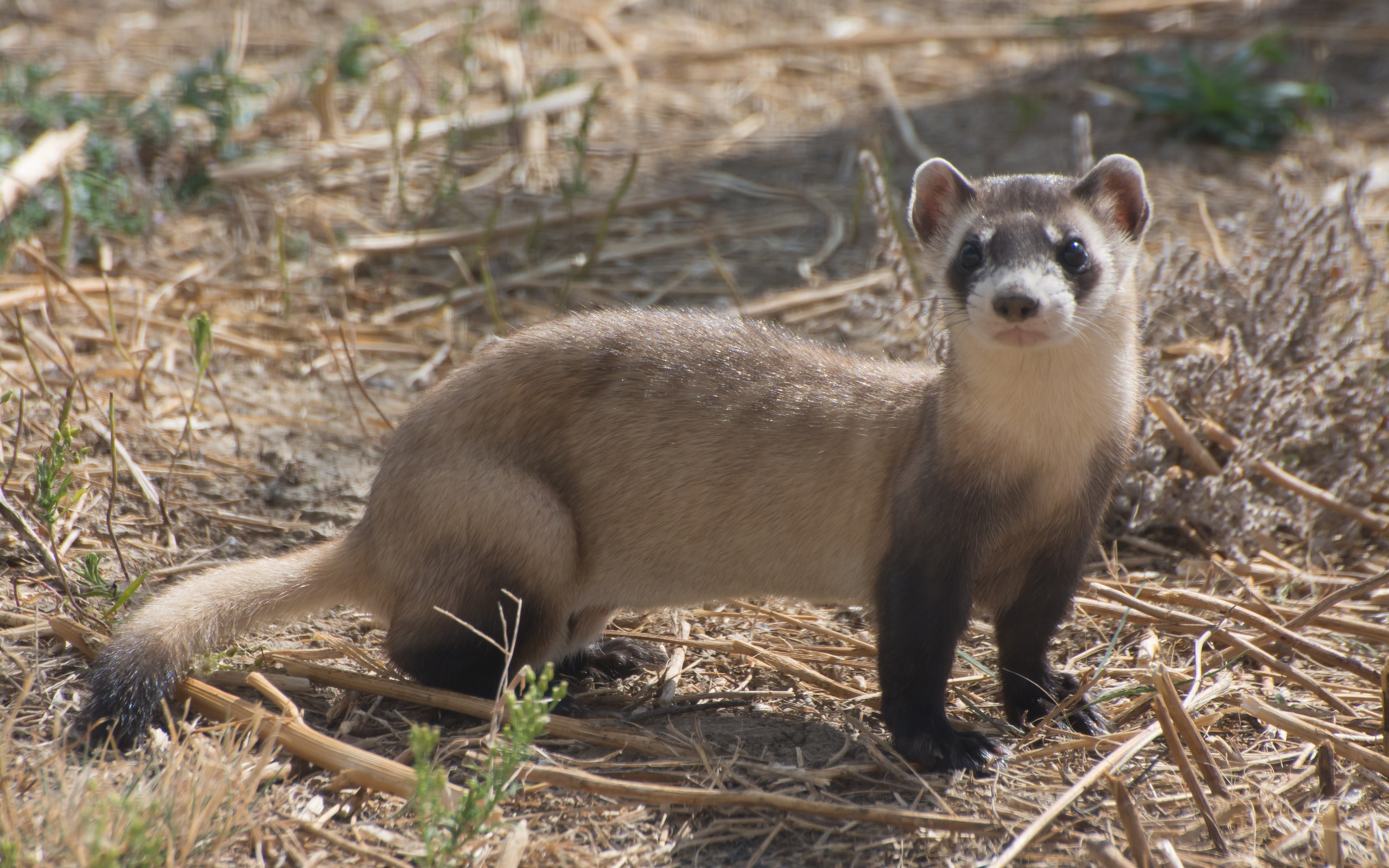
Species deep dive · black footed ferret
Only a few hundred. The U.S. Fish and Wildlife Service says current data suggest there are "several hundred" black-footed ferrets living in the wild, spread across 34 reintroduction sites in eight U.S. states plus Canada and Mexico. Because ferrets are nocturnal and live underground, nobody can count them exactly (USFWS). Reporting in 2024 put the figure at roughly 340 (The Atlantic). Every one of them descends from just seven ferrets that bred in captivity in the 1980s, and that is why scientists have started cloning.
Here's how North America's only native ferret went extinct twice, how a ranch dog brought it back, and what clones of a ferret who died in the 1980s are doing for it today.
The ferret that went extinct twice
Black-footed ferrets once lived across the Great Plains and western grasslands, from Saskatchewan to Chihuahua. One estimate puts their late-1800s population at 500,000 to 1 million. As farmland spread and prairie dogs were poisoned, the ferrets vanished. By the late 1950s they were presumed extinct. A small population turned up in Mellette County, South Dakota, in 1964, but it died out in the wild in 1974. In 1979 what was thought to be the last black-footed ferret died in captivity (USFWS).
Then, on 26 September 1981, a ranch dog named Shep near Meeteetse, Wyoming, brought a dead animal home to his owners, John and Lucille Hogg. The local taxidermist recognised it as a black-footed ferret (Smithsonian's National Zoo). Biologists then found about 120 ferrets living in the prairie dog colonies nearby (Wyoming Game and Fish Department).
That last colony didn't stay safe for long. Sylvatic plague and canine distemper hit it in the mid-1980s, and between 1985 and 1987 every remaining ferret was caught for a captive breeding program. The last wild one came in in 1987. That left 18 ferrets, seven males and 11 females, as the entire species (Smithsonian's National Zoo). Only seven of them became the genetic founders of every ferret alive today (USFWS).
From 18 ferrets to more than 10,000 kits
The breeding program worked. Since it began in 1986, more than 10,500 kits have been born in human care at the National Black-footed Ferret Conservation Center in Colorado and partner zoos. The first release came in 1991, when 49 ferrets went into Shirley Basin, Wyoming (Smithsonian's National Zoo). In 2016, 35 ferrets were released onto the same two ranches near Meeteetse where Shep found the species in 1981 (Wyoming Game and Fish Department).
So why are there still only a few hundred in the wild? Because a black-footed ferret can't live without prairie dogs. It eats them, and it sleeps, hides and raises its kits in their burrows, because ferrets don't dig their own (USFWS). Prairie dogs make up more than 90% of its diet, according to a Fish and Wildlife Service fact sheet (USFWS fact sheet). One diet study found a little less, at about 75% for adult males and juveniles and about 66% for adult females, which also catch mice (USFWS).
Plague, peanut butter and drones
The biggest threat today is sylvatic plague, a disease from outside North America that kills both prairie dogs and ferrets. The Fish and Wildlife Service calls it the most significant challenge to keeping ferret populations healthy (USFWS). Captive-raised ferrets are vaccinated against plague before release, but that doesn't help if the colony they depend on dies (USFWS).
So scientists vaccinate the prairie dogs too. The U.S. Geological Survey developed an oral plague vaccine for prairie dogs, packed into peanut-butter-flavoured baits. In field trials from 2013 to 2015 across seven western states, prairie dogs on vaccine plots survived plague outbreaks better than those on placebo plots (USGS). In 2016, teams in Montana even tested dropping the baits from drones (USFWS).
Willa, the ferret who came back as clones
Seven founders means very little genetic diversity. Without enough of it, a species becomes more vulnerable to disease and genetic problems, adapts less well, and breeds less successfully (USFWS). One of the original Meeteetse ferrets, a female named Willa, never successfully reproduced, so her genes were missing from the population. Her cells, though, had been frozen and stored for more than 30 years at San Diego Zoo Wildlife Alliance's Frozen Zoo (USFWS).
- 10 December 2020: Willa's first clone, Elizabeth Ann, was born. She was the first clone of a U.S. endangered species (Revive & Restore).
- May 2023: Two more clones, Noreen and Antonia, were born (Revive & Restore).
- June 2024: Antonia had two kits, Sibert and Red Cloud. It was the first time a clone of a U.S. endangered species produced offspring (Revive & Restore).
- Summer 2025: Four more litters, 12 kits (six females and six males), were born to Antonia, Noreen and Antonia's offspring (USFWS).
Elizabeth Ann and Noreen have since died (USFWS). Willa now officially counts as the species' eighth founder (Revive & Restore). The clones themselves aren't being released. They stay in breeding facilities for research and monitoring (USFWS). The plan is to release their descendants instead (Here & Now, WBUR).
Cloning isn't a fix on its own. The Fish and Wildlife Service says wild populations and prairie habitat remain essential to recovery (USFWS). Without prairie dogs and some way to stop plague, even a genetically healthy ferret has nowhere to live.
For more animals that zoos kept alive until they could go home, read are zoos bad? The honest answer. For another species that fell to a handful of animals, see how many California condors are left.
How the black-footed ferret plays in Wilder
The Black-footed Ferret (Mustela nigripes) is a Rare Mammalia card in the Grassland element. It costs 2 Energy, with Attack 2 and Health 2, and it has Ambush and Resilient: a night hunter that strikes from a burrow, and a species that keeps coming back. Flavour text: "Every black-footed ferret alive today comes from ferrets rescued in Wyoming in the 1980s."
Wilder is a free browser collectible card game about real animals, and you can play it free in your browser with no signup.
Photo credit
Hero photograph: USFWS Mountain-Prairie, "Endangered Black-Footed Ferret", Wikimedia Commons, public domain (U.S. Fish and Wildlife Service). Cropped for the Field Journal hero.

Questions people ask
Are black-footed ferrets nocturnal?
Yes. They are mostly active at night and spend much of their time underground in prairie dog burrows, which makes them very hard to spot. Studies found they are usually most active on nights when the moon is above the horizon, though they are occasionally seen by day (USFWS).
How long do black-footed ferrets live?
Only a few years. In the wild, females have lived to about 5 years and males to about 4. Many die young: at Meeteetse, Wyoming, the last natural wild population, mean life expectancy was just 0.9 years (USFWS).
When are black-footed ferret kits born?
In late spring. Ferrets mate from mid-March to early April, and after about 42–45 days the mother gives birth underground to usually 3–4 kits. Their eyes open at about 37 days, they come above ground around July, and they leave home in autumn (USFWS).
How big is a black-footed ferret?
Small and slim: 48–61 cm (19–24 in) long including the tail, and 635–1,134 g (1.4–2.5 lb). It has a buff body, black feet, a black tail tip and a black mask across the eyes (USFWS).
Where can you see black-footed ferrets?
Mostly at their breeding centres. Besides the National Black-footed Ferret Conservation Center in Colorado, captive breeding happens at Cheyenne Mountain Zoo, the Smithsonian's Conservation Biology Institute, Louisville Zoo, Phoenix Zoo and Toronto Zoo. The Fort Collins Museum of Discovery runs ferret live cams (USFWS).
Sources
- U.S. Fish and Wildlife Service: Black-footed Ferret (Mustela nigripes) species profile
- U.S. Fish and Wildlife Service: Q&As, Black-footed Ferret Cloning Research Update (2024)
- U.S. Fish and Wildlife Service: Cloned Black-footed Ferret Kits Offer Hope for the Species (2025)
- U.S. Fish and Wildlife Service: Black-footed Ferret fact sheet
- U.S. Fish and Wildlife Service: Hope for the Endangered Black-Footed Ferret (2016)
- Smithsonian's National Zoo and Conservation Biology Institute: Black-Footed Ferrets, Top Milestones
- Wyoming Game and Fish Department: BFF 4 EVER
- Revive & Restore: Black-footed Ferret Project
- U.S. Geological Survey: Plague vaccine helps reduce outbreaks in prairie dog colonies
- The Atlantic: How Long Should a Species Stay on Life Support? (2024)
- Here & Now, WBUR: Clones of endangered ferrets offer path to recovery (2026)