Kihansi Spray Toad: The Waterfall Toad Extinct in the Wild
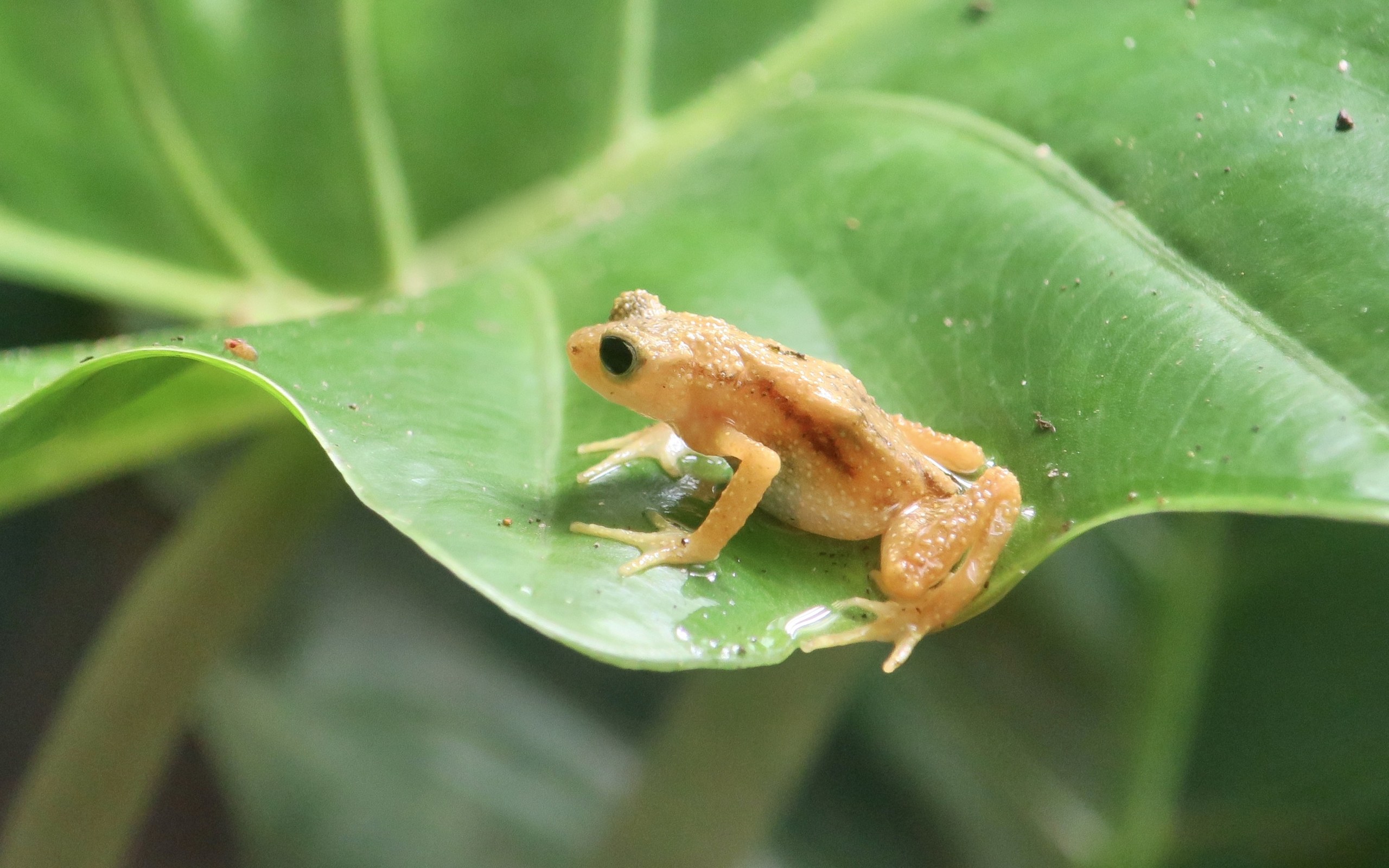
Species deep dive · kihansi spray toad
Because its whole world was the spray of one waterfall, and people turned the waterfall down. The Kihansi spray toad lived only in about 2 hectares (5 acres) of mist-soaked vegetation at the base of the falls in Tanzania's Kihansi Gorge. A hydropower dam upstream cut the falls' flow by 90%, the mist zone shrank, and a deadly fungus arrived. The toad was last seen in the wild in the mid-2000s and was declared Extinct in the Wild by the IUCN in 2009 (WCS). It survives because zoos took in 499 of them in 2000, and the fight to get it back into the gorge is still going.
Here's how a toad found only in 1996 lost its home within a decade, what the zoos did, and why putting it back has been so hard.
A toad that lived inside a waterfall's mist
In 1996, scientists climbing into a small, nearly inaccessible gorge on the Kihansi River in the Udzungwa Mountains found it full of tiny yellow toads. Their calls carried over the roar of the falls, and the population was later estimated at about 20,000 (GEF). Their entire range was the spray zone of the falls, about 20,000 square metres, the smallest known range of any vertebrate (Scientific American).
The spray made the gorge floor cooler and wetter than the land around it (CPSG). The toad is also unusual among amphibians because it doesn't lay eggs. Females give birth to fully formed toadlets, each smaller than a grain of rice (CPSG). The Global Environment Facility describes this as an adaptation that keeps eggs from being washed away by the spray (GEF).
The dam, the drought and the fungus
In the late 1990s the Lower Kihansi hydropower dam was built just upstream. It supplies a large share of Tanzania's electricity, but it cut the falls to 10% of their former flow and the mist zone shrank sharply (WCS, 2010). To make up for it, the World Bank funded a gravity-fed sprinkler system to recreate the spray (WCS). According to the IUCN Conservation Planning Specialist Group, nine months passed before it worked, and the spray zone dried out in the meantime (CPSG).
Then came chytrid, the fungal disease behind amphibian die-offs around the world. The Kihansi population crashed from about 20,000 toads to none (GEF). Sources differ on the last wild sighting, 2004 or 2005 (WCS, 2010; WCS, 2012). Scientists still debate the exact cause, but WCS says it was likely a combination of habitat change and chytrid (WCS). Amphibians living outside the gorge carried the same strain, called Bd-CAPE, with only mild infections. That suggests stress from the changed habitat helped the disease kill the toads (Science).
Saved in the Bronx, Detroit and Toledo
Scientists saw the collapse coming. In November 2000, at the Tanzanian government's invitation, the Wildlife Conservation Society's Bronx Zoo collected 499 spray toads from the gorge (WCS Wild View; Scientific American). Some went to the Detroit Zoo, which later sent its remaining animals to the Toledo Zoo to start that zoo's breeding colony (The Oakland Press, 2004; Nahonyo et al. 2018). Nobody had kept the species before, so keepers had to invent its care from scratch, from spray systems to water quality (Scientific American). The Bronx and Toledo programmes succeeded. By 2010, about 5,000 toads lived at Toledo and 1,500 at the Bronx Zoo (WCS, 2010).
In August 2010, 100 toads were flown home to a new breeding centre at the University of Dar es Salaam (WCS, 2010). In late 2012, 2,000 were released into the Kihansi Gorge. WCS described it as the first time an amphibian declared extinct in the wild had been reintroduced into its native habitat (WCS, 2012).
Why it isn't back yet
The releases between 2012 and 2022 did not produce a lasting wild population (TAWIRI). The fungus never left. In February 2022, 1,000 captive-bred toads were released into one of the spray wetlands and about 98% died. A 2026 study confirmed that Bd-CAPE caused the die-off and found the fungus still widespread in the gorge, carried by other frog species that don't get sick (Ecology and Evolution, 2026).
Tanzania hasn't given up. The Tanzania Wildlife Research Institute keeps a biosecure assurance population of about 5,000 toads in two laboratories. Under a new round of experimental trials it has released 700 toads into the restored Upper Kihansi wetlands and 100 into the Lufulutonya wetland along the Kihansi River, with long-term monitoring (TAWIRI). A 2026 grant is paying for chytrid surveillance, microclimate and water monitoring, and checks on whether Lufulutonya can serve as a second refuge (Mohamed bin Zayed Species Conservation Fund).
The spray toad shows both what zoos can do and where they stop. They can keep a species from vanishing, but they can't remove a fungus from a gorge. For the bigger picture, read are zoos bad? The honest answer. For another species zoos returned to the wild, see the Partula snail's comeback on Moorea.
How the Kihansi spray toad plays in Wilder
The Kihansi Spray Toad (Nectophrynoides asperginis) is a Rare Amphibia card in the Water element. It costs 1 Energy, with Attack 1 and Health 2, and it has Resilient, for a species that survived extinction in the wild. Flavour text: "A dam silenced its waterfall, so zoos kept it alive until it could go home."
Wilder is a free browser collectible card game about real animals, and you can play it free in your browser with no signup.
Photo credit
Hero photograph: RatioTile, "Kihansi spray toad" (a Kihansi spray toad at the Bronx Zoo), Wikimedia Commons, CC BY-SA 4.0. Cropped for the Field Journal hero.

Questions people ask
How big is a Kihansi spray toad?
Tiny. Adults are about 2 cm long, and the largest reach about 2.9 cm. An adult weighs only a few grams (CPSG; Scientific American; GEF).
What do Kihansi spray toads eat?
Very small invertebrates. Gut analyses of wild spray toads found arthropods from 18 different orders. At the Bronx Zoo they are fed pinhead crickets, springtails, bean beetles, orange isopods and two species of fruit fly to copy that variety (WCS Wild View).
What is chytrid fungus?
A skin disease of amphibians caused by the fungus Batrachochytrium dendrobatidis (Bd). It kills some species, while others carry it without getting sick. In the Kihansi Gorge, frogs of other species still carry the strain that killed the spray toads, and that remains a barrier to bringing the toad back (Ecology and Evolution, 2026).
Is the Kihansi spray toad a frog or a toad?
A true toad. It is a member of the toad family Bufonidae, as listed in a 2026 study of the amphibians in its gorge (Ecology and Evolution, 2026). Unlike most amphibians, it gives birth to live young instead of laying eggs (CPSG).
Sources
- Wildlife Conservation Society: Rare Toad Saved By Zoos, Restored to the Wild (2012)
- Wildlife Conservation Society: Kihansi Spray Toads Make Historic Return to Tanzania (2010)
- WCS Wild View: Menu for a Tiny Toad (2014)
- IUCN SSC Conservation Planning Specialist Group: Kihansi Spray Toad
- Global Environment Facility: The Kihansi Spray Toad's Journey Back Home (2015)
- Scientific American: Once Extinct in the Wild, Kihansi Spray Toad Returns to Tanzania (2012)
- Science: Toad extinction highlights deadly fungus spreading through Africa
- Ecology and Evolution (2026): Monitoring the Prevalence and Distribution of Chytrid Fungus in the Kihansi Spray Toad Population
- Tanzania Wildlife Research Institute: Southern Highlands Wildlife Research Centre
- Mohamed bin Zayed Species Conservation Fund: Kihansi spray toad (2026 grant)
- The Oakland Press (2004): Detroit Zoo gave toads the best it had
- Nahonyo et al. (2018) Conservation efforts of Kihansi spray toad Nectophrynoides asperginis. Tanzania Journal of Science 43(1):23–35