Eastern Hellbender: The Giant Salamander That Breathes Through Its Skin
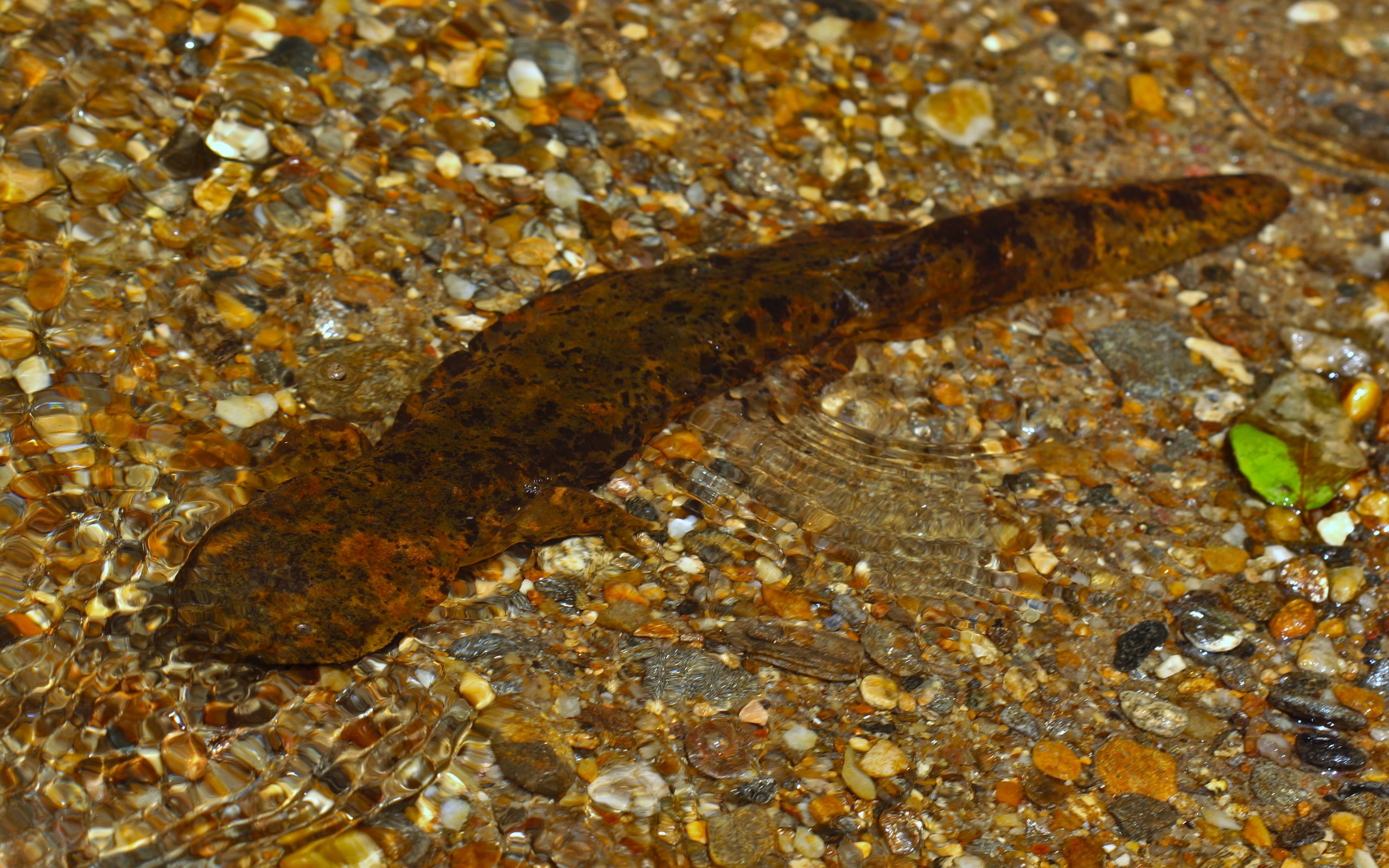
Species deep dive · eastern hellbender
Yes, the eastern hellbender really does breathe through its skin. An adult gets more than 90% of the oxygen it uses, and gets rid of 97% of its carbon dioxide, through its skin rather than its lungs (Guimond & Hutchison 1973). The loose, wrinkly folds along its sides add surface area for that exchange, which is why this giant salamander can only live in cool, clean, well-oxygenated streams (Smithsonian's National Zoo).
The Eastern Hellbender, Cryptobranchus alleganiensis alleganiensis, is North America's largest salamander. It grows to about 74 cm (more than 2 ft) and up to about 2.2 kg (5 lb), which makes it one of the largest salamanders in the world. Only its Asian cousins, the giant salamanders of China and Japan, grow bigger (Smithsonian's National Zoo). It spends most of its life under large, flat rocks in permanent streams across 15 US states (U.S. Fish & Wildlife Service). It has no gills as an adult, and its way of breathing shapes almost everything about it, from where it lives to why it is disappearing.
A skin that works like a gill
In 1973, physiologists Guimond and Hutchison measured how hellbenders exchange gases in air and water separately, at 5, 15 and 25 °C. At every temperature, aquatic respiration through the skin accounted for over 90% of the oxygen taken in. The hellbender's lungs turned out to be large, transparent sacs that are poor at gas exchange and probably work more for buoyancy. They called it the largest aquatic vertebrate without gills that relies almost entirely on breathing in water, with a skin that works as "a veritable gill" (Guimond & Hutchison 1973).
The trick is in the folds. Capillaries sit close under the skin's surface and pull oxygen straight out of the water, and the fleshy, lasagna-like folds increase the area they can work with (Smithsonian's National Zoo). The U.S. Fish & Wildlife Service puts it simply: cool, clear water matters because hellbenders breathe entirely through their skin (U.S. Fish & Wildlife Service). Warm, muddy or polluted water carries less oxygen and clogs the very surface the animal breathes with.
Dads that guard the nest
Hellbender fathers do the childcare. A male digs out a hollow under a big rock, waits for a female to enter, and does not let her leave until she has laid her eggs and he has fertilised them. He then guards the nest until the eggs hatch, and may stay on for a while with the hatchlings (U.S. Fish & Wildlife Service). For months he keeps the eggs supplied with oxygen by gently rocking his body back and forth like a fan (Smithsonian's National Zoo).
When fathers eat their eggs
Guarding dads sometimes eat some of the eggs they are guarding, a behaviour called filial cannibalism that turns up in several amphibians (Smithsonian's National Zoo). What surprised researchers was how often a male ate the whole clutch.
Because nests sit under boulders that cannot be lifted without wrecking them, William Hopkins's team at Virginia Tech put concrete nest boxes into streams in south-west Virginia and checked them by snorkelling (Virginia Tech News). Over 8 years they followed 182 nests at 10 sites along a gradient of forest cover upstream. Nest failure rose at sites with little riparian forest upstream, and at several sites reproductive failure was 100%, mainly because the caring male ate the clutch. Larger clutches at degraded sites were the most likely to be eaten, and the pattern was not explained by hungry, thin males (Hopkins et al. 2023).
A follow-up study raised eggs from 99 clutches in the lab. Eggs from sites with the most upstream forest produced about 70% more viable hatchlings than eggs from the least-forested sites, but egg quality in the lab did not predict which clutches the fathers ate in the wild (Funkhouser et al. 2024). The trigger is still unknown. The researchers suggest changes in water chemistry or silt, and they see chronic nest failure as one reason many hellbender populations are now made up mostly of old adults (Hopkins et al. 2023).
How the eastern hellbender is doing
Not well. Of 626 known historical populations, 41% are believed to be gone and another 36% are declining (U.S. Fish & Wildlife Service). Silt is a particular problem: when streamside forests are cleared, rain washes sediment in and fills the crevices under rocks that hellbenders need for shelter and nesting (Smithsonian's National Zoo). The Missouri population has been federally Endangered since 2021, and in December 2024 the Service proposed listing the eastern hellbender as Endangered across its whole range (Federal Register).
There is hands-on help too. In 2026, in a first for North Carolina, biologists from the U.S. Forest Service, the North Carolina Wildlife Resources Commission, Clemson University and the Tennessee Aquarium Conservation Institute collected 215 eggs in Pisgah National Forest to raise in captivity. About half had hatched by late October, and the plan is to release them in spring 2029, once they are around 23 cm (9 in) long and safer from predators, to boost dwindling populations, including in waterways devastated by flooding from Tropical Storm Helene (Asheville Citizen-Times).
On the Wilder card
In Wilder the Eastern Hellbender is an Uncommon Amphibia card in the Water element: Cost 3, Attack 2, Health 5, with Ambush and Guardian. Ambush lets it attack the turn it is played, which suits a predator that waits under a rock for crayfish to come close. Guardian means enemies must attack it before your other creatures or your Den, a fair game version of a father who will not leave his nest. Its flavour text reads: "Its wrinkly skin folds soak up most of its oxygen straight from the stream." For its bigger relatives, read about the Chinese Giant Salamander and the Japanese Giant Salamander.
Wilder is a free browser collectible card game about real animals, and you can play it free in your browser with no signup.
Photo credit
Hero photograph: Peter Paplanus, eastern hellbender (Cryptobranchus alleganiensis) swimming in a river in the United States (September 2021), via Flickr and Wikimedia Commons, licensed CC BY 2.0. Cropped for the Field Journal hero.

Questions people ask
Can hellbenders see?
Only poorly. Their eyes are weak and have no eyelids, so they rely mostly on touch. They also have light-sensing cells in their skin, concentrated in the tail, so a hellbender can poke its tail out from under a rock to tell whether it is day or night (Smithsonian's National Zoo).
How far do hellbenders move in their lives?
Not far. Once a hellbender has a good den under a rock it keeps it year after year, and if undisturbed it may spend nearly its whole life within a stretch of river about 60 m (200 ft) long (Smithsonian's National Zoo).
When do eastern hellbenders breed?
In autumn. Males prepare nests under big rocks in the fall, and a female lays two strands of usually 100 to 350 eggs. They hatch in four to six weeks, and the father guards the hatchlings until they leave the nest, usually in late winter or early spring (Missouri Department of Conservation).
Are hellbenders living fossils?
In body plan, yes. Hellbenders and their ancestors have kept a similar shape and lifestyle for more than 160 million years. Their only living relatives in the family Cryptobranchidae are the Asian giant salamanders of China and Japan, such as the Chinese and Japanese giant salamanders, on the other side of the world (Smithsonian's National Zoo).
Do hellbenders shed their skin?
Yes. Hellbenders shed the outer layer of their skin as they grow and, like other amphibians, eat it for the nutrients. Their skin also gives off a slime that is not toxic but tastes intensely bitter, which helps put predators off (Smithsonian's National Zoo).
Sources
- Guimond & Hutchison (1973): Aquatic respiration: an unusual strategy in the hellbender Cryptobranchus alleganiensis alleganiensis, Science 182
- Hopkins et al. (2023): Filial cannibalism leads to chronic nest failure of eastern hellbender salamanders (Cryptobranchus alleganiensis), The American Naturalist 202
- Funkhouser et al. (2024): Association between reduced upstream riparian forest cover and impaired development of embryos from eastern hellbenders, Freshwater Biology 70
- Virginia Tech News (2023): Virginia Tech study reveals reason hellbenders are disappearing
- Smithsonian's National Zoo (2026): 11 fascinating facts about the hellbender, North America's largest amphibian
- U.S. Fish & Wildlife Service: Eastern hellbender
- Federal Register (2024): Endangered species status for eastern hellbender (proposed rule)
- Missouri Department of Conservation, Xplor (2019): Into the water with a hellbender researcher
- Asheville Citizen-Times (2026): In first for NC, biologists raise hellbenders to repopulate post-Helene