Atlantic Puffin: Where Do Puffins Go in Winter?
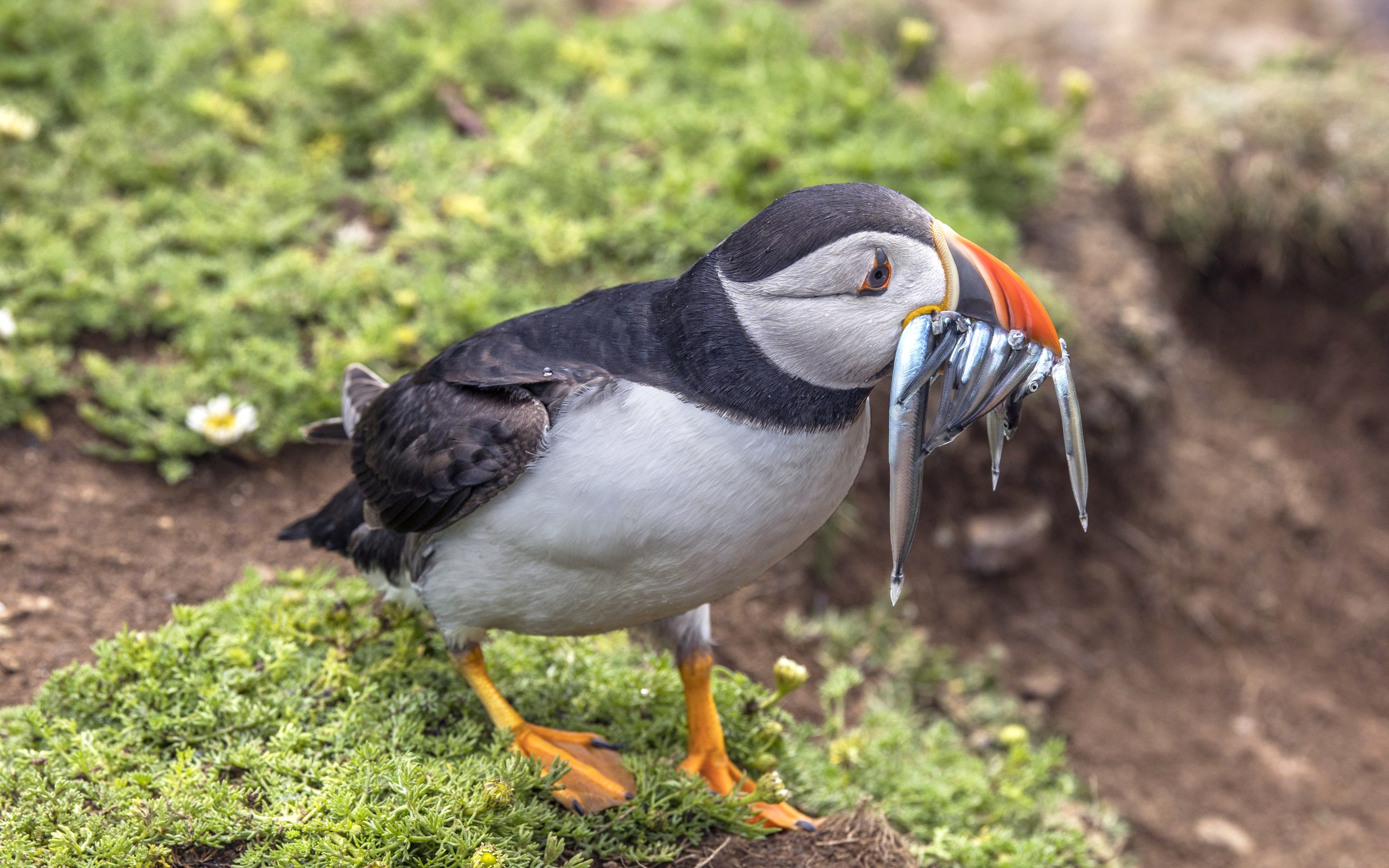
Species deep dive · atlantic puffin
Atlantic puffins spend the winter out on the open North Atlantic, far from land and mostly on their own. After the breeding season they leave their colonies and do not come ashore again until spring, sometimes going up to eight months without touching land (BirdLife International 2026). Tracking shows that "out at sea" means very different places for different colonies, from a few hundred kilometres offshore to the middle of the ocean (Fayet et al. 2017).
In summer the Atlantic Puffin, Fratercula arctica, is one of the easiest seabirds in the world to watch: it stands outside its burrow on a grassy cliff top with a beak full of fish. Then, from August, it simply vanishes. BirdLife International describes puffins wintering from August to early spring on the open ocean far from land (BirdLife International 2022). For most of the history of puffin research, nobody knew where they went.
How scientists found out
The answer came from geolocators, tiny loggers on a puffin's leg that record light levels. Day length and the timing of midday give a rough position for every day of the year. In 2007, researchers fitted 1.5 g geolocators to 50 adult puffins on the Isle of May in Scotland, the largest puffin colony in the North Sea, and got usable data back from 13 of them (Centre for Ecology & Hydrology via ScienceDaily).
Ringing recoveries had suggested that puffins from Britain's east coast stayed inside the North Sea all winter. The loggers showed that the north-western North Sea was indeed their most-used area, but more than three-quarters of the birds also made excursions of one to four months into the Atlantic before coming back (Harris et al. 2010). The researchers called that finding "entirely unexpected" and linked it to worsening conditions in the North Sea and a jump in winter deaths of adults.
Where puffins go: a map of the whole ocean
Later, a team led by Annette Fayet at the University of Oxford tracked 270 puffins from 13 colonies across the species' range, caught between 2007 and 2015. Wintering hotspots turned up around and south of Ireland, south-west of Iceland, at the entrance of the Labrador Sea and near the Charlie-Gibbs Fracture Zone in the middle of the North Atlantic (Fayet et al. 2017).
How far a puffin goes depends a lot on where it breeds. The birds' average distance from their colony ranged from under 250 km for some colonies to more than 1,700 km for others. Puffins from bigger colonies, and from places with poorer local winter conditions, migrated further, which points to competition for food as one reason to travel (Fayet et al. 2017). Some birds from the Celtic Sea go as far as the Mediterranean, and in North American waters puffins winter far offshore from the edge of the pack ice south to about Maryland (BirdLife International 2022; Audubon).
Each puffin also seems to have its own route. Tracking of birds from Skomer in Wales showed that each individual followed a different route from the others, travelled alone, and repeated its own pattern winter after winter (BirdLife International 2022). Young puffins start that habit early: a chick usually leaves its burrow at night, 38 to 44 days after hatching, and flies straight out to sea (Audubon).
What a puffin does all winter
Mostly, it floats. The same loggers also record when they are wet, which lets researchers estimate how a puffin spends its day. In Fayet's study, sustained flight took up only 0.6% to 4.9% of daylight hours, or about 5 to 29 minutes a day, and foraging dives took 15% to 35% of daylight. Puffins do not dive at night, so all birds spent most of the day sitting on the water (Fayet et al. 2017).
Winter choices carry over into summer. Birds that wintered further north worked harder and burned more energy in the colder water, and colonies whose puffins wintered further north, travelled further or came from bigger colonies raised fewer chicks the next season (Fayet et al. 2017).
The flightless weeks
Puffins also moult in winter, and they do it the hard way. Like many auks, they shed all their main flight feathers at almost the same time, which leaves them unable to fly until the new ones grow. A 2022 study that combined light and saltwater loggers found flightless periods of one to two months a year. Two birds that made long migrations of more than 2,000 km appeared to moult twice in one winter and were flightless for up to 77 days in total (Darby et al. 2022; University College Cork via Phys.org). The bright outer plates of the bill are shed after breeding too, so a winter puffin at sea looks plainer than the summer bird (Audubon).
Why winter storms matter so much
A puffin that cannot fly, in rough seas where it cannot see its prey, is in real danger. Seabird ecologists in the Channel Islands explained that puffins hunt by sight and need clear water, so long spells of storms leave them starving and exhausted (BBC News). In the winter of 2025–26, more than 38,000 seabirds were found stranded on the Atlantic coasts of Spain, Portugal and France, the largest seabird "wreck" in Europe in a decade. In the last comparable wreck, in 2013–14, more than 54,000 seabirds were reported dead and puffins were the worst-hit species (BirdLife International 2026).
The effects show up in the colonies. On the Isle of May, the 2026 count found an estimated 36,500 occupied burrows, down from 52,000 in 2024, and the researchers blamed a run of marine heatwaves and storms that hit survival in three of the last five winters (UK Centre for Ecology & Hydrology). Across the UK, the RSPB says about one in four puffins has been lost since 2000 (BBC News). It is not the same story everywhere: Skomer counted 52,019 puffins in 2026, about 8,000 more than in 2025 (BBC News).
On the Wilder card
In Wilder the Atlantic Puffin is a Common Aves card in the Water element: Cost 2, Attack 2, Health 2, with Flock and Feast (Feast bonus +1 Attack / +1 Health). Flock suits a bird that packs its summer cliffs by the thousand, and Feast is a nod to a hunter that comes home with a beak full of sandeels. Its flavour text reads: "Ten fish crosswise in one bill is a normal trip. The British record is 62." Puffins are not penguins, and they fly; for a bird that really cannot, and that breeds in the depth of the Antarctic winter, read about the Emperor Penguin.
Wilder is a free browser collectible card game about real animals, and you can play it free in your browser with no signup.
Photo credit
Hero photograph: Charles J. Sharp, "Puffin (Fratercula arctica) with lesser sand eels (Ammodytes tobianus)", Skomer Island, Wales (20 June 2021), via Wikimedia Commons, licensed CC BY-SA 4.0. Cropped for the Field Journal hero.

Questions people ask
When do puffins come back to land?
In spring. Puffins return to northern European coasts to breed from about April to August (BirdLife International), and World Puffin Day on 14 April marks their return to cliffs such as Bempton in England (BBC News). They usually breed at the colony where they hatched (BirdLife International).
Do puffins mate for life?
Mostly. Atlantic puffins are mainly monogamous, and both parents care for their single chick (BirdLife International). Pairs often keep the same mate from year to year, and in courtship the two swing their bills sideways and clash them together (Audubon).
How deep can an Atlantic puffin dive?
Most feeding happens within about 15 m (50 ft) of the surface, but a puffin can dive to about 60 m (200 ft) (Audubon). BirdLife gives dives of up to 40 m lasting up to a minute, with the wings used for 'flying' underwater and the feet as a rudder (BirdLife International).
How do puffins sleep at sea?
On the water. Puffins rest on the sea surface, and in winter they spend most daylight hours just sitting there (Fayet et al. 2017). Tracking also revealed that a sleeping puffin often tucks its feet into its plumage, which at first fooled leg loggers into recording flight (BBC News).
Sources
- Fayet et al. (2017): Ocean-wide drivers of migration strategies and their influence on population breeding performance in a declining seabird, Current Biology 27
- Harris et al. (2010): Wintering areas of adult Atlantic puffins Fratercula arctica from a North Sea colony as revealed by geolocation technology, Marine Biology 157
- Centre for Ecology & Hydrology via ScienceDaily (2010): Where do puffins go in the winter?
- Darby et al. (2022): A new biologging approach reveals unique flightless molt strategies of Atlantic puffins, Ecology and Evolution 12
- University College Cork via Phys.org (2022): Study finds flightless puffins vulnerable to winter storms for two months a year
- BirdLife International (2022): Seabird of the month: Atlantic Puffin
- BirdLife International (2026): Puffins' cliffs might turn quieter this year
- UK Centre for Ecology & Hydrology (2026): Climate change hits puffin numbers on the Isle of May
- BBC News (2026): Critical time for puffin survival after Storm Goretti
- BBC News (2026): UK puffin population down 25% since 2000
- Audubon Field Guide: Atlantic Puffin
- BBC News (2010): Puffins' winter odyssey revealed