How Big Is the Japanese Giant Salamander? Nearly the World's Largest
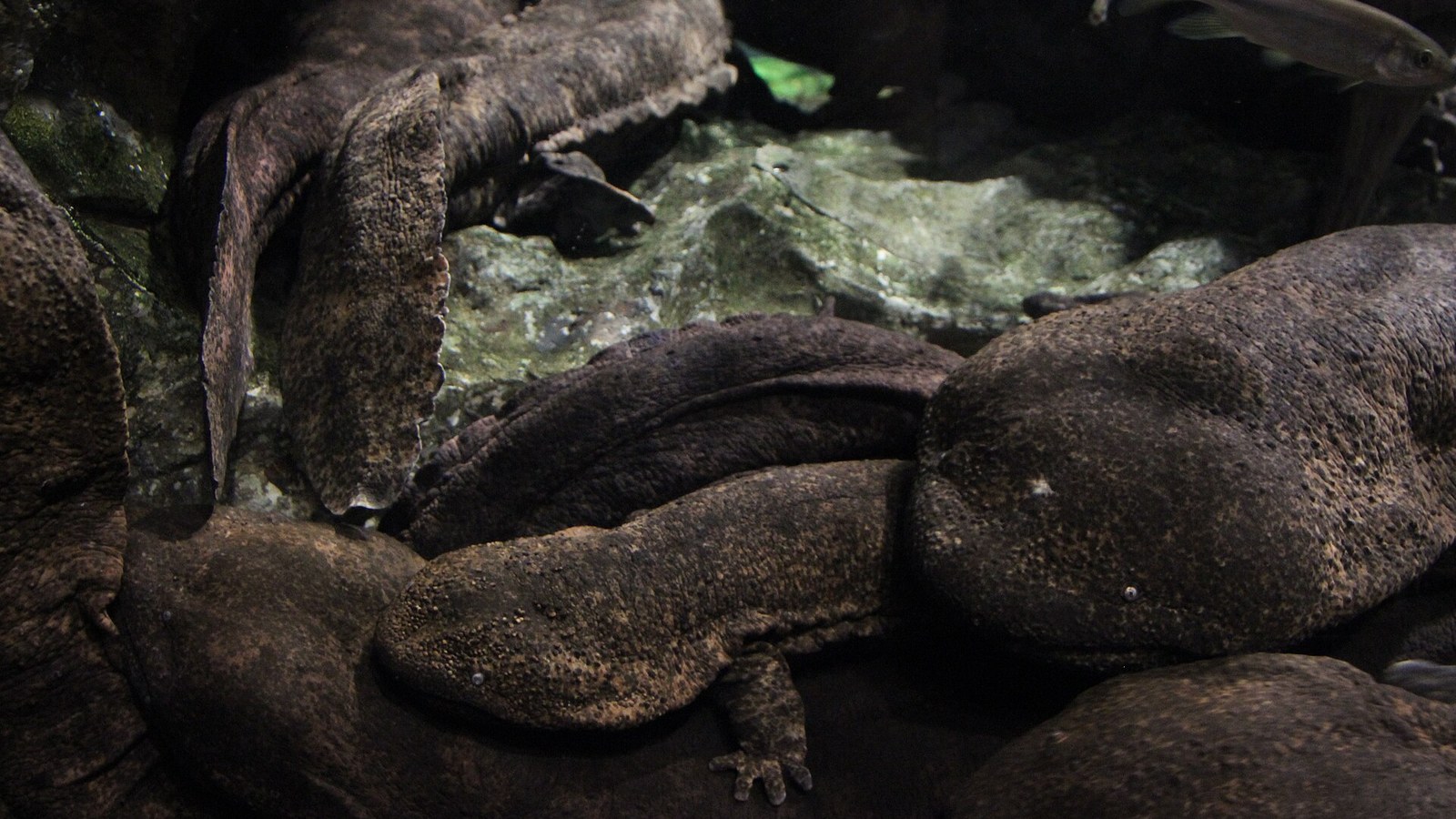
Species deep dive · japanese giant salamander
How big is the Japanese giant salamander? Up to about 1.5 metres long and about 25 kg, according to Animal Diversity Web — roughly the length of a grown person lying down. That makes Andrias japonicus one of the largest living amphibians. It is not quite the absolute record holder. The biggest salamander ever reported measured about 1.8 m (five feet nine inches) and was caught near Guiyang, China, in the early 1920s. Genetic work now ties that giant more closely to the South China giant salamander (Andrias sligoi) than to Japan's endemic species.
So if someone tells you the Japanese giant salamander is "the world's largest amphibian," the honest answer is: almost — it shares the podium with its Chinese cousins.
Japan’s river giant
The Japanese Giant Salamander (Andrias japonicus) is fully aquatic. It lives in cold, fast, rocky mountain streams of western Honshu, with smaller populations on Shikoku and northern Kyushu, at elevations of roughly 180 to 1,350 m. Adults spend the day under rocks or in bank burrows and hunt at night. Their skin is wrinkled and mottled brown-grey-green for camouflage. Small, lidless eyes see poorly; lateral-line-like sense organs pick up water movement instead. Oxygen moves through the skin, so the loose folds along the sides matter. Metabolism is slow enough that they can go weeks without eating.
They are sit-and-wait suction feeders. When prey comes close — freshwater crabs, fish, frogs, insects, worms, even the odd small mammal — the wide mouth gapes and sucks it in.
Fathers guard the nest
Breeding starts in late summer. Large males fight over underwater dens — rocky caverns, burrows or hollows in the streambed — and may kill smaller rivals. Females lay 400 to 500 eggs in strings that look like beads. The male fertilizes them and then guards the clutch for 12 to 15 weeks until hatching, fending off fish and other males. Captive animals have lived 50+ years; one famous Siebold specimen reached at least 52.
When threatened, they release a sticky white mucus that smells like Japanese pepper — the folk name hanzaki ("torn in half") nods to their ability to regenerate limbs.
Why the Chinese cousins are bigger (sometimes)
For a century, almost every Chinese giant salamander was treated as one species, Andrias davidianus. Museum DNA and field genetics have since split them. A 2019 Ecology and Evolution study (Turvey and colleagues) recognized at least three Chinese lineages, including A. davidianus and A. sligoi, and argued that A. sligoi is possibly the world's largest amphibian. More named species have followed since. The ~1.8 m Guiyang animal sits in that Chinese complex, not in Japan.
Wilder already covered that split in Chinese Giant Salamander: How Big It Gets and Why It's Now Several Species. This piece is the Japanese counterpart: same family Cryptobranchidae, same "living fossil" look, different country and a slightly smaller size ceiling.
Status in Japan
Japan has protected the species as a Special Natural Monument since 1952. The Wilder field guide lists it as Vulnerable on the IUCN Red List (2022 assessment) and on CITES Appendix I. The main threats are concrete riverbanks, dams and other works that wipe out nesting dens, plus past hunting for food and medicine. Hybrids with introduced Chinese giant salamanders are a growing worry in some rivers.
How it plays in Wilder
In Wilder TCG the Japanese Giant Salamander is a Cost 4 Amphibia Water Rare (ATK 3 / HP 6) with Guardian and Cold-Blooded. Guardian fits a den-master father that holds the nest for months. Cold-Blooded makes it cheaper in Summer and pricier in Winter. Flavor text: "Den-master fathers fan eggs with their tails and snack on the moldy ones." Pair it with the larger Chinese Giant Salamander (Journal) or the cave-dwelling Olm (Journal).
Play Wilder free in your browser. No signup needed.
Photo credit
Hero photograph: Makarok, "Andrias japonicus 2", Japanese giant salamanders at the Kyoto Aquarium (Wikimedia Commons), CC BY-SA 4.0. Cropped for the Field Journal hero.

Questions people ask
Is the Japanese giant salamander the world's largest amphibian?
It is one of the largest, but not the absolute record. Andrias japonicus reaches about 1.5 m and ~25 kg (Animal Diversity Web). The ~1.8 m animal reported from Guiyang, China, in the 1920s likely belongs to the Chinese Andrias complex, possibly A. sligoi (Turvey et al. 2019).
How does it compare to the Chinese giant salamander?
Japan's species is endemic and a bit smaller on average. China's former "one species" is now several lineages; some individuals exceed Japanese maxima. See our Chinese giant salamander Journal piece and the Japanese and Chinese cards.
Where does the Japanese giant salamander live?
Cold mountain streams in western Japan — mainly western Honshu, plus parts of Shikoku and northern Kyushu — at about 180–1,350 m elevation. It almost never leaves the water (Animal Diversity Web).
Do the fathers care for the eggs?
Yes. Males fight for nesting dens, then guard 400–500 eggs for 12–15 weeks until hatching, keeping out fish and rival males (Animal Diversity Web). That is why the Wilder card has Guardian.
Is the Japanese giant salamander protected?
Yes. It has been a Japanese Special Natural Monument since 1952, is listed as Vulnerable (IUCN 2022) on the Wilder field guide, and is on CITES Appendix I (Wilder card).
Sources
- Animal Diversity Web — Andrias japonicus (Laura Winkler)
- Turvey et al. (2019) Historical museum collections clarify the evolutionary history of cryptic species radiation in the world's largest amphibians. Ecology and Evolution 9:10070–10084
- Wilder TCG — Japanese Giant Salamander field guide
- Wilder Field Journal — Chinese Giant Salamander: How Big It Gets and Why It's Now Several Species
- Japanese Ministry of Land, Infrastructure, Transport and Tourism (multilingual) — Encounter a Rare Species: The Japanese Giant Salamander