Ocelot: How Many Are Left in Texas, and Can a Breeding Center Save Them?
Species deep dive · tilcayo tiger cat
Somewhere between 80 and 120. Ocelots are the last wild cats of their kind in the United States, and all of them live in deep South Texas. The Caesar Kleberg Wildlife Research Institute says fewer than 100 are known in the wild there (CKWRI), the Association of Zoos and Aquariums puts Texas ocelots at 80 to 120 animals (AZA), and the East Foundation wrote in summer 2026 that potentially fewer than 120 remain (CKWRI and East Foundation). They are split into just two small populations, and 2026 is the year a purpose-built breeding center is meant to start raising kittens to give them a third.
Here's why a cat most people picture in a rainforest ended up clinging on in Texas brush, what keeps killing it, and how the new plan is supposed to work.
America's most endangered wild cat
The ocelot (Leopardus pardalis) lives from northern Argentina to the southern tip of the United States. Its U.S. range is believed to have once reached across Arizona, Texas, Arkansas and Louisiana. Unregulated hunting, trapping and poisoning, plus the loss of its brushy habitat, shrank that to two pockets near the Gulf of Mexico, and the ocelot has been listed as endangered under the Endangered Species Act since 1982 (Recover Texas Ocelots).
One Texas population lives in and around Laguna Atascosa National Wildlife Refuge in Cameron County. The other lives on private ranches in Willacy, Kenedy and Kleberg counties (Recover Texas Ocelots). How small can that get? In 2014, after two males died, the known ocelot population on the refuge had dropped to 11. A trail-camera photo of a mother with a young ocelot brought it back to 12, and the U.S. Fish and Wildlife Service treated a single kitten as significant news (USFWS).
In Texas, ocelots live in dense Tamaulipan thornscrub and eat mostly mice, gophers, rats, rabbits and small songbirds (Recover Texas Ocelots). They need thick cover to hunt and hide, and less than 5% of the ocelot's natural habitat in Texas is left (Recover Texas Ocelots).
Roads, storms and inbreeding
Habitat loss is the main reason ocelots became endangered in Texas, but cars are what kill them now. The Fish and Wildlife Service calls vehicle strikes the main cause of ocelot deaths in recent years (USFWS). Over the last 20 years, nearly half of all recorded ocelot deaths in Texas were caused by vehicle collisions. The Texas Department of Transportation has built 15 wildlife underpasses near Laguna Atascosa to help them cross (Recover Texas Ocelots).
The other two problems come from being so few and so close together. Small, isolated populations inbreed, which can lower fertility and make disease worse. And because both groups sit on the low coast, one hurricane, wildfire or disease outbreak could wipe out a large part of them. "All of our eggs are basically in one basket," says David Hewitt of the Caesar Kleberg Wildlife Research Institute. A wildfire came dangerously close a couple of years ago and only stopped because the wind shifted (Recover Texas Ocelots).
The plan: breed them, teach them, release them inland
The answer partners settled on is a brand-new population, started from scratch, away from the coast.
- The breeding center. Texas A&M University–Kingsville's Caesar Kleberg Wildlife Research Institute broke ground on a $20 million Ocelot Conservation Facility on 9 October 2024. It has 16 ocelot enclosures and four quarter-acre "rewilding" pens, and it's the first facility in the U.S. dedicated to breeding ocelots for release (Texas A&M University–Kingsville). Construction began in early 2025, and the facility is due to be completed in 2026 (CKWRI and East Foundation).
- The parents. Zoo ocelots come in through the AZA's SAFE Ocelot program. Four female zoo ocelots have already been picked for transfer, based on pedigree, genetics and breeding history (AZA). The team also plans to use semen collected from wild Texas ocelots, so the kittens carry local genes (Texas A&M University–Kingsville).
- Wild school. Mothers raise their kittens in large, semi-natural enclosures where they explore thick brush and hunt live prey, with as little human contact as possible. At about one year old, kittens that behave like wild cats will be released (CKWRI and East Foundation).
- The new home. Releases go to the East Foundation's San Antonio Viejo Ranch and nearby private land in Jim Hogg and Starr counties, an area of about 470 km² of potential habitat with no ocelots today and no high-traffic highways (Recover Texas Ocelots).
Most of that land is private, so landowners needed a guarantee that wandering ocelots wouldn't bring new restrictions. On 19 March 2024, the Fish and Wildlife Service and the East Foundation approved a Programmatic Safe Harbor Agreement that does exactly that, valid for 30 years (Texas Parks and Wildlife Department).
Nobody expects this to be quick. A population model built for the project found that starting a new population will likely take at least 10 years of annual releases (Recover Texas Ocelots). To take ocelots off the endangered list, one criterion is at least 200 ocelots living wild in Texas for at least 10 years (Recover Texas Ocelots). For another species brought back by breeding and careful releases, read how black-footed ferrets came back from 18 animals.
The biggest of the small spotted cats
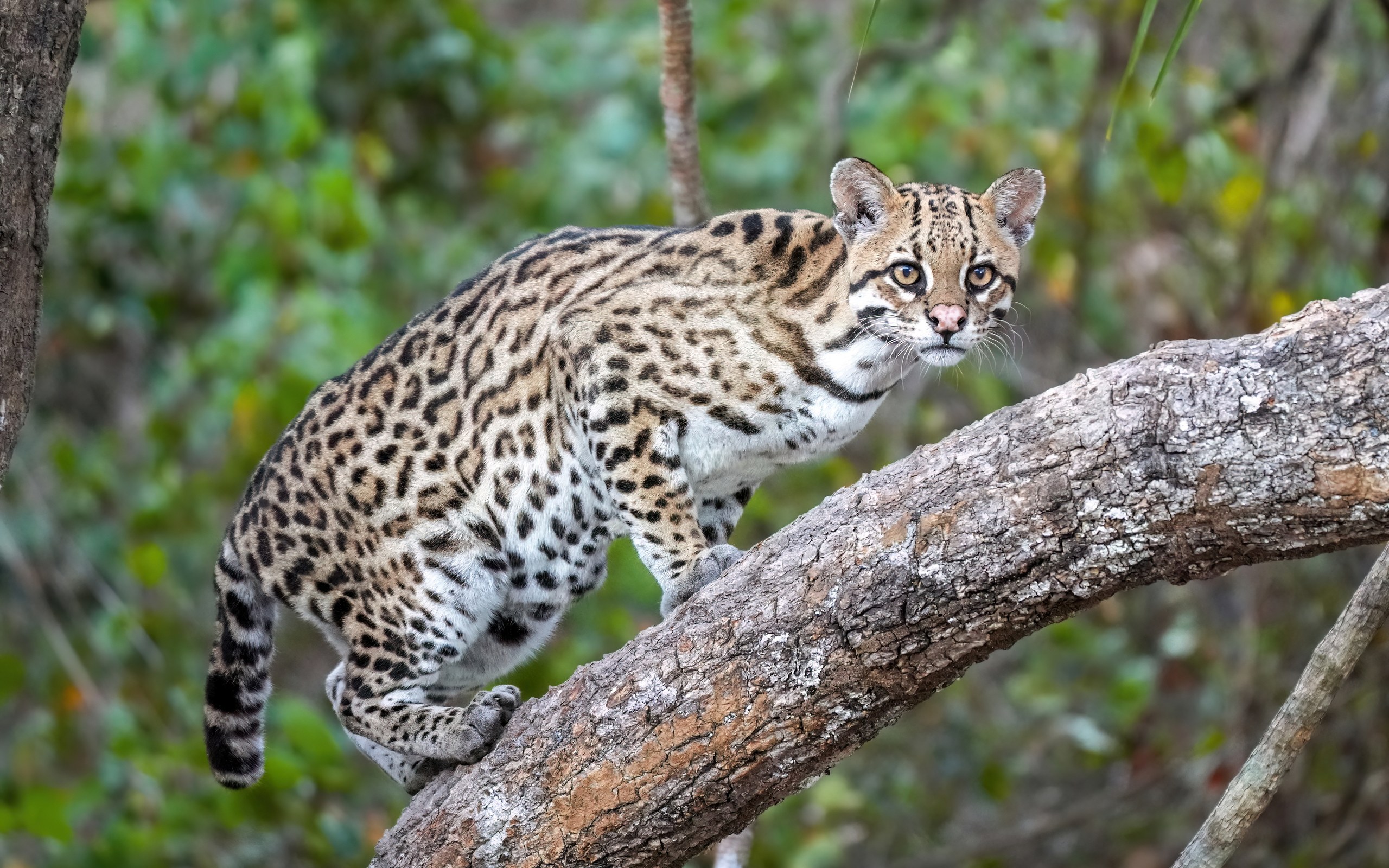
The ocelot is the largest member of Leopardus, the genus of small American spotted cats (Animal Diversity Web). Its relatives include the margay and the tiger cats, among them the Tilcayo tiger cat of Bolivia's cloud forests, named as a new species in 2026. Each ocelot's facial markings are distinct enough to tell individuals apart, and its large paws give it the Spanish name manigordo, meaning "big feet" (Animal Diversity Web).
Ocelots were nearly wiped out once before, by fashion. From the early 1960s to the mid-1980s spotted furs were in high demand, and an ocelot fur coat could sell for $40,000 in West Germany. International trade became illegal in most countries after CITES took effect in 1975 (Animal Diversity Web). Further south the species recovered, which is why Texas matters so much: it's the edge of the range, and the only place the United States still has them.
How the ocelot's cousin plays in Wilder
The ocelot doesn't have a Wilder card yet, and we've added it to our card requests. Its closest relative in the game is the Tilcayo Tiger Cat (Leopardus tilcayo), a Mythic Mammalia card in the Forest element. It costs 2 Energy, with Attack 2 and Health 3, and its ability is Pounce: for 1 Energy, deal 1 damage to an enemy creature. When it dies, it shuffles three Tilcayo Kittens (0-cost 1/1s that draw a card) into your deck, a small cat that keeps coming back. Other American cats you can play include the Jaguar and the Mountain Lion.
Wilder is a free browser collectible card game about real animals, and you can play it free in your browser with no signup.
Photo credit
Hero photograph: Giles Laurent, "Ocelot in Encontro das Águas State Park" (a wild ocelot in Parque Estadual Encontro das Águas, Mato Grosso, Brazil), Wikimedia Commons, CC BY-SA 4.0. Cropped for the Field Journal hero.

Questions people ask
Are ocelots dangerous to people or livestock?
No. Recover Texas Ocelots says these small, elusive cats have no impact on human safety and don't prey on cattle or other livestock. White-tailed deer have turned up in Texas ocelots' diet, but that is most likely scavenging of young dead deer rather than hunting (Recover Texas Ocelots).
How big is an ocelot compared with a house cat?
Much bigger. Ocelots weigh 8.5–16 kg and are 65–97 cm long, and males are considerably larger than females (Animal Diversity Web). Texas ocelots typically weigh about 7–16 kg (15–35 lb) (Recover Texas Ocelots).
How long do ocelots live?
About 7 to 10 years in the wild. In human care they can live much longer: the oldest known captive ocelot reached 21.5 years at the Phoenix Zoo (Animal Diversity Web).
Are ocelots endangered everywhere, or just in the US?
Just in parts of their range. The IUCN lists the ocelot as Least Concern across its whole range, from Texas to northern Argentina, but its overall population is decreasing and it is considered endangered in some countries, including the United States (Recover Texas Ocelots).
Where can you see an ocelot in Texas?
Most easily at a zoo. Seeing a wild one is a once-in-a-lifetime event. The Gladys Porter Zoo in Brownsville keeps two resident ocelots and hosts an annual Ocelot Conservation Festival (Recover Texas Ocelots). The new Kingsville breeding facility won't be open to visitors, but it plans to share camera footage (CKWRI).
Sources
- Caesar Kleberg Wildlife Research Institute: CKWRI Ocelot Conservation Facility
- Caesar Kleberg Wildlife Research Institute / East Foundation: Ocelot Conservation Facility Update (29 July 2026)
- Association of Zoos and Aquariums: Conserving America's Most Endangered Wild Cat (Bill Swanson, 7 March 2026)
- Texas A&M University-Kingsville: CKWRI breaks ground on Ocelot Conservation Facility (9 October 2024)
- Texas Parks and Wildlife Department: USFWS, East Foundation Sign Safe Harbor Agreement to Aid Ocelot Recovery in Texas (5 April 2024)
- U.S. Fish and Wildlife Service: Refuge Trail Camera Reveals Significant Discovery! (4 December 2014)
- Recover Texas Ocelots: About the Texas Ocelot
- Recover Texas Ocelots: Some questions and answers
- Recover Texas Ocelots: The reintroduction process
- Recover Texas Ocelots: Kingsville Facility Gives Ocelots Second Chance (Tenley Jackson)
- Animal Diversity Web (University of Michigan Museum of Zoology): Leopardus pardalis