Ostrich: Do Ostriches Really Bury Their Heads in the Sand?
Species deep dive · ostrich
No. Ostriches don't bury their heads in the sand. When an ostrich senses danger and can't run away, it flops to the ground and lies still with its head and neck stretched flat along the soil. Its head and neck are pale and blend in with the ground, so from a distance only the body shows and the bird looks headless (San Diego Zoo Wildlife Alliance; National Geographic). Ostriches also spend a lot of time with their heads down at their nests and while feeding, which adds to the illusion (Live Science).
Here's where the myth came from, what the world's largest bird actually does when it's in trouble, and why red-necked ostriches are walking back into parts of the Sahel this year.
Blame a Roman encyclopedia
The idea is usually traced back about 2,000 years. In Book 10 of his Natural History, the Roman writer Pliny the Elder marvelled that the ostrich could digest anything, then called its stupidity "no less remarkable": "for although the rest of their body is so large, they imagine, when they have thrust their head and neck into a bush, that the whole of the body is concealed" (Pliny, Natural History, via Perseus). Note that Pliny wrote bush, not sand. Somewhere along the way the bush became sand, and gave us the saying "bury your head in the sand" for ignoring a problem (Live Science).
The same chapter claims ostriches fight with their hooves and pick up stones with their feet to throw at people chasing them (Pliny, Natural History, via Perseus). Ancient natural history mixed real observation with a lot of tall tales.
What an ostrich really does with its head
Three real behaviours explain the myth.
- Lying flat to hide. This is the big one. A threatened ostrich that can't escape drops to the ground and presses its long neck flat in front of it. Its plumage blends with sandy soil, and from far away the bird looks like a mound with no head (National Geographic). Animal Diversity Web says this "peculiar behavior probably gave rise to the myth" (Animal Diversity Web).
- Tending the nest. Ostriches don't build nests. They lay in a shallow scrape in the ground, and both parents turn the eggs several times a day. From a distance, a bird bent over that hole can look like it has its head in the ground (Live Science).
- Feeding. Ostriches spend much of their time with their heads close to the ground, looking for food (Live Science).
Burying its head would also be a terrible defence for a bird this big. Its usual answer to danger is to run, and if it's cornered it kicks (San Diego Zoo Wildlife Alliance).
Day shift and night shift at the nest
The hiding trick works on eggs too. Several hens lay in one communal nest, a shallow scrape dug by the male, and the dominant "main hen" puts her own eggs in the centre. The drab grey-brown main hen usually sits on the eggs during the day, and the black-and-white male takes over at night (San Diego Zoo Wildlife Alliance). So the drab hen sits in daylight and the dark male sits in the dark.
Ostrich parents also bluff. When chicks are threatened, the male may stretch out his neck with his mouth open. It isn't the start of an attack but a distraction display, meant to draw the predator's eye while the chicks scatter with the female (San Diego Zoo Wildlife Alliance).
Red-necked ostriches are coming home
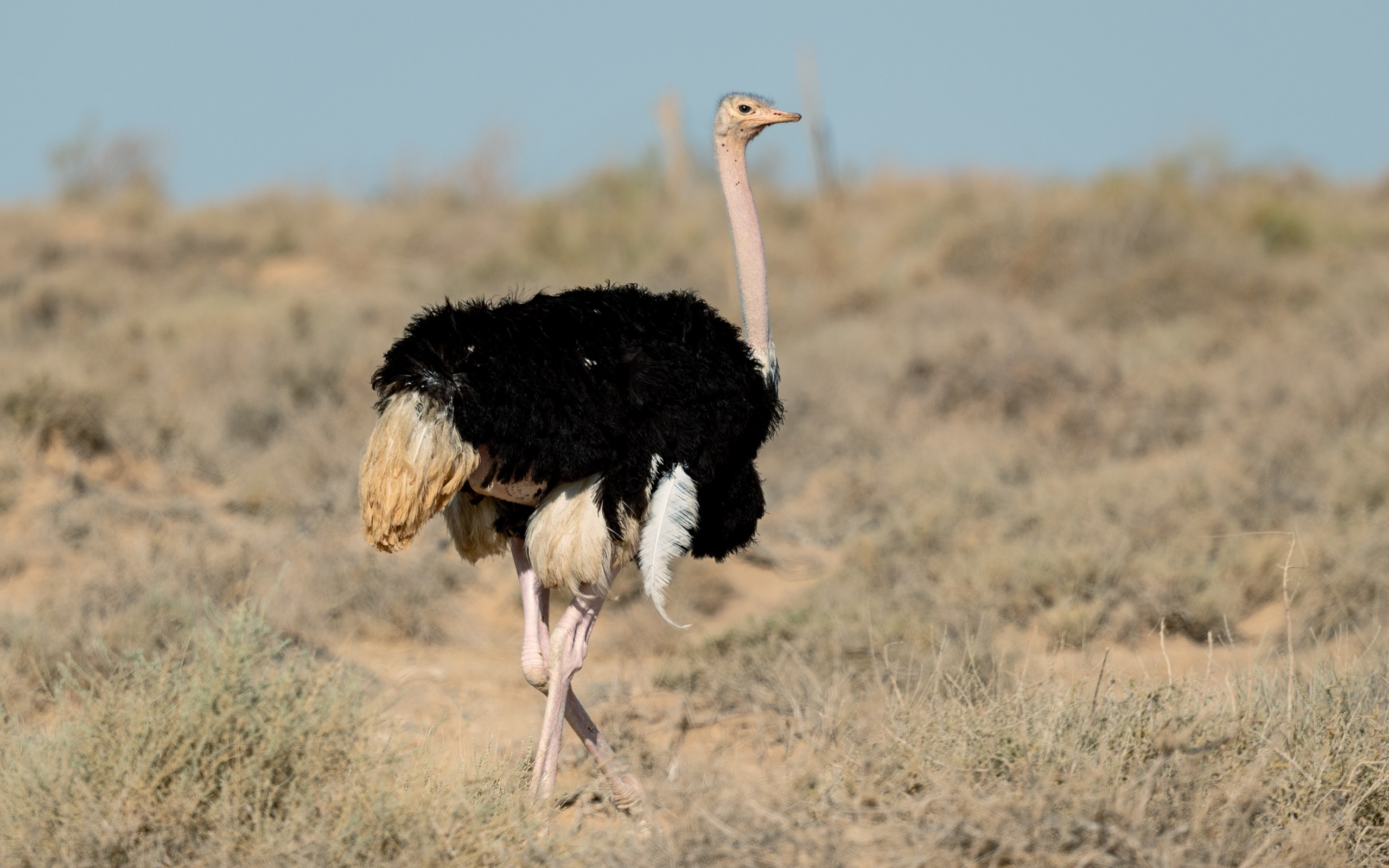
The bird in our photo is a red-necked ostrich, also called the North African ostrich (Struthio camelus camelus). It's the largest recognised ostrich subspecies, named for the pink to reddish skin on its neck and throat. It once ranged across the Sahel and Sahara from Ethiopia and Sudan to Senegal and Mauritania, but over the past century it has vanished from most of that area (African Parks). Hunting, egg collection and habitat damage drove the decline (Sahara Conservation).
Two 2026 milestones show it coming back:
- Chad. In 2020, 30 ostrich chicks from Zakouma National Park were moved to a facility in Fada, and 15 more followed in 2021. The first 11 were released in the Ennedi Natural and Cultural Reserve, where many people knew ostriches only from rock art. By June 2026, teams counted 103 red-necked ostriches there: 22 adults, 50 juveniles and 31 chicks (African Parks).
- Niger. The country's last wild ostrich disappeared in 2004. On 2 September 2026, eight North African ostriches, five females and three males, were released into the Gadabedji Biosphere Reserve. They came from a national captive-breeding program that Sahara Conservation and partners began in 2007 (Sahara Conservation; Sahara Conservation).
Ostriches overall are not rare. The IUCN lists the common ostrich as Least Concern, though its population is decreasing (National Geographic). The Sahel subspecies is the one that needed rescuing. For how ostriches compare with cassowaries, emus and penguins, see the largest birds in the world, ranked. For more animal myths, read can sharks smell blood a mile away?
How the ostrich plays in Wilder
The Ostrich (Struthio camelus) is a Rare Aves card in the Grassland element. It costs 5 Energy, with Attack 5 and Health 6, and it has Flock and Guardian: a bird that lives in groups and stands between its chicks and danger. Flavour text: "It cannot fly, but a kick from its two-toed foot can kill a lion."
Wilder is a free browser collectible card game about real animals, and you can play it free in your browser with no signup.
Photo credit
Hero photograph: Slim Alileche, "Autruche à cou rouge 1" (a male red-necked ostrich in Bouhedma National Park, Tunisia), Wikimedia Commons, CC BY-SA 4.0. Cropped for the Field Journal hero.

Questions people ask
Why do ostriches swallow sand and stones?
To grind their food. Ostriches swallow sand, pebbles and small stones, which collect in the gizzard and help break down tough plant food. Their intestines are about 14 metres (46 feet) long, which helps them absorb as many nutrients as possible (San Diego Zoo Wildlife Alliance).
How fast can an ostrich run?
Up to about 70 km/h (43 mph) in short sprints, and it can keep up a steady 50 km/h (31 mph). A single stride can be 3 to 5 metres (10 to 16 feet) long, and chicks just a month old can run at close to 56 km/h (35 mph) (San Diego Zoo Wildlife Alliance).
Can an ostrich kick kill a lion?
Yes, it can. A cornered adult ostrich attacks with a clawed foot that delivers a kick powerful enough to kill a lion (San Diego Zoo Wildlife Alliance). Each two-toed foot has a long, sharp claw, and an ostrich kick can also kill a human (National Geographic).
Do ostriches need to drink water?
Not usually. Ostriches get the water they need from the plants they eat, though they will drink if they come to a water hole (San Diego Zoo Wildlife Alliance). They can go without water for long periods, yet they also like to bathe when they get the chance (Animal Diversity Web).
How big is an ostrich egg?
About 15 cm long, 13 cm across and 1.5 kg (3 lb). It's the largest egg of any living bird, yet small next to the adult that lays it (San Diego Zoo Wildlife Alliance). One ostrich egg weighs about as much as two dozen chicken eggs (National Geographic).
Sources
- San Diego Zoo Wildlife Alliance: Ostrich (Struthio camelus)
- National Geographic: Ostrich facts
- Live Science: Do ostriches really bury their heads in the sand? (Elise Poore, 10 November 2024)
- Pliny the Elder, The Natural History, Book 10, Chapter 1: The Ostrich (Bostock and Riley translation, Perseus Digital Library, Tufts University)
- Animal Diversity Web (University of Michigan Museum of Zoology): Struthio camelus
- African Parks: The return of the red-necked ostrich to Ennedi (13 October 2026)
- Sahara Conservation: North African ostrich reintroduced into its natural habitat in Niger (8 September 2026)
- Sahara Conservation: North African ostrich recovery