Tilcayo Tiger Cat: Can You Buy One as a Pet?
Species deep dive · tilcayo tiger cat
No. You can't legally buy a Tilcayo tiger cat, at any price. Leopardus tilcayo is a wild cat from the cloud forests of Bolivia's Yungas, and it was only named as a species in 2026. There is no captive-bred population and no breeder. Bolivia has banned capturing and keeping wild animals since 1990, and tiger cats have been on CITES Appendix I, the strictest level of international trade protection, since the same year (DS 22641, FAOLEX; CITES CoP7). Any "Tilcayo kitten for sale" listing is either a scam or wildlife trafficking.
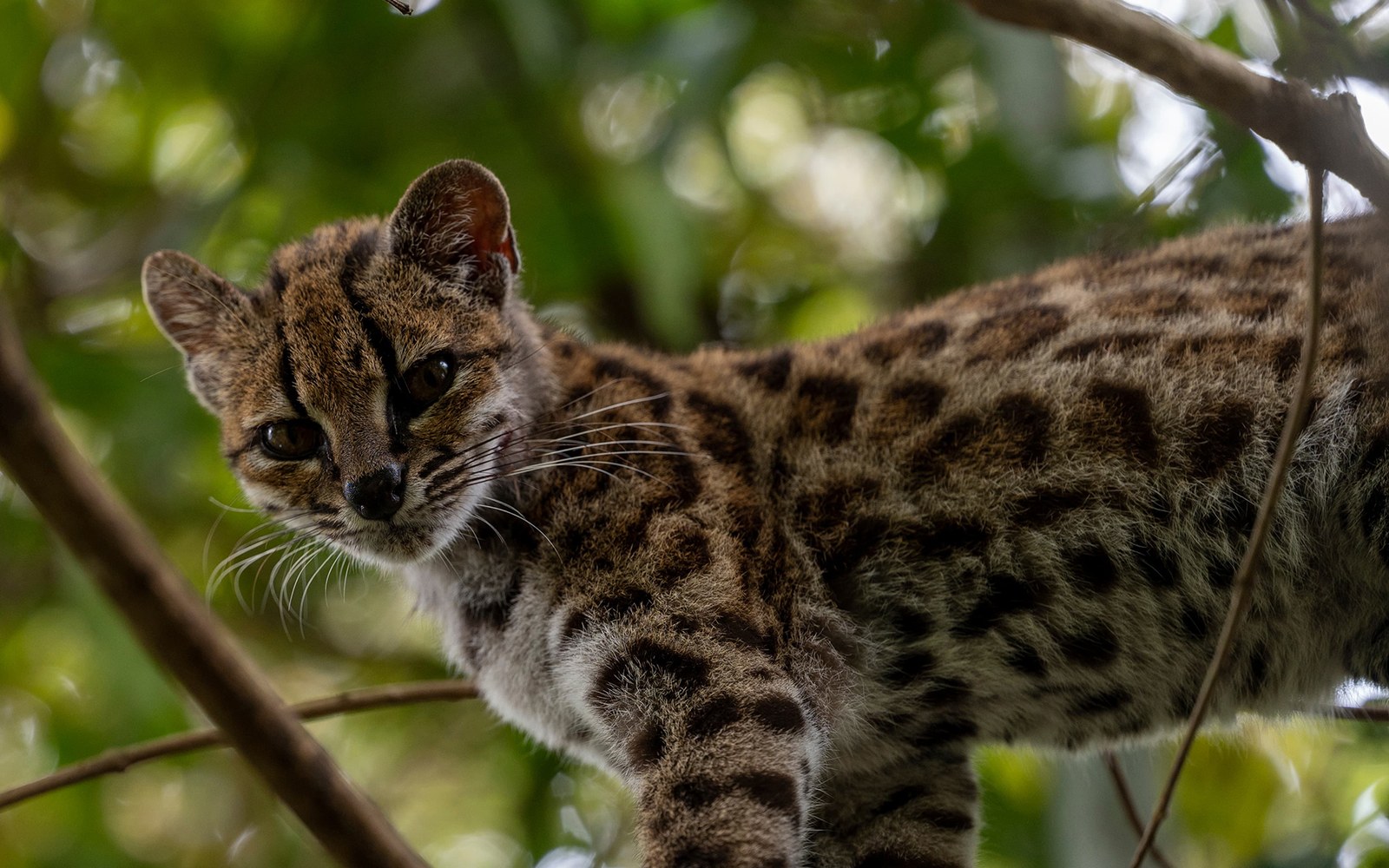
The searches are easy to understand. Photos of the tilcayo show a cat about the size of a small house cat, with big eyes, short round ears and a coat of dark rosettes. But everything that makes it look cuddly in a photo comes with a wild animal attached.
There are no tilcayos to sell
Science knows very few individual tilcayos. The species description in Current Biology rests on genomes from across South America's tiger cats. Of live animals, the researchers examined just two, plus a handful of camera-trap records from the wild (Current Biology01110-3); Reuters). That doesn't mean only two exist. It means nobody has counted them yet, and the IUCN hasn't assessed the species on its own.
No published source describes a zoo or breeder holding tilcayos for breeding, so a tilcayo offered for sale would have to come from the wild. That is exactly the trade the law is written to stop. For more on how the species was discovered, read our Tilcayo tiger cat deep dive.
What the law says
In Bolivia, Supreme Decree 22641 of 8 November 1990 declared an indefinite general ban (veda general indefinida) on harassing, capturing, collecting and keeping wild animals. The only exception is non-commercial scientific work (FAOLEX). Taking a tilcayo kitten out of the forest is illegal in the only country where the species is known to live.
Internationally, the tilcayo was counted as part of the tiger cat, Leopardus (then Felis) tigrinus, until 2026. CITES moved tiger cats to Appendix I at its 1989 meeting in Lausanne, with effect from 18 January 1990. Appendix I bans commercial international trade (CITES). The listing had a reason. The proposal reported that around 50,000 tiger cat skins a year were traded in the early 1980s (CITES CoP7 Prop. 22).
The cat that was mistaken for a pet
The tilcayo's own story shows how this goes wrong. The species' holotype, the individual that now defines Leopardus tilcayo, is a male named Tigrino. National Geographic reports that a man found him as a kitten on a road near a forest and kept him for about a year, believing he was some kind of domestic breed. In 2017 Tigrino went to the Senda Verde wildlife sanctuary in Bolivia's Yungas, where he still lives. In 2026 he was about ten years old, roughly 18 inches long and about 3 pounds (National Geographic).
Tigrino was lucky. He ended up with people who knew what he was, and his DNA helped prove he belonged to a new species. But a cat that spent its first year in a house can't simply be put back into the cloud forest. That's why sanctuaries like Senda Verde end up caring for animals for the rest of their lives.
Small wild cats are already trafficked as pets
The pet trade for small spotted cats isn't hypothetical. A 2026 study in Biological Conservation analysed wildlife-crime records from Colombia between 2015 and 2021. It found 643 enforcement events involving 708 wild felids, and about 80% of the animals were alive. Ocelots made up 56.7% of the cats and oncillas, close relatives of the tilcayo, 12.6%. In 60.1% of cases, people handed over cats they had been keeping (Muñoz Cassolis et al. 2026). Mongabay's report on the study describes more than 700 small wildcats seized or surrendered, most of them alive and kept as pets (Mongabay).
A newly famous species, a cute face and a restricted range is the kind of mix that traffickers look for. Every search for "tilcayo price" is a small sign of demand. The best thing a fan can do is not create more.
What to do instead
- Don't buy, and report it. If you see a tilcayo, oncilla or tiger cat for sale, treat it as a red flag and report it to the platform and your national wildlife authority.
- Support the animals that are already rescued. Senda Verde cares for Tigrino and around 1,200 other rescued animals. You can donate to Senda Verde or follow their updates.
- Meet one legally, on a card. If you want a tilcayo in your collection, there's a free one in Wilder.
How the Tilcayo Tiger Cat plays in Wilder
In Wilder, the Tilcayo Tiger Cat is a Mythic Mammalia card in the Forest element. It costs 2 Energy, with Attack 2 and Health 3. Its ability is Pounce: for 1 Energy it deals 1 damage to an enemy creature, like a small cat that stalks and strikes from cover. When it dies, it shuffles 3 Tilcayo Kittens into your deck, each a 0-cost 1/1 that draws a card. Its flavour text: "Hidden in the Bolivian cloud forest for a century. Named at last in 2026." The only tilcayo kittens you should ever collect are those ones.
Wilder is a free browser collectible card game, and you can play it free in your browser with no signup.
Photo credit
Hero photograph: Tigrino, the Leopardus tilcayo holotype, at Senda Verde Wildlife Sanctuary. Photo: La Senda Verde, used with permission. Cropped to fit the Field Journal hero.
Questions people ask
Is it legal to own a tiger cat in the United States?
Not as an ordinary pet purchase. The US lists the tiger cat, Leopardus tigrinus, the species the tilcayo was counted under until 2026, as Endangered under the Endangered Species Act, since 28 March 1972 (US Fish and Wildlife Service). The Act bans importing endangered species and selling them across state lines or abroad without a federal permit (16 U.S.C. 1538). State and local exotic-pet laws can add further limits.
Can you buy a tiger cat or oncilla in Europe?
Generally no. The EU has listed Leopardus tigrinus in Annex A of its wildlife trade rules since 1 June 1997 (I-CITES). Article 8 of Regulation 338/97 bans buying, selling, offering for sale and other commercial use of Annex A animals. A national authority can only grant a case-by-case exemption certificate, for example for legally captive-bred animals or research (EUR-Lex).
Is a Bengal cat related to the Tilcayo tiger cat?
Not closely. The Bengal is a domestic breed that comes from crosses between domestic cats and the Asian leopard cat, Prionailurus bengalensis. Jean Mill began the crosses in 1963, and The International Cat Association accepted the breed in 1986 (TICA). The tilcayo is a wild South American Leopardus cat (Current Biology01110-3)). Spotted fur is the only thing the two have in common.
Where can you see a real Tilcayo tiger cat?
At Senda Verde Wildlife Sanctuary in Bolivia's Yungas, home of Tigrino, the male whose DNA defines the species. He has lived there since 2017 (National Geographic). Wild tilcayos are small, elusive and probably mostly nocturnal, so even researchers mostly know them from camera traps (Reuters).
Sources
- Lescroart, Nogales-Ascarrunz et al. 2026, phylogenomics of tiger cats and description of Leopardus tilcayo (Current Biology)
- Meet the first new cat species discovered in 100 years (National Geographic, 2026)
- New cat species identified in Bolivia, first in over a century (Reuters, 17 Sept 2026)
- Decreto Supremo 22641, veda general indefinida (Bolivia, 8 Nov 1990, via FAOLEX)
- Amendments to Appendices I and II, CoP7 (CITES, Lausanne 1989)
- CoP7 Proposal 22: transfer of Felis tigrina to Appendix I (CITES, 1989)
- Leopardus tigrinus taxon record (I-CITES, French Ministry of Ecology)
- Council Regulation (EC) No 338/97, Article 8 (EUR-Lex)
- Tiger cat, Leopardus (=Felis) tigrinus (US Fish and Wildlife Service, ECOS)
- 16 U.S. Code 1538, prohibited acts (Endangered Species Act section 9, Cornell LII)
- Big cats get the press, but small wildcats are being poached and trafficked in silence (Mongabay, Feb 2026)
- Munoz Cassolis et al. 2026, illegal trade in wild felids in Colombia (Biological Conservation 314: 111639)
- Bengal breed history (The International Cat Association)
- Donate (Senda Verde Wildlife Sanctuary)