Mauritius Kestrel: Saved From Four Birds, Now Declining Again
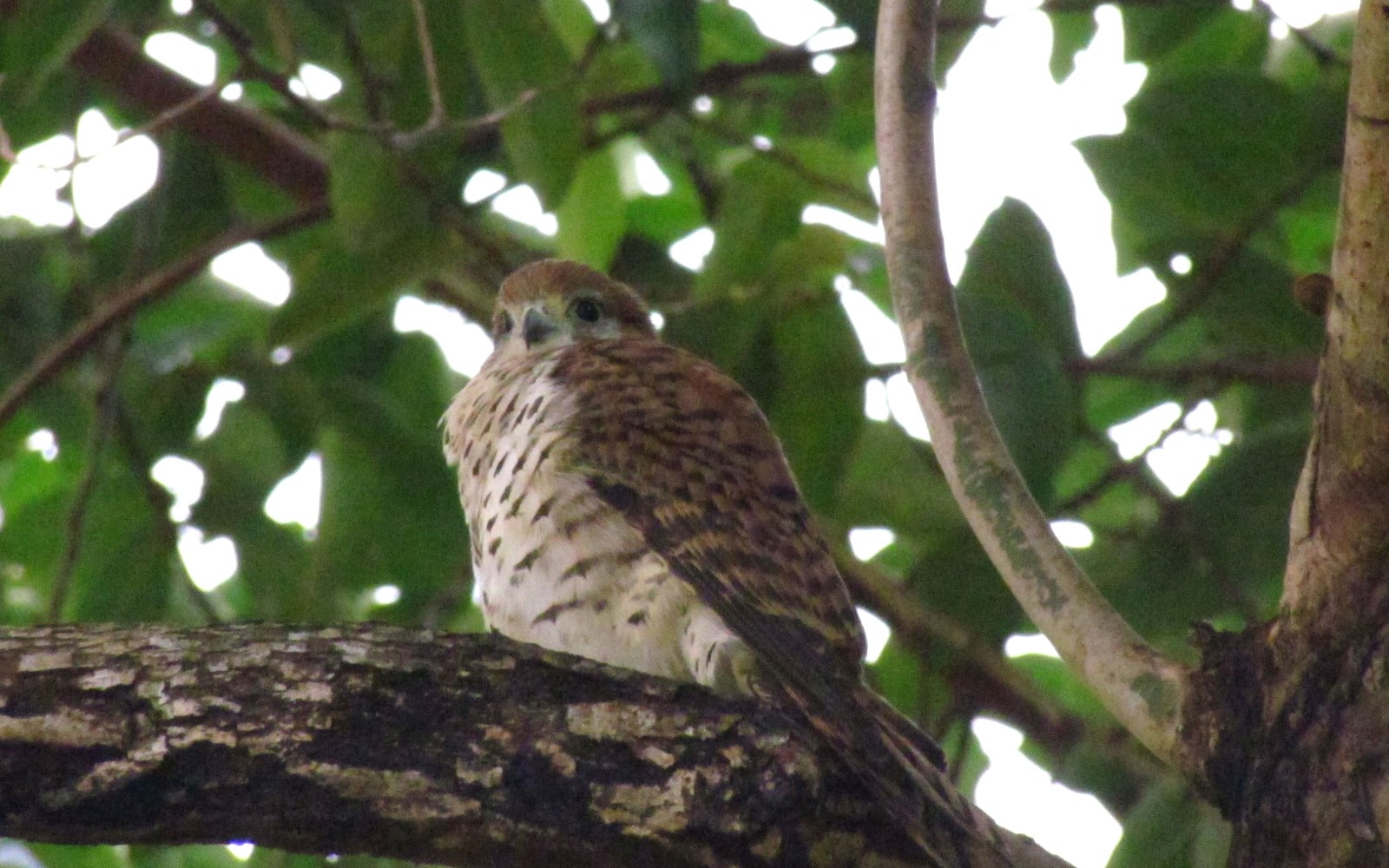
Species deep dive · mauritius kestrel
The Mauritius kestrel is famous as the bird that was saved from just four known wild individuals in 1974. Fifty years later, it is declining again. BirdLife International lists it as Endangered, with an estimated 140–170 mature birds left and the number falling (BirdLife). Two 2026 genetic studies and a season of nest cameras now help explain why rescuing the population didn't fully repair the damage.
The breeding season runs from September to February, so the kestrels of Mauritius are on their nests right now (MWF report to the African Bird Club).
Four birds in 1974
The Mauritius kestrel is a small forest falcon found only on the island of Mauritius in the Indian Ocean. By the 1970s, most of the island's native forest had been cleared, and organochlorine pesticides used in the 1950s and 1960s had harmed the birds as well. Introduced predators such as rats, cats, mongooses and crab-eating macaques raid their nests (BirdLife). In 1974 only four wild birds were known, including a single breeding pair (Jones et al. 1995, Ibis). For a time it was the most endangered bird of prey in the world (The Peregrine Fund).
The rescue that followed became a textbook case. The Peregrine Fund sent biologist Stan Temple to assess the kestrel in 1973 and later supported Carl Jones and his team on Mauritius. Its own centre in Idaho bred 46 kestrels between 1988 and 1991 for return to the island (The Peregrine Fund). Eggs were taken from wild nests to make pairs lay again, chicks were hand-reared, and the birds were given nest boxes and extra food. By 1993–94, 331 captive-bred kestrels had been released (Jones et al. 1995). The population peaked at roughly 350–500 birds in the late 1990s (BirdLife).
Back on the danger list
Intensive management ended, and the recovery stalled. The kestrel was rated Vulnerable from 2000 to 2013, but was uplisted to Endangered in 2014. By 2018 the population was estimated at fewer than 250 birds. One of the original subpopulations, in the Moka Mountains, had already died out by 2007, leaving three (BirdLife). A long-term review of the four reintroduced populations found very different outcomes after 20 years, including one local extinction, one recent decline and comparative stability elsewhere (Nicoll et al. 2021, Ibis).
Carl Jones, who led the original rescue, reflected on this in 2021: "we should have continued this care for longer" (ZSL).
The damage written in its genes
Passing through a bottleneck of four birds leaves a mark. A 2000 study in Nature compared modern kestrels with old museum specimens and found "ghost alleles", gene variants that had existed before the crash and were now gone (Groombridge et al. 2000). A 2008 study of the reintroduced eastern population found inbreeding rising by about 2.6% per generation (Ewing et al. 2008, Conservation Biology).
Two preprints posted in 2026, not yet peer-reviewed, go much further:
- Wang et al. sequenced 130 kestrel genomes spanning nearly 200 years. Before the crash, a long history of small numbers had already purged some harmful variants. But the bottleneck sharply increased inbreeding, exposed more harmful variants and left a signature of genomic erosion linked to lower reproductive success. Their title sums it up: conservation rescued the kestrel from extinction, "but not from genomic erosion" (Wang et al. 2026).
- Norris et al. built a family tree of 1,758 kestrels from 1,240 nest records collected over 30 years. Inbred eggs were less likely to survive to fledging, and inbred birds raised fewer young each year. At current levels of inbreeding, the authors estimate that population growth is negative (Norris et al. 2026).
What the nest cameras saw
To find out exactly what goes wrong in the nest, the Mauritian Wildlife Foundation used 36 camera traps in the 2025/26 season. It filmed 44 breeding attempts, 73% of all those found, in and around Black River Gorges National Park and the Bambou Mountains (MWF report).
The most common reason a breeding attempt failed was simple: the eggs weren't viable, and the pair eventually abandoned them. The most common cause of chick death was the youngest chick in a brood being too small to compete with its siblings for food. Next came other animals. The cameras caught crab-eating macaques and black rats eating eggs, Indian mynas and honeybees killing chicks, and rats taking chicks. In one November 2025 nest box, a female kestrel was filmed fighting off a rat over her brood across several nights (MWF report).
Non-viable eggs are just what you'd expect from the inbreeding results above, though the camera study itself didn't test genetics. The predators point to a fixable problem. The Nicoll team found that kestrels in nest boxes nest more often, lay larger clutches and rear larger broods. Their models suggested that scaling up nest-site management would help the declining population more than another round of translocations (Nicoll et al. 2021).
For other island birds and animals brought back from the edge, read our pieces on the Guam kingfisher and the Partula snail.
How the Mauritius kestrel plays in Wilder
In Wilder, the Mauritius Kestrel is a Rare Aves card in the Forest element. It costs 2 Energy, with Attack 2 and Health 2, plus Ambush and Resilient. Ambush suits a forest falcon that dashes out from a perch to snatch geckos, and Resilient suits a species that has already survived being reduced to four birds. Its flavour text: "Four known wild birds in 1974. Incubators, nest boxes, and hundreds back in the forest." For a bigger, faster cousin, try the Peregrine Falcon, a Rare 3-cost 4/3 with Ambush.
Wilder is a free browser collectible card game, and you can play it free in your browser with no signup.
Photo credit
Hero photograph: Josh Noseworthy, "Mauritius Kestrel" (2012), via Wikimedia Commons, CC BY 2.0. Cropped to fit the Field Journal hero.

Questions people ask
Can the Mauritius kestrel hover like other kestrels?
Yes. Like other kestrels, it can face into a headwind and hold itself in one spot, flapping and steering with its tail while it scans for prey. Its wings are shorter, broader and more rounded than most kestrels', though, so it mostly hunts by dashing from a perch and weaving between branches in dense forest (The Peregrine Fund).
What does the Mauritius kestrel eat?
Mostly geckos. Phelsuma day geckos and other tree-dwelling lizards make up about 90% of its diet. It also takes small birds, including introduced bulbuls, waxbills and doves, plus shrews, rats and large insects such as dragonflies, cockroaches and locusts (The Peregrine Fund).
How many eggs does a Mauritius kestrel lay?
Usually 3 or 4, though clutches range from 1 to 5. Incubation most often takes 28–33 days, and chicks fledge at about 35 days. Pairs may lay a second clutch, usually if the first fails, but second clutches are less successful. Breeding runs from September to February, in cliff and tree cavities or nest boxes (MWF report to the African Bird Club).
Do male and female Mauritius kestrels look different?
No, they look alike. Unlike the common kestrel and the American kestrel, male and female Mauritius kestrels have the same colouring: a rusty head, a white breast with black spots and a barred tail (The Peregrine Fund).
Where can you see a Mauritius kestrel in the wild?
Only on Mauritius. The birds live in three subpopulations: two in the west, around the northern Black River Gorges National Park and Bel Ombre, and one in the Bambou Mountains in the east (MWF report). BirdLife notes that the Ferney Valley in the east holds about half of the population (BirdLife).
Sources
- Mauritius Kestrel Falco punctatus species factsheet (BirdLife International DataZone)
- Jones et al. 1995, The restoration of the Mauritius Kestrel Falco punctatus population (Ibis)
- Mauritius Kestrel (The Peregrine Fund)
- New hope for the recovery of the endangered Mauritius kestrel (ZSL, 2021)
- Groombridge et al. 2000, 'Ghost' alleles of the Mauritius kestrel (Nature)
- Ewing et al. 2008, Inbreeding and loss of genetic variation in a reintroduced population of Mauritius kestrel (Conservation Biology)
- Nicoll et al. 2021, Contrasting recovery trajectories of four reintroduced populations of the Endangered Mauritius Kestrel (Ibis)
- Wang et al. 2026, Conservation rescued the Mauritius kestrel from extinction but not from genomic erosion (bioRxiv preprint)
- Norris et al. 2026, Inbreeding depression and population viability in a recovering population of Mauritius kestrels (bioRxiv preprint)
- Using camera traps to determine the cause of egg and chick failure in the Endangered Mauritius Kestrel (Mauritian Wildlife Foundation report to the African Bird Club, 2026)