Japanese Honey Bee: Why Do They Smear Their Hive Entrance?
Species deep dive · japanese honey bee
To keep giant hornets out. When a scout from the northern giant hornet starts inspecting their nest, Japanese honey bees fly off, chew on plants and smear the material in dark spots around their entrance. Researchers think this helps stop the hornet's scout from turning into a mass attack, though nobody yet knows exactly how it works. A study published in January 2026 found that the spots aren't just plants: many of them contain mushrooms and other fungi (Fujiwara et al. 2016; Sumimiya et al. 2026).
Why one hornet scout is such bad news
The northern giant hornet (Vespa mandarinia) doesn't just pick off bees one at a time. In a full attack, a scout first marks a honey bee nest with a chemical signal and then brings back nestmates, up to about 50 of them. The hornets kill the defending bees one after another, and a group can wipe out a colony's defenders within a few hours. Then they move in and carry the bee larvae and pupae home to feed their own young (Mattila et al. 2020).
The Japanese honey bee (Apis cerana japonica), which evolved alongside this hornet, is famous for one answer: hundreds of workers wrap a hornet in a tight ball and heat it to death (Ono et al. 1995). You can read how that "bee ball" works in our northern giant hornet piece. It comes at a price, though. The ball reaches up to about 46 °C, and bees that took part in one had a dramatically shorter life expectancy than bees of the same age that didn't. Bees that had already joined a ball were also more likely to join the next one, which may keep the damage concentrated in workers that are already short-lived (Yamaguchi et al. 2018). Smearing the entrance looks like another, cheaper layer of defence.
What the bees actually do
The behaviour was first pinned down by researchers watching colonies near Ichinoseki in Iwate Prefecture, northern Japan, over five years. They marked worker bees visiting a patch of a knotweed, Persicaria nepalensis, and watched them gnaw the leaves, flower parts and buds, fly home and smear the material around the hive entrance. The smears darkened to black or dark brown. Most were within 15 cm of the entrance, and they were much more common in September and October, the season when hornets attack (Fujiwara et al. 2016).
To test whether hornets were the trigger, the team flew a giant hornet tethered on a fine wire around hives to imitate a scout. Smearing started 15 to 30 minutes later. Two other hornets that sometimes raid honey bee hives, Vespa simillima xanthoptera and Vespa analis, triggered no smearing at all. Only the giant hornet, the species that recruits nestmates for mass attacks, did (Fujiwara et al. 2016).
A follow-up study found how the bees spread the alarm. After a giant hornet scout appeared, some bees performed a dance at the hive entrance, and both the dancers and the bees that followed them went on to smear plant material there. Other hornet species didn't set off the dance (Fujiwara et al. 2018).
Not just plants: mushrooms too
What exactly goes into the spots? In the January 2026 study, researchers at Tamagawa University placed glass slides at hive entrances, let the bees smear them, and then read the DNA in individual spots. Of 165 DNA sequences they identified, 56 came from plants, 68 from mushrooms and 41 from other fungi (Sumimiya et al. 2026). So the bees collect from fungi at least as often as from plants. Why they choose these materials is still an open question.
In Vietnam, the bees use dung
The Japanese honey bee is a subspecies of the Asian honey bee, Apis cerana, and farther south the same species does something even stranger. In Vietnam, where the related giant hornet Vespa soror attacks hives, Asian honey bee workers were filmed collecting clumps of animal dung, including chicken and water buffalo dung, and sticking them in spots around their hive entrances. Of 67 beekeepers surveyed who kept these bees, 63 had seen the spots (Mattila et al. 2020).
The spots seemed to work. On moderately or heavily spotted hives, hornets spent 77 to 81% less time sitting at the entrance and 94% less time chewing on it, compared with lightly spotted hives, and attacks by several hornets at once were less common. The researchers called it the first known case of honey bees using a tool (Mattila et al. 2020).
So how does smearing stop hornets?
Nobody knows for sure yet. One idea is that the strong-smelling material masks the chemical mark the hornet scout leaves, so her nestmates struggle to find the target. Another is that the smell simply repels hornets from the entrance, where they have to land and chew to break in (Fujiwara et al. 2016; Mattila et al. 2020). Both may be true. What's clear is that the bees save it for the hornets that recruit a gang and try to move in, not for every wasp that shows up.
The western honey bee, the honey bee kept by most of the world's beekeepers, evolved without giant hornets and has no defence like this. In the Vietnam survey, beekeepers who kept only western honey bees saw no spots on their hives (Mattila et al. 2020).
How the Japanese honey bee plays in Wilder
The Japanese Honey Bee (Apis cerana japonica) is an Uncommon Insecta card in the Air element. It costs 2 Energy, with Attack 1 and Health 3, and has Flock and Guardian, so enemies must attack it first, just as the colony throws itself in front of the nest. Its ability, Heat Ball, costs 2 Energy and deals 2 damage to an enemy creature. Flavour text: "Hundreds of bees, one giant hornet, about 46 °C. Only the bees can take the heat." Put it on the table next to the Northern Giant Hornet and you have one of nature's great arms races in two cards.
Wilder is a free browser collectible card game about real animals, and you can play it free in your browser with no signup.
Photo credit
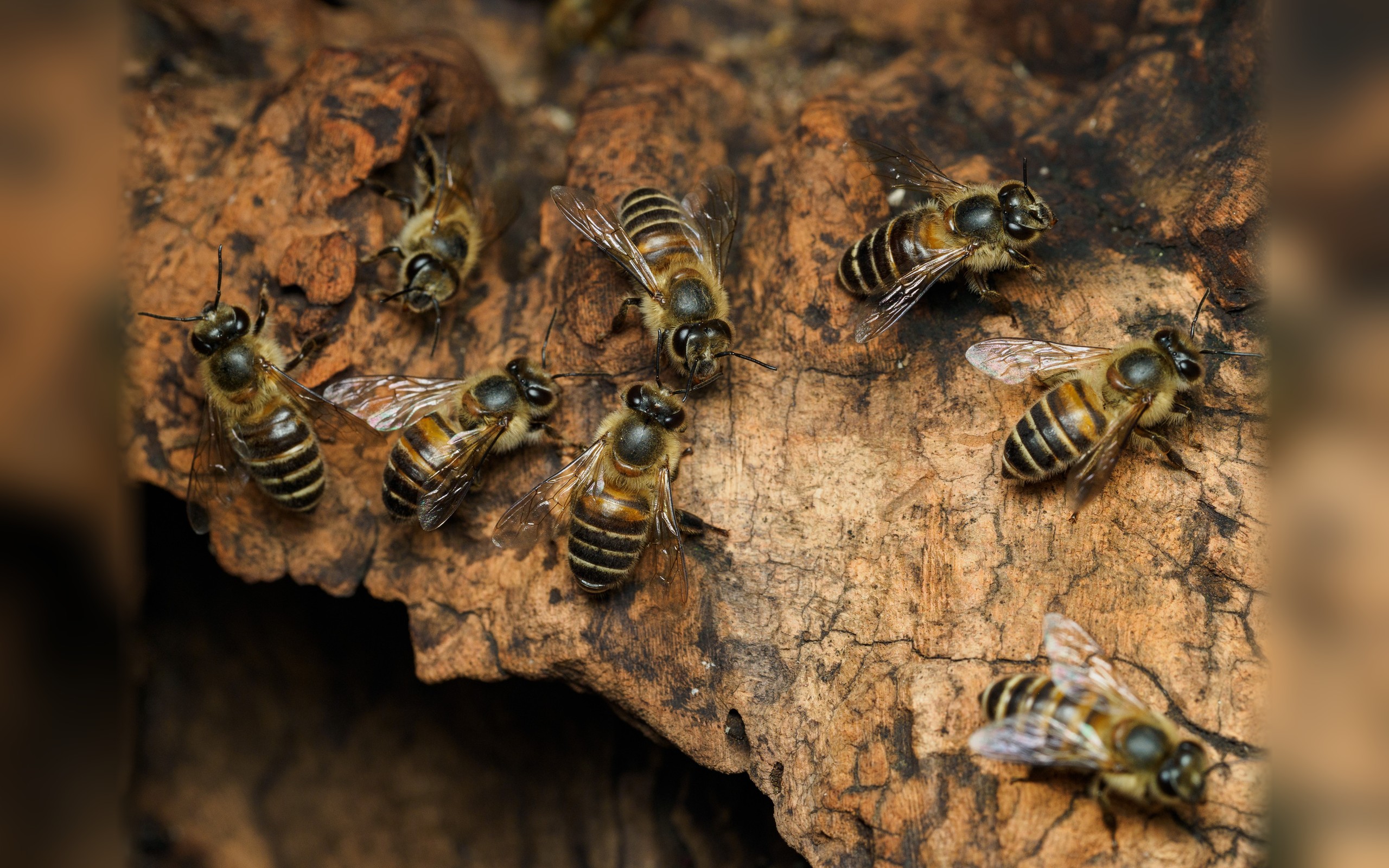
Hero photograph: Tetsuya Emura, "Apis cerana japonica - Tokyo Prefecture, Japan, July 2023" (Japanese honey bees at the entrance of a wild colony in the Tokyo area, July 2023), Wikimedia Commons, CC BY-SA 4.0. Padded to fit the Field Journal hero.

Questions people ask
Do Japanese honey bees live in Hokkaido?
Not natively, but that may be changing. The bee's known northern limit has been the Shimokita Peninsula in Aomori. In 2026, researchers confirmed a wild colony that had overwintered in Chitose, Hokkaido, the first such record there. They suggest recent warming may let the bee settle on the island. The report is a preprint and hasn't been peer-reviewed yet (Sakamoto et al. 2026, Jxiv).
Do Japanese honey bees heat-ball other hornets too?
Yes. The heat-balling defence was first described in 1987 against a smaller hornet, Vespa simillima xanthoptera (Ono et al. 1987), and later shown against the giant hornet (Ono et al. 1995). Entrance smearing is different: in tests it was triggered only by the northern giant hornet (Fujiwara et al. 2016).
Why do Japanese honey bees chew on lettuce?
Probably for the same hornet defence. Japanese honey bees have been recorded visiting and gnawing the leaves of head lettuce in autumn (Yokoi 2015). Researchers who later studied entrance smearing linked this leaf-gnawing to the dark stains the bees leave around their hive entrances in the hornet season (Fujiwara et al. 2016).
Do Asian honey bees use dung against the yellow-legged hornet?
Not in the Vietnam study. The bees spotted their hives with dung when attacked by the giant hornet Vespa soror, but hardly at all when visited by Vespa velutina, the yellow-legged hornet. That smaller hornet rarely landed on hives and never chewed the entrances; it mostly caught single bees in flight (Mattila et al. 2020).
Sources
- Fujiwara, Sasaki & Washitani (2016) A scientific note on hive entrance smearing in Japanese Apis cerana induced by pre-mass attack scouting by the Asian giant hornet Vespa mandarinia, Apidologie 47:789-791
- Fujiwara, Sasaki & Washitani (2018) First report on the emergency dance of Apis cerana japonica, which induces odorous plant material collection in response to Vespa mandarinia japonica scouting, Entomological Science 21:93-96
- Sumimiya, Ono & Sasaki (2026) The Japanese honey bee Apis cerana japonica collects and applies plant and fungal materials to the hive entrance as a potential defense against the northern giant hornet Vespa mandarinia, Applied Entomology and Zoology
- Mattila et al. (2020) Honey bees (Apis cerana) use animal feces as a tool to defend colonies against group attack by giant hornets (Vespa soror), PLoS ONE 15(12): e0242668
- Yamaguchi et al. (2018) Double-edged heat: honeybee participation in a hot defensive bee ball reduces life expectancy with an increased likelihood of engaging in future defense, Behavioral Ecology and Sociobiology 72:123
- Ono et al. (1995) Unusual thermal defence by a honeybee against mass attack by hornets, Nature 377:334-336
- Sakamoto, Yoshida & Morii (2026) Discovery of a wild nest of the Japanese honey bee Apis cerana japonica in Hokkaido (preprint, in Japanese), Jxiv
- Yokoi (2015) Visitation and gnawing behaviour of Japanese honeybee Apis cerana japonica to lettuce, Apidologie 46:489-494
- Ono, Okada & Sasaki (1987) Heat production by balling in the Japanese honeybee, Apis cerana japonica, as a defensive behavior against the hornet Vespa simillima xanthoptera, Experientia 43:1031-1032