White-Tailed Deer: Can Humans Get Chronic Wasting Disease?
Species deep dive · white tailed deer
As far as anyone knows, no. No human case of chronic wasting disease (CWD) has ever been reported, and the disease "hasn't been shown to infect people," according to the US Centers for Disease Control and Prevention (CDC). But scientists can't yet rule it out, because a related prion disease in cattle, mad cow disease, did jump to people. That's why health agencies tell hunters not to eat meat from any deer that tests positive. And CWD keeps spreading through deer herds. On 6 November 2026, New York confirmed it in a wild white-tailed deer for the first time since 2005 (NYSDEC).
The white-tailed deer (Odocoileus virginianus) is North America's most widespread deer, and its range runs from southern Canada to northern South America, including Peru and Bolivia (IUCN). It's also one of the animals most affected by CWD, a disease that headlines sometimes call "zombie deer disease."
What is chronic wasting disease?
CWD is a fatal brain disease of the deer family, including white-tailed deer, mule deer, elk, moose and reindeer. It's caused by prions: misfolded versions of a normal protein that make other copies of the protein misfold too. They slowly build up in and damage the brain and nervous system (USGS; CDC). It belongs to the same family of diseases as scrapie in sheep, mad cow disease (BSE) in cattle and Creutzfeldt-Jakob disease in people. There's no treatment or vaccine, and CWD is the only prion disease known to affect free-living wild animals (USGS).
Deer pass prions to each other through saliva, urine, faeces and blood, either directly or through contaminated soil, food and water. Prions can stay in the soil for years (CDC). The illness is slow. It takes on average 18–24 months from infection to visible signs, and during that time the animal looks and acts normal. The most obvious sign is steady weight loss. Sick deer may also stop mixing with others, seem unaware of their surroundings and lose their fear of people (USGS). Most hunter-harvested deer that test positive show no outward signs at all (Minnesota DNR).
So can people catch it?
Here's what the evidence says:
- No human cases. CWD infections in people have never been reported (CDC).
- A long monkey study found no transmission. At the US National Institutes of Health, cynomolgus macaques, monkeys that are closely related to us, were given CWD-infected deer and elk brain material by mouth or directly into the brain. After 11–13 years, the scientists found no sign that any of them had been infected. Squirrel monkeys, more distant relatives, did get sick easily (Race et al. 2018).
- But it isn't ruled out. The CDC notes that some studies in monkeys suggest they could get CWD by eating meat or brain tissue from infected deer or elk, so in theory CWD could be a risk to people. If it ever did spread to humans, eating infected meat would be the most likely route (CDC).
That uncertainty matters because so many people eat venison. In a CDC survey, nearly 1 in 5 US residents said they had hunted deer or elk, and more than 6 in 10 said they had eaten venison or elk meat (CDC). The CDC works with states to watch the health of hunters in places where CWD has been around for decades, as an early warning (CDC).
Where CWD is now
CWD was first found in captive deer in Colorado in the late 1960s, and the first wild deer case was reported in 1981 (CDC; USGS). As of June 2026 it had been detected in wild or captive deer-family animals in 37 US states and five Canadian provinces, as well as Norway, Sweden, Finland and South Korea (USGS). In the worst-hit parts of Wyoming, Colorado and Wisconsin, more than 40% of wild deer-family animals are infected, and the disease has caused population declines in white-tailed deer, mule deer and elk (USGS).
The autumn 2026 hunting season brought more news:
- New York: an adult female white-tailed deer shot in the Town of Sparta, Livingston County, tested positive. New York had tested more than 70,000 wild deer since 2002 without another case. Hunters in six surrounding towns must now submit a sample from every deer they take (NYSDEC).
- Wisconsin: a farmed deer in Taylor County tested positive, the county's first case, which triggers a ban on baiting and feeding deer there (CIDRAP).
- Wyoming: 95% of the state's mule deer herds and 71% of its elk herds are now infected, meaning CWD has been found in them, and over 10% of the deer-family animals tested so far in 2026 were positive (CIDRAP).
Staying safe as a hunter or venison eater
The CDC's advice for hunting where CWD is present (CDC):
- Don't shoot, handle or eat a deer that looks sick or acts strangely, or one that you find dead.
- Wear latex or rubber gloves when field-dressing, and handle the brain and spinal cord as little as possible.
- Don't use your kitchen knives or tools on the carcass.
- Check your state's rules, and strongly consider getting the deer tested before you eat it.
- If a processor handles your deer, ask for it to be processed on its own, so you only get meat from your animal.
- If the test comes back positive, don't eat the meat.
How the white-tailed deer plays in Wilder
The White-tailed Deer (Odocoileus virginianus) is a Common Mammalia card in the Forest element. It costs 3 Energy, with Attack 2 and Health 4, and has the Herd keyword. Its ability, Tail Flag, costs 2 Energy and gives another friendly creature Camouflage, after the white tail that whitetails flash to warn the rest of the group. Flavour text: "Bounds through the underbrush." To learn why that tail matters, read why white-tailed deer flag their tails. For another member of the deer family, meet the Roosevelt elk and its autumn bugle.
Wilder is a free browser collectible card game about real animals, and you can play it free in your browser with no signup.
Photo credit
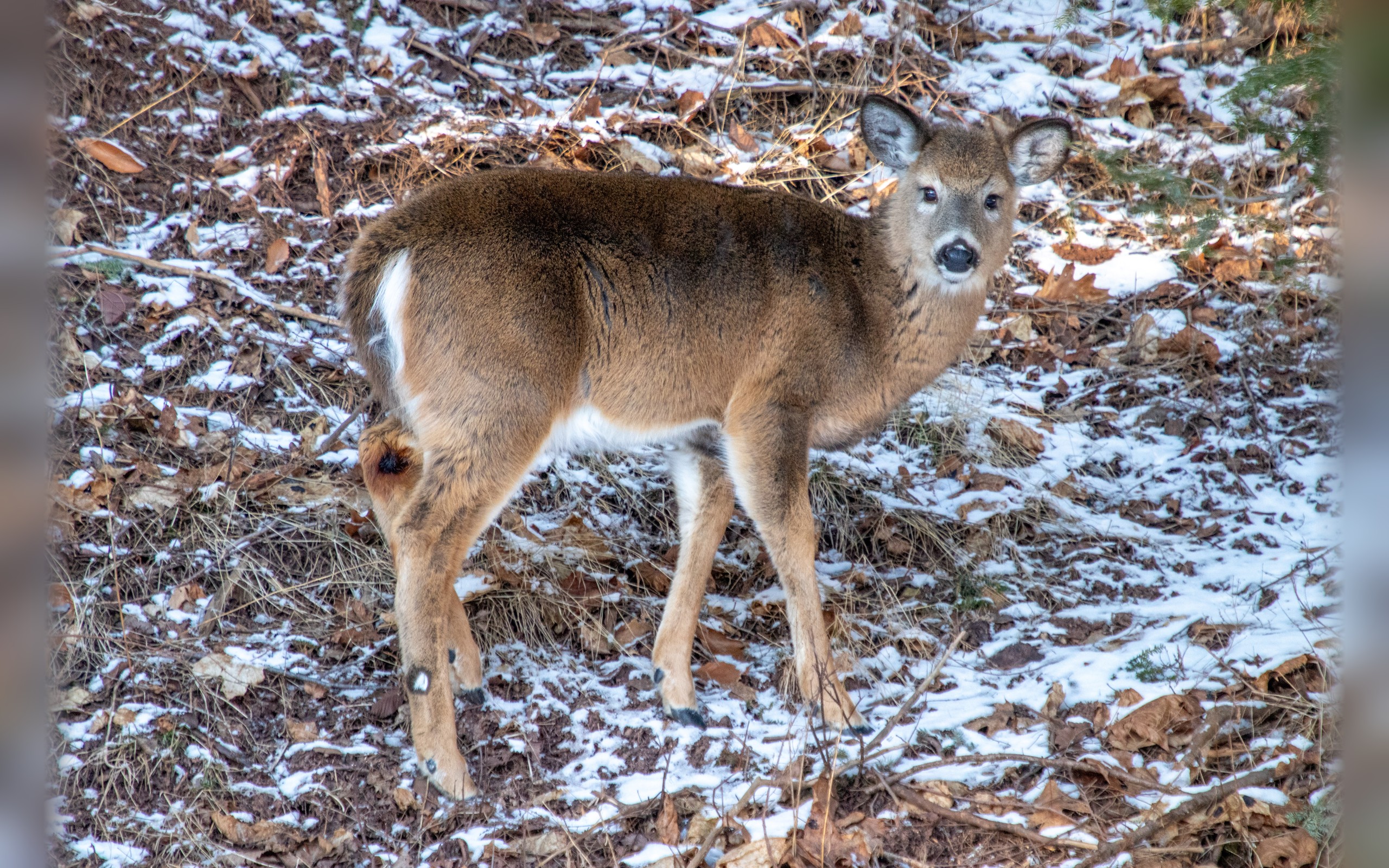
Hero photograph: Hayden Soloviev, "Northern white-tailed deer doe (Odocoileus virginianus borealis), Truro, Nova Scotia, January 24, 2026", Wikimedia Commons, CC BY 4.0. Padded to fit the Field Journal hero. The deer in the photo is not known to have CWD.

Questions people ask
Does cooking venison kill chronic wasting disease prions?
No. The prions that cause CWD are very resistant to heat and to freezing, so cooking or freezing infected meat won't remove them (Minnesota DNR). That's why the advice is to test deer from CWD areas and not to eat meat from any animal that tests positive (CDC).
Can dogs get chronic wasting disease?
There's no evidence they can. New York's wildlife agency says there is no evidence linking CWD to disease in people, dogs or cats, or in livestock such as cattle; the disease is known in deer, moose and elk (NYSDEC). To be safe, keep pets from scavenging sick or dead wildlife.
Has chronic wasting disease been found in Sweden?
Yes, in a handful of moose. Sweden's National Veterinary Institute (SVA) reports four cases, all in older female moose: three in Norrbotten in 2019 and one in Västerbotten in 2020. From 2016 to 2025, Norway confirmed 41 cases (21 wild reindeer, 17 moose and three red deer) (NVI), and SVA notes three moose in Finland. Cases in older moose may be a spontaneous form of the disease (SVA).
How is a deer tested for chronic wasting disease?
From lymph nodes in the neck. In Minnesota, for example, two lymph nodes are taken from the head and neck of a harvested deer and sent to a certified lab, and results usually take 7–14 days. The CWD test isn't a food safety test, but it can show whether the deer was infected (Minnesota DNR).
Where did chronic wasting disease come from?
Nobody knows for sure. Scientists have two main ideas: a normal deer prion protein may have changed into the disease-causing form on its own, or the disease may have come from scrapie, a prion disease of domestic sheep (Minnesota DNR). It was first recorded in captive mule deer in Colorado in the late 1960s (USGS).
Sources
- CDC: About Chronic Wasting Disease (CWD) (updated 21 Jan 2026)
- USGS National Wildlife Health Center: Chronic wasting disease
- USGS National Wildlife Health Center: Expanding distribution of chronic wasting disease (June 2026)
- NYSDEC: DEC announces chronic wasting disease found in Livingston County wild deer (6 Nov 2026)
- CIDRAP: CWD digest - detections in New York, Wisconsin trigger control measures; high proportion of Wyoming herds infected (Nov 2026)
- Race et al. (2018) Lack of transmission of chronic wasting disease to cynomolgus macaques, Journal of Virology 92(14): e00550-18
- Minnesota DNR: CWD questions and answers
- SVA (Swedish National Veterinary Institute): Avmagringssjuka (CWD) hos hjortdjur
- IUCN Red List: Odocoileus virginianus (White-tailed Deer) (Gallina & Lopez Arevalo 2016)
- Norwegian Veterinary Institute: Chronic Wasting Disease surveillance programme (updated 1 October 2026)
- Norwegian Veterinary Institute: The surveillance programme for Chronic Wasting Disease (CWD) in free ranging and captive cervids in Norway 2025 (21 reindeer, 17 moose and 3 red deer, 2016–2025)