Bull Shark: Are Bull Sharks the Most Dangerous Shark?
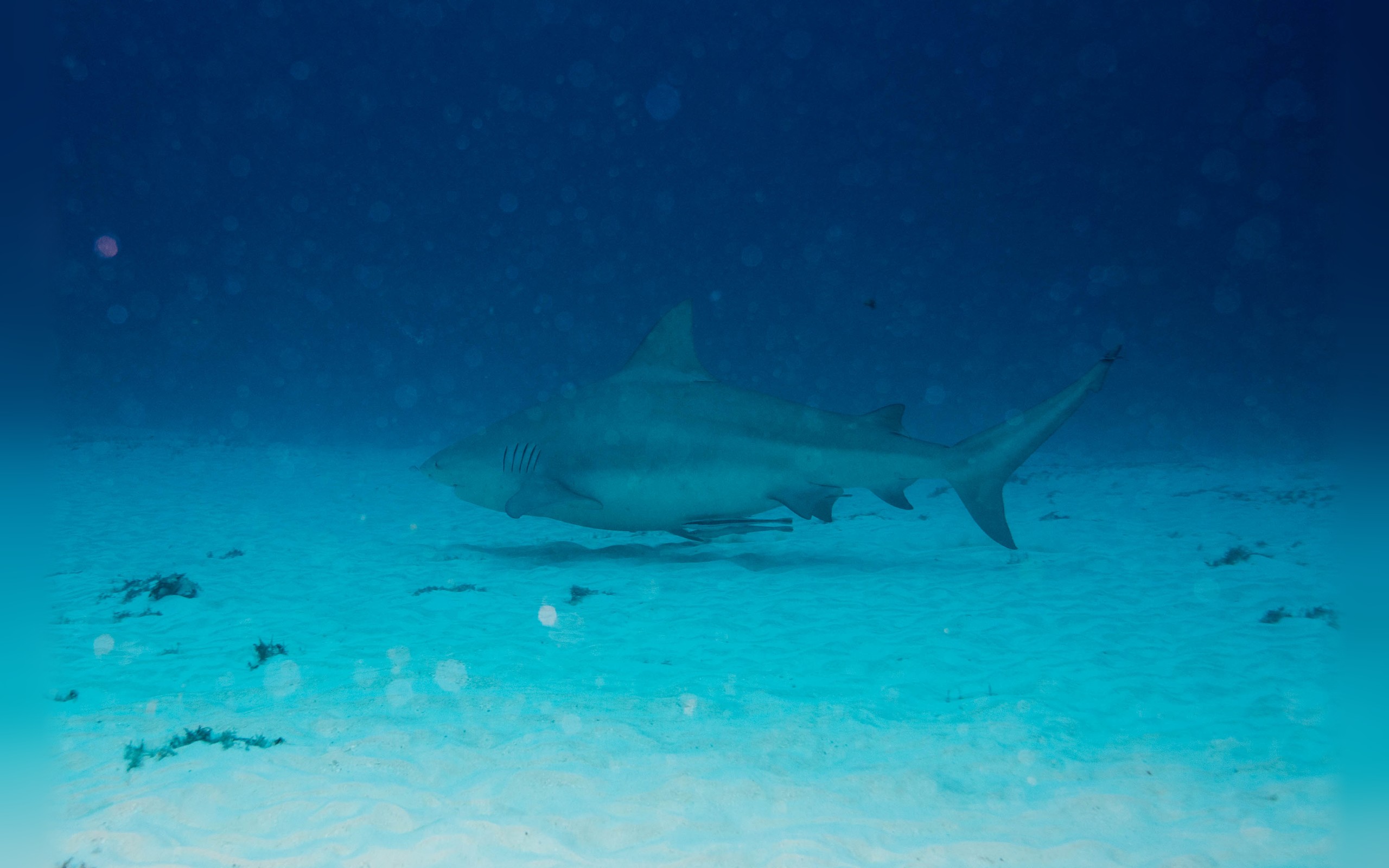
Species deep dive · bull shark, tiger shark, blue shark
Not by the numbers. The International Shark Attack File (ISAF) credits the great white shark with the most confirmed unprovoked bites and deaths, followed by the tiger shark, with the bull shark third: 119 confirmed unprovoked bites, 26 of them fatal (Florida Museum, ISAF). But many shark scientists think the bull shark's real share is bigger than its count. It's big, common, comfortable in fresh and brackish water, and lives in exactly the shallow, murky places where people swim, wade and fish. It's also hard to identify after a bite, so some of its attacks probably end up in the "unknown shark" pile. The Florida Museum notes that the bull shark "is considered by many to be the most dangerous shark in the world" for those reasons (Florida Museum).
The bull shark (Carcharhinus leucas) is a stocky, blunt-nosed requiem shark of warm coasts worldwide. Most grow to about 3.4 m, and it's one of very few sharks that can live in rivers and lakes as well as the sea (Florida Museum).
What the shark attack numbers say
ISAF, run by the Florida Museum of Natural History, keeps the world's main scientific file of shark bites. Its table of species confirmed in unprovoked bites (page last updated in January 2022) lists (Florida Museum, ISAF):
- White shark: 351 unprovoked bites, 59 fatal
- Tiger shark: 142 unprovoked bites, 39 fatal
- Bull shark: 119 unprovoked bites, 26 fatal
- All species together: 949 unprovoked bites, 142 fatal, from more than 35 species
Other species on the same table, including the blue shark, have far fewer confirmed unprovoked bites.
ISAF calls these three the "Big Three" because they are large, common where people enter the water, and have teeth built to shear rather than just hold. It also warns that the table should be used with caution. Bites by easy-to-recognise sharks, such as white and tiger sharks, are nearly always assigned to the right species, while bites by Carcharhinus requiem sharks, the group the bull shark belongs to, seldom are (Florida Museum, ISAF).
Australia, which keeps one of the most detailed national records, tells the same story. The Australian Shark-Incident Database lists 361 bites by white sharks, 229 by tiger sharks and 197 by bull sharks between 1791 and 2022. Measured as the share of bites that killed someone, tiger sharks come first (38%), then bull sharks (32%), then white sharks (25%) (Riley et al. 2022, Scientific Data).
Even so, shark bites of any kind are rare. In 2025 ISAF confirmed 65 unprovoked bites worldwide and 9 unprovoked deaths, close to the 2020–2024 averages of 61 bites and 8 deaths a year. ISAF linked at least four of 2025's fatal bites to white sharks (Florida Museum, ISAF 2025 report).
Why bull sharks are considered so dangerous
They go where other big sharks can't. Bull sharks move freely between salt water and fresh water. In one experiment, young bull sharks caught in a river were moved into full-strength seawater over 16 days and coped well. Their kidneys and rectal gland, the organs that handle salt, changed how hard they worked to match the water. The researchers concluded that the young sharks' preference for the upper reaches of rivers probably has more to do with avoiding predators or finding food than with any physical limit (Pillans et al. 2005). They have been found 3,700 km (2,300 mi) up the Amazon in Peru (Florida Museum) and about 1,850 km (1,150 mi) up the Mississippi to Alton, Illinois (Thomerson et al. 1977; U.S. Army Corps of Engineers).
They live where people are. Bull sharks prefer shallow coastal water, usually less than 30 m deep, and often enter bays, harbours, lagoons and river mouths (Florida Museum). On Australia's Gold Coast, tagged young bull sharks spent most of their time in the upper Nerang River, while larger juveniles also used the residential canals near the river mouth. The study warned that as natural river habitat is lost, artificial canals may become more important to bull sharks, with an associated risk of bites on people (Werry et al. 2012).
They like murky water. Bull sharks have small eyes and seem to rely less on sight in the cloudy water they prefer (Florida Museum). After heavy rain, rivers pour fresh, muddy water into harbours and onto beaches, which suits bull sharks and makes it hard for a shark to tell what it's looking at. In January 2026, after days of heavy rain, New South Wales recorded four shark bites in 48 hours. Fisheries scientists said bull sharks were likely involved in at least three of them, all around Sydney, including the bite on a 12-year-old boy in brackish water in Sydney Harbour, who later died. They could not confirm the species from the injuries alone (ABC News; BBC News). Authorities' advice was simple: avoid swimming in murky, low-visibility water.
They're hard to identify. Many requiem sharks look alike. NOAA's identification guide separates the bull shark from look-alikes such as the sandbar and dusky sharks by details like a very short, blunt snout and no ridge of skin between the two dorsal fins (NOAA Fisheries). A frightened swimmer in murky water rarely sees any of that. The Florida Museum notes that bull sharks are not as readily identified as white or tiger sharks and may be behind a large share of attacks that are never assigned to a species. Many bites in parts of Central America, Africa, India and Southeast Asia, where bull sharks are common, also go unreported (Florida Museum).
The 1916 creek attacks
In 1916, five people were bitten along the New Jersey coast in 12 days, and four died. Three of the attacks happened in Matawan Creek, a tidal creek only about 12 m wide and more than 24 km from the open ocean, which is not a place most large sharks would go. A young white shark caught nearby allegedly had human remains in its stomach, but the bull shark has long been a suspect, and the case has never been settled (Florida Museum).
So which shark is the most dangerous?
On the record, the great white is No. 1 for confirmed unprovoked bites and deaths, and the tiger shark is No. 2 (Florida Museum, ISAF). The bull shark sits third on the count, but it's the shark most likely to turn up where you don't expect a shark at all: in a harbour after rain, in a canal, or far up a river. For more on the No. 1, read about the great white shark as an ambush hunter.
How the bull shark plays in Wilder
The Bull Shark (Carcharhinus leucas) is an Uncommon Pisces card in the Water element. It costs 4 Energy, hits hard with Attack 5 against Health 4, and has Ambush and Resilient: a nod to a predator that cruises slowly near the bottom, then strikes fast, and that can handle water other sharks can't. Flavour text: "A sea shark that has swum over 3,000 km up the Mississippi." On its card page, see how it would fare against the great white shark in a fun "who would win" matchup.
Wilder is a free browser collectible card game about real animals, and you can play it free in your browser with no signup.
Photo credit
Hero photograph: Ratha Grimes, "Carcharhinus leucas playa del carmen" (a bull shark over sand at Playa del Carmen, Mexico, 6 December 2013), Wikimedia Commons, CC BY 2.0. Padded to fit the Field Journal hero.

Questions people ask
Do bull sharks really live in Lake Nicaragua?
Yes, but they aren't trapped there. Lake Nicaragua's bull sharks were once thought to be a landlocked freshwater population. Researchers later found that they reach the Caribbean through a system of rivers and estuaries (Florida Museum). That's why one of the bull shark's local names is the Nicaragua shark.
Are bull shark bites more likely at dusk?
Slightly, in Australia's records. Most shark bites there happen in daylight, when most people are in the water, but a somewhat higher share of bull shark bites happened at dusk than of tiger or white shark bites (Riley et al. 2022). Shark experts advise not swimming at dawn or dusk (Florida Museum, ISAF).
How far north do bull sharks swim along the US East Coast?
As far as Massachusetts in summer. In the western Atlantic, bull sharks move north along the US coast in the warm months and head back to tropical waters when coastal water cools (Florida Museum). They have also been recorded about 1,850 km (1,150 mi) up the Mississippi River, at Alton, Illinois (Thomerson et al. 1977; U.S. Army Corps of Engineers).
How can you lower your risk of a shark bite where bull sharks live?
Avoid murky water and keep it simple. After heavy rain, stay out of brown, low-visibility water in harbours, river mouths and beaches (ABC News). ISAF also advises swimming with a buddy and close to shore, avoiding dawn and dusk, staying away from schools of fish and people fishing, leaving jewellery at home and not splashing a lot (Florida Museum, ISAF).
Sources
- Florida Museum, International Shark Attack File: Species implicated in attacks (confirmed unprovoked; page last updated 25 Jan 2022)
- Florida Museum, International Shark Attack File: Yearly worldwide shark attack summary (2025 report)
- Florida Museum, International Shark Attack File: Quick tips to reduce risk
- Florida Museum: Bull shark (Carcharhinus leucas) species profile
- Riley et al. (2022) The Australian Shark-Incident Database for quantifying temporal and spatial patterns of shark-human conflict, Scientific Data 9:378
- Pillans et al. (2005) Freshwater to seawater acclimation of juvenile bull sharks (Carcharhinus leucas), Journal of Comparative Physiology B 175:37-44
- Werry et al. (2012) Natural or artificial? Habitat-use by the bull shark, Carcharhinus leucas, PLoS ONE 7(11): e49796
- NOAA Fisheries: Shark identification for the Cooperative Shark Tagging Program (A-B), bull shark
- ABC News: Four shark attacks in 48 hours on NSW beaches. What do we know about them? (20 Jan 2026)
- BBC News: Boy, 12, dies from injuries after Sydney shark attack (Jan 2026)
- Thomerson, Thorson and Hempel (1977) The bull shark, Carcharhinus leucas, from the upper Mississippi River near Alton, Illinois, Copeia 1977: 166-168
- U.S. Army Corps of Engineers, St. Louis District (2023) City of Alton, Illinois, Flood Risk Reduction Study (Flood Plain Management Services): Alton is at Mississippi River Mile 203
- Head of Passes - Wikipedia (Cairo, Illinois, is at mile 953.8 AHP, the U.S. Army Corps of Engineers mileage datum from the mouth of the Mississippi)