Saltwater Crocodile: How Dangerous Are Salties to People?
Species deep dive · saltwater crocodile
Very dangerous, wherever people and large saltwater crocodiles share the same water. Salties are one of the few animals that will treat an adult human as prey, and they kill hundreds of people a decade across Southeast Asia and the Pacific (CrocAttack). But how dangerous a saltie is depends far more on what people do near the water than on how many crocodiles there are. Australia's Northern Territory holds about 100,000 of them and still averages fewer than one fatal attack a year (NT Government; Charles Darwin University).
The saltwater crocodile (Crocodylus porosus) is the largest living reptile. Males normally grow up to about 6 m, and it lives in rivers, estuaries, swamps and coasts from India to northern Australia and the western Pacific (Be Crocwise, NT Government). In northern Australia, females start building their nests in November (Be Crocwise).
How many people do saltwater crocodiles attack?
The most complete worldwide count is CrocAttack, a database of attacks by crocodiles and their relatives. For the ten years 2015–2024 it recorded (CrocAttack):
- Indonesia: 1,167 attacks, 556 of them fatal (more than 95% by saltwater crocodiles, the rest by the false gharial)
- Papua New Guinea: 584 attacks, 369 fatal (all believed to be saltwater crocodiles)
- Malaysia: 196 attacks, 140 fatal
- Solomon Islands: 117 attacks, 44 fatal
- Timor-Leste: 73 attacks, 42 fatal
- Australia: 57 saltwater crocodile attacks, 11 fatal
CrocAttack stresses that attacks go unrecorded in some remote areas, such as Indonesian Papua, so the real numbers are likely higher. Australia's records, on the other hand, are thought to be nearly complete (CrocAttack).
Why Australia has so many crocs but few deaths
The Northern Territory had an estimated 100,000 wild saltwater crocodiles in 2017, thought to be approaching the numbers before hunting, and more than Queensland and Western Australia (NT Government). That's a big comeback for a species that was almost wiped out in the Territory by the 1970s and has been protected there since 1971 (NT Government; Be Crocwise).
Even so, attacks stay rare. A Charles Darwin University study found 76 attacks in the NT between 1979 and 2022, about 30% of them fatal. Attack rates levelled off from 2009 even though crocodile and human numbers kept rising, and fell by about 10% in the following decade, after the government's "Be Crocwise" education campaign began. About 90% of victims were NT locals, and between 2011 and 2021 people in the NT were 363 times more likely to be badly hurt or killed in a road accident than by a crocodile (Charles Darwin University; Baker et al. 2024).
Queensland tells a similar story. An official information sheet counts 51 crocodile attacks from 21 December 1985 to 9 December 2025, 16 of them fatal (Queensland Government information sheet). The department's public webpage, which lists attacks since December 1985, also includes a later non-fatal attack at Palm Creek near Ingham on 20 January 2026 (Queensland Government).
It's about the water, not the number of crocs
The difference is mostly about how people use crocodile water. In Indonesia, 47.6% of the attacks recorded in 2015–2024 happened while people were fishing, and 32.4% during everyday water, sanitation and hygiene tasks, such as bathing or washing in rivers. In Malaysia the figures were 55.2% and 26.7%. In Australia, 42.3% of victims were doing a leisure activity other than fishing, and 34.6% were fishing (CrocAttack). People who have to wash, fetch water or fish in croc rivers every day face a risk that people in Darwin can largely choose to avoid.
Crocodile numbers matter less than you'd expect. East Nusa Tenggara in Indonesia reported more saltwater crocodile attacks than anywhere else in the range over the decade, yet its average density is only about 0.4 non-hatchling crocodiles per kilometre of waterway (CrocAttack). The CDU team's models predicted that the NT's crocodile population would have to be cut by as much as 90% just to prevent one attack a year, which is a drop of about 48% in the attack rate. Doing that humanely would cost about A$87.75 million. By comparison, the NT spent A$250,000 on the Be Crocwise campaign between 2013 and 2016 (Charles Darwin University).
How a saltie ambushes
Salties are built to go unseen. A large one can stay underwater for up to an hour by slowing its heart to 2–3 beats a minute. At the surface it shows only its eyes, ears, nostrils and the top of its head, so it's easy to miss and hard to judge how big it is. Its muscular tail powers sudden lunges out of the water (NT Government). For the physics of that famous bite, read why the saltwater crocodile has the strongest bite on Earth.
Staying safe in croc country
The Northern Territory's Be Crocwise advice is simple (Be Crocwise):
- Stand at least 5 m back from the water's edge when fishing, and never stand on overhanging logs.
- Don't lean out of a boat or dangle your arms or legs over the side. The smaller the boat, the greater the risk.
- Throw away fishing scraps well away from the water.
- Never go into the water to get back a snagged lure.
Only swim where signs say it's safe, and take crocodile warning signs seriously.
How the saltwater crocodile plays in Wilder
The Saltwater Crocodile (Crocodylus porosus) is an Uncommon Reptilia card in the Water element. It costs 6 Energy, with Attack 5 and a big Health of 10, and has Basking, Guardian, Thorns and Relentless. Its ability Death Roll costs 3 Energy and deals 2 damage to an enemy creature, after the spinning roll crocodiles use to tear apart large prey. Flavour text: "Has the strongest bite on Earth. Acts like it." See how it ranks against the Komodo dragon and the green anaconda in the largest reptiles in the world, ranked. For another animal that's more dangerous near water than people think, read about the hippopotamus.
Wilder is a free browser collectible card game about real animals, and you can play it free in your browser with no signup.
Photo credit
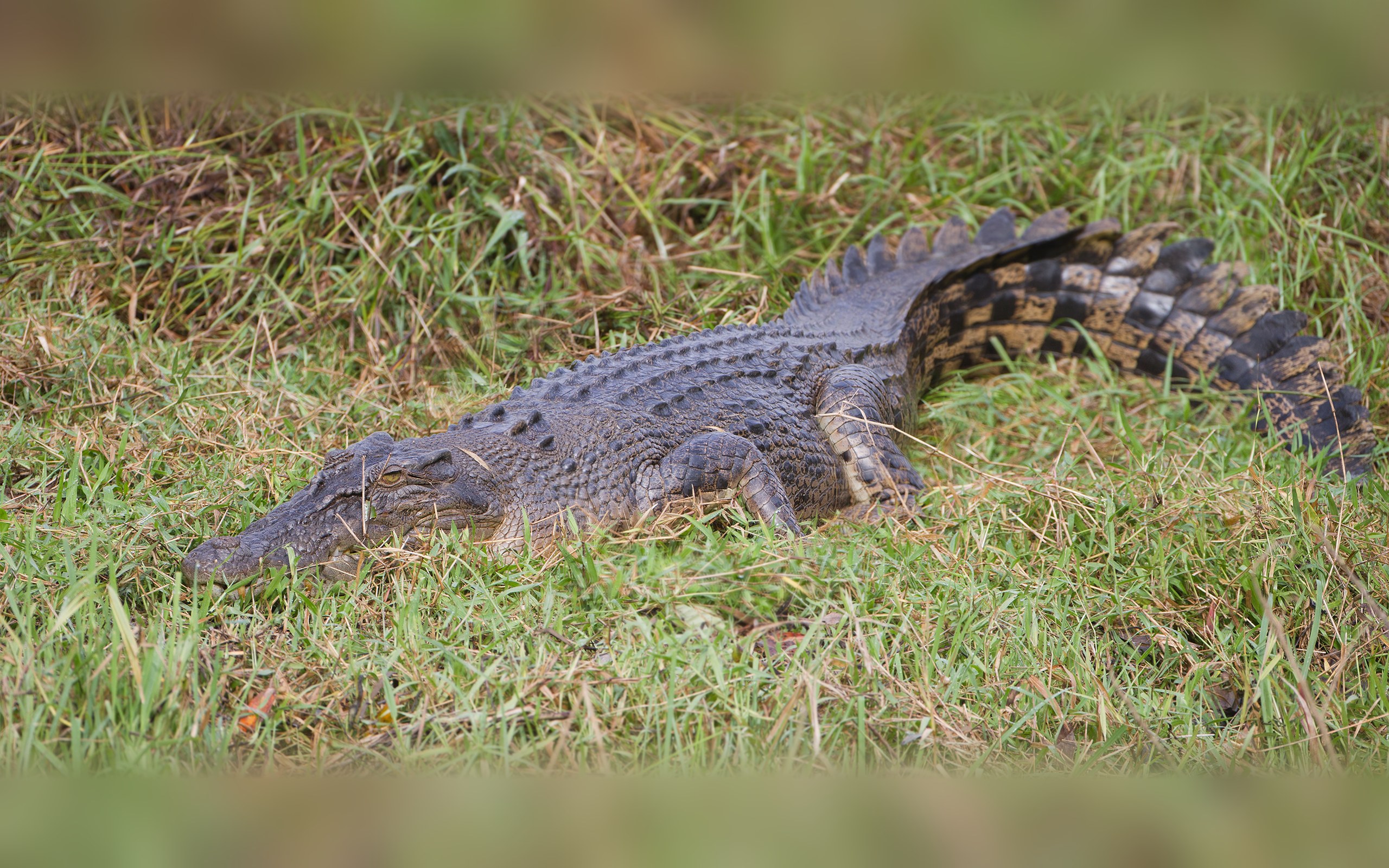
Hero photograph: JJ Harrison, "Crocodylus porosus - Daintree River" (a wild saltwater crocodile on the bank of the Daintree River, Queensland, Australia, 2 July 2011), Wikimedia Commons, CC BY 3.0. Padded to fit the Field Journal hero.

Questions people ask
Can you outrun a saltwater crocodile on land?
Don't count on it. A crocodile's tail is solid muscle, and for short bursts crocodiles can move faster than people on land, according to the Northern Territory Government (NT Government). The safer plan is never to be close enough to need to run.
Are freshwater crocodiles dangerous too?
Much less. Australia's smaller freshwater crocodile (Crocodylus johnstoni) was involved in 17 recorded attacks in 2015–2024, and none were fatal (CrocAttack). It lives mainly in fresh water, largely upstream and away from the coast. Saltwater crocodiles can live far upstream too, so a freshwater river isn't automatically safe (NT Government; Be Crocwise).
Are saltwater crocodiles endangered?
Not globally. The IUCN lists the saltwater crocodile as Least Concern (IUCN Red List), mainly because northern Australia's populations are back near pre-hunting levels. In much of mainland Asia it's still threatened, and it has disappeared from Cambodia, Thailand and Vietnam (CrocAttack).
Do saltwater crocodiles guard their nests?
Yes. Females build mound nests from vegetation between November and May, lay an average of about 50 eggs and defend the nest from predators. The sex of the young depends on nest temperature, and only about 1% of hatchlings are thought to survive to adulthood in the wild (Be Crocwise, NT Government).
Which crocodile attacks the most people in India?
The mugger crocodile, not the saltie. India recorded 768 crocodile attacks in 2015–2024, 317 of them fatal. Most were by the mugger (Crocodylus palustris), because saltwater crocodiles live only in a small part of India, such as Odisha's coast (CrocAttack).
Sources
- CrocAttack: 2015-2024 attack statistics (worldwide crocodilian attack database)
- Charles Darwin University: Culling crocs not the answer to stopping attacks (26 Aug 2024)
- Baker et al. (2024) The influence of crocodile density on the prevalence of human attacks, People and Nature
- Queensland Government: Crocodile attacks in Queensland (since December 1985)
- Queensland Department of the Environment, Tourism, Science and Innovation: Information sheet - Crocodile attacks on humans in Queensland, 21 Dec 1985 to 9 Dec 2025
- Northern Territory Government: Crocodiles in the NT
- Northern Territory Government: Conservation of crocodiles
- NT Government, Be Crocwise: Saltwater crocodiles
- NT Government, Be Crocwise: Stay safe while fishing & boating
- IUCN Red List: Crocodylus porosus (Saltwater Crocodile)