Camel Spider: Are Camel Spiders Dangerous? The Truth Behind the Myths
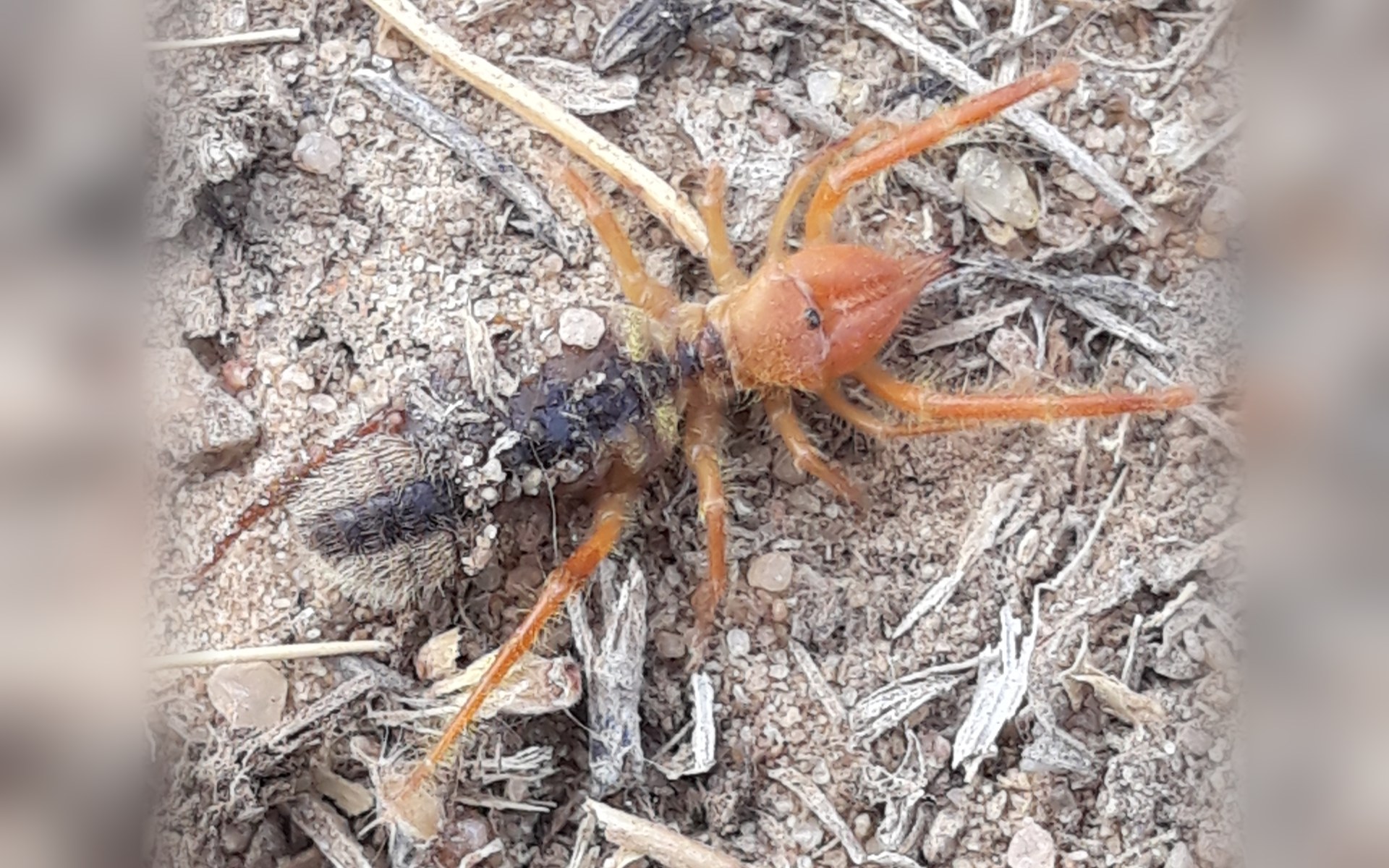
Species deep dive · camel spider
No. Camel spiders are not dangerous to people. They have no venom glands, they can't kill you, and they only bite when they're cornered or grabbed (Defense Centers for Public Health). A bite from a big one hurts and can break the skin, and the real risk is that the wound gets infected. Almost everything else you've heard about them, from flesh-numbing venom to screaming desert chases, is a myth.
"Camel spider" is a nickname for the solifuges (order Solifugae), also called sun spiders, wind scorpions or solpugids. They're arachnids, but they're neither spiders nor scorpions: they have their own order, with about 1,095 described species in 12 families (University of Arizona Cooperative Extension). Wilder's card is one of the big ones, the Egyptian giant solpugid (Galeodes arabs) of the deserts of North Africa and the Middle East.
Where the camel spider legends came from
The scary stories are old. Arachnologist Rod Crawford of the Burke Museum in Seattle notes that the legend of camel spiders that numb sleeping people and eat their flesh has been widespread in Arab countries for more than 200 years. It reached North America with veterans of the 1990–91 Gulf War (Burke Museum).
The internet version took off in April 2004, when a photo of solifuges from Iraq was mass-emailed. The animals, about 4 cm long according to someone who knew the sergeant in the photo, looked around 40 cm long because of false perspective. Follow-up emails piled on new claims: that they eat camels' stomachs, lay eggs under camels' skin, run at 40 km/h (25 mph) while screaming and jump 1.2–1.8 m (4–6 ft) straight up (Burke Museum; National Geographic News, 2004).
Here's how the main claims hold up.
"They're as big as dinner plates"
False. The largest solifuges are no more than about 15 cm (6 in) long with their legs stretched out, and most species are only 1–7 cm (Defense Centers for Public Health). Crawford puts the maximum body length of the Near Eastern species at 5 cm (Burke Museum). The giant ones in the photos are a camera trick.
"Their venom numbs you so they can eat your flesh"
False. Solifuges have no venom glands and no fangs or stinger to inject anything (University of Arizona Cooperative Extension; Defense Centers for Public Health). Crawford notes one possible exception, a species in India, but even there no anaesthetic and no way of delivering venom has been shown (Burke Museum).
What they do have is jaws. Each of the two huge chelicerae works like a combined pair of pliers and a knife: the camel spider grabs and crushes its prey, then saws it into pulp (Defense Centers for Public Health). It then sucks out the body fluids and throws away the bigger pieces (University of Arizona Cooperative Extension). Those jaws are why a large one can tear human skin if you pick it up, and why the bite can get infected.
"They run 40 km/h and scream as they come at you"
Both false. Solifuges are fast for arachnids, which is where the name "wind scorpion" comes from (University of Arizona Cooperative Extension). But Crawford found that the highest speed cited in scientific sources is about 16 km/h (10 mph), and the only accurately measured speeds he could find were under 1.6 km/h (1 mph) (Burke Museum). The US military's Defense Centers for Public Health also put their running speed at about 1.6 km/h (Defense Centers for Public Health).
They can't scream either. The loudest sound a solifuge usually makes is its jaws crunching prey (Defense Centers for Public Health). Some species can rub parts of their jaws together to make a faint buzz or hiss, called stridulation, but it's barely audible (Burke Museum).
"They chase people"
Not really. During the day, solifuges try to stay out of the hot sun. When one runs at a person standing in the desert, it's heading for the shade, and it will follow a moving shadow, which makes it look like it's chasing you (Defense Centers for Public Health; Burke Museum).
"They eat camels and lay eggs under their skin"
False. Camel spiders hunt animals much smaller than themselves: insects, scorpions, spiders, centipedes and sometimes small lizards. Most species lay their eggs in underground burrows or in crevices in wood (Defense Centers for Public Health), and Crawford stresses that they lay them in the soil, not in camels (Burke Museum).
What camel spiders are actually good at
Take away the myths and you're left with a fast, greedy hunter that's quite useful to people. A camel spider looks as if it has ten legs, but the front pair are pedipalps, which it holds out like feelers. Their tips are sticky, so it can grab prey with them and even climb smooth surfaces like glass (Defense Centers for Public Health). Solifuges also use their pedipalps to scoop water up to their mouths (University of Arizona Cooperative Extension).
Because they eat scorpions, spiders, centipedes and other arthropods, extension and public health experts describe them as beneficial predators that are generally harmless to people (University of Arizona Cooperative Extension; Defense Centers for Public Health).
How the camel spider plays in Wilder
The Camel Spider (Galeodes arabs) is an Uncommon Arachnida card in the Desert element. It costs 2 Energy, with Attack 2 and Health 2, and has Relentless and Feast (Feast bonus +1 Attack / +1 Health), a nod to a predator that keeps eating whenever it can. Its flavour text: "No venom, no silk: just huge chopping jaws and a sprint of about 16 km/h." That's the top-end speed figure; as you've read above, the speeds actually measured are much slower.
If you like arachnids that look scarier than they are, pair it with the Tohono Vinegaroon, another arachnid with no venom that defends itself with a vinegar spray instead. For arachnids that really can hurt you, read about the Sydney funnel-web spider and its antivenom, or see why scorpions glow under UV light. For more myths taken apart, try do sharks smell blood a mile away?.
Wilder is a free browser collectible card game about real animals, and you can play it free in your browser with no signup.
Photo credit
Hero photograph: Karim Haddad, "Egyptian Giant Solpugid (Galeodes arabs) in Algeria" (16 September 2023, via iNaturalist), Wikimedia Commons, CC BY 4.0. Cropped and padded to fit the Field Journal hero.

Questions people ask
Do camel spiders live in the United States?
Yes, but they're smaller. Solifuges, often called sun spiders or wind scorpions in the US, live mostly in the West and Southwest. A checklist recorded 196 species in mainland North America, mostly in the United States (Brookhart & Cushing 2006). The Southwest has more than 50 species, which are mostly 15–45 mm long (University of Arizona Cooperative Extension).
Can camel spiders jump?
Not well. The story that they can jump up to about 1.8 m (6 ft) is a myth, and their jumping ability is poor. Some species are very good climbers, though, and can crawl up trees and the walls of buildings while hunting (Defense Centers for Public Health).
Are camel spiders attracted to light?
Yes. At night, solifuges will run toward any light source, including flashlights and campfires (Defense Centers for Public Health). If one turns up indoors, it's usually there to hunt insects such as crickets (University of Arizona Cooperative Extension).
What should you do if a camel spider bites you?
Clean the bite with disinfectant. There's no venom to treat. The risk is that a bite that breaks the skin gets infected, and Burke Museum arachnologist Rod Crawford says disinfectant can prevent that (Burke Museum). If one lands on you, brush it off instead of swatting it, and never try to pick one up (Defense Centers for Public Health).
Sources
- Burke Museum (Rod Crawford): Myth - Too many "camel spider" tall tales
- Burke Museum (Rod Crawford): Myth - Near East "camel spiders," danger!
- Defense Centers for Public Health - Aberdeen (US Army): Camel Spider (Solifugids), updated 12 Aug 2024
- University of Arizona Cooperative Extension (Jeff Schalau): Solpugids or Sun Spiders (2022)
- Brookhart & Cushing (2006) An annotated checklist of continental North American Solifugae, Journal of Arachnology 34:299-329
- National Geographic News (2004): Camel Spiders - Behind an E-Mail Sensation From Iraq (archived)