Axolotl: Can You Keep One as a Pet, and Is It Legal?
Species deep dive · axolotl
Often yes, but not everywhere, and never one from the wild. Axolotls are sold as pets in many countries, and in the United States and Canada most pet axolotls come from captive-bred stock (VCA Animal Hospitals). Some places restrict them, though. California, for example, lists every salamander in the genus Ambystoma, the axolotl's genus, as a restricted "detrimental" animal, so you need a state permit to import, transport or keep one there (14 CCR § 671). Rules differ between countries, states and even cities, so check with your local wildlife or agriculture authority before you buy.
Why some places restrict axolotls
California's reason is its own salamanders. The regulation lists animals as "detrimental" when they pose a threat to native wildlife, agriculture or public health, and it names the genus Ambystoma as the "nonnative tiger salamander group" (14 CCR § 671). In other words, the worry isn't the axolotl in your tank but the one that ends up in a local pond. Never release a pet axolotl outdoors.
Across borders, the axolotl is also listed on Appendix II of CITES, the international treaty on wildlife trade (CITES). That doesn't ban trade, but it means international shipments need the right paperwork.
Wild axolotls are a different story
In the wild, the axolotl survives only in the canals of Xochimilco and a few nearby sites in Mexico City. The IUCN lists it as Critically Endangered, with an estimated 50 to 1,000 mature animals left (IUCN Red List). Counts recorded about 6,000 axolotls per square kilometre in 1998 and only 36 in 2014. In the first phase of the latest census by UNAM ecologist Luis Zambrano's team, from September 2024 to February 2025, the nets caught none at all, although axolotl DNA in water samples showed they are still there, mostly in protected refuge canals (WIRED en Español).
So the axolotl is one of the commonest salamanders in aquariums and one of the rarest in nature. Pet and lab axolotls don't make up for that. They descend from animals first brought to Paris in 1864, which spread across Europe through aquarium keepers and laboratories (Reiß et al. 2015). Our axolotl deep dive explains why captive animals can't simply be used to restock Xochimilco.
What keeping one really involves
Axolotls are fully aquatic and need a proper aquarium, not a bowl on a sunny windowsill. The basics, from vets and a long-running research colony:
Cool water. The Ambystoma Genetic Stock Center, University of Kentucky, keeps its animals at 15 to 18 °C (60 to 65 °F) and says they should never be kept above about 22 °C (72 °F) (Ambystoma Genetic Stock Center). Above 24 °C (75 °F), axolotls become sluggish, float uncontrollably and are prone to bacterial and fungal infections (VCA).
Clean, treated water. Remove the chlorine or chloramine added to tap water, use a filter with a gentle flow, and keep up with partial water changes. Fast-moving water stresses axolotls and can damage their gills (VCA; Ambystoma Genetic Stock Center). The colony guide also recommends hard rather than soft water and a pH between about 6.5 and 8.
No small gravel. Axolotls gulp their food and swallow small stones with it, which can block their gut. Keep the tank floor and decorations too big to swallow (VCA).
Gentle hands. Rough handling can cost an axolotl a limb. It may grow back, but that takes months (VCA). They are animals to watch, not to hold.
If you can't commit to that for many years, the kindest choice is not to buy one. If you want to help wild axolotls, UNAM's Chinampa-Refugio project works with farmers in Xochimilco to filter canal water and keep out invasive carp and tilapia, and its Adoptaxolotl campaign funds the work through virtual adoptions (UNAM).
How the axolotl plays in Wilder
The Axolotl (Ambystoma mexicanum) is a Rare Amphibia card in the Water element. It costs 2 Energy, with Attack 2 and Health 3, and has the Regenerate keyword, a nod to the salamander that can regrow lost legs. Flavour text: "Why grow up when you can regrow everything?" If you like giant salamanders, compare it with the Eastern Hellbender.
Wilder is a free browser collectible card game about real animals, and you can play it free in your browser with no signup.
Photo credit
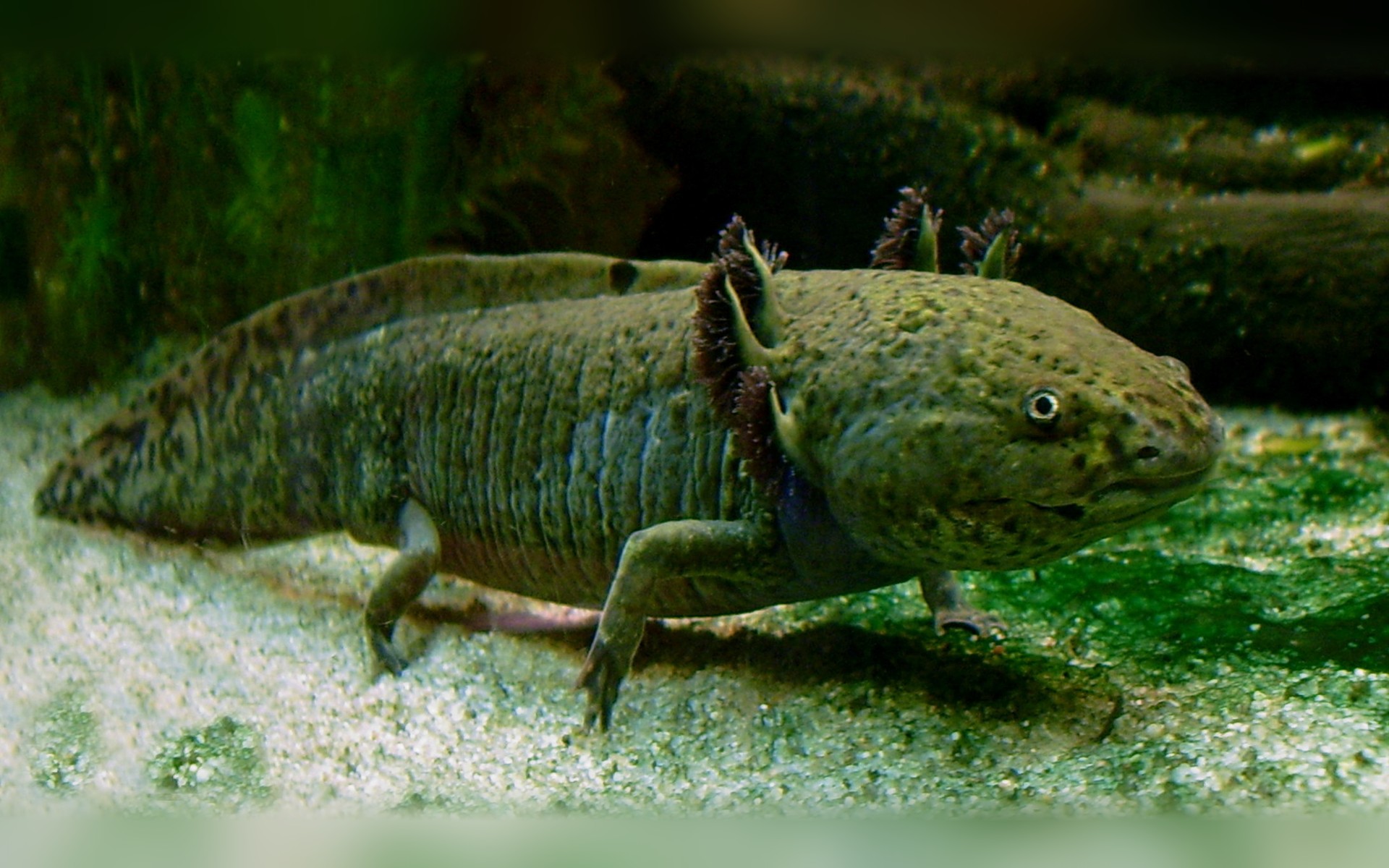
Hero photograph: LoKiLeCh, "Axolotl ganz" (a wild-type, dark-coloured axolotl in an aquarium, 2008), Wikimedia Commons, CC BY-SA 3.0. Padded to fit the Field Journal hero.

Questions people ask
How long do pet axolotls live, and how big do they get?
About 10 to 15 years in captivity. Most adults reach about 23 to 25 cm (9 to 10 in) long. Adult males can be told apart by a noticeable bulge around the vent (VCA Animal Hospitals).
What do axolotls eat?
Small animals. Axolotls are carnivores. In captivity they eat frozen bloodworms, blackworms, pieces of earthworm, brine shrimp, small feeder fish and salmon pellets. Young axolotls are fed daily and adults every 2 to 3 days, giving only what they finish in a few minutes, because obesity is a common problem (VCA Animal Hospitals). In the wild they ate snails, worms, crustaceans and small fish (Ambystoma Genetic Stock Center).
Do axolotls have lungs as well as gills?
Yes. Although an axolotl keeps its feathery larval gills for life, it still develops lungs and sometimes swims to the surface to gulp air. It also flicks its gills now and then to stir fresh, oxygenated water past them (Ambystoma Genetic Stock Center). Our axolotl deep dive explains why it never grows up.
Can two axolotls live in the same tank?
Adults, yes, if the tank is big enough. The rule of thumb at the Ambystoma Genetic Stock Center, University of Kentucky, is two adults per ten-gallon (about 38-litre) aquarium. Young ones are a different matter: larvae snap at anything that moves and bite off each other's toes and feet, so keep similar sizes together (Ambystoma Genetic Stock Center).
Sources
- IUCN Red List: Ambystoma mexicanum (Axolotl), Critically Endangered, assessed 2019
- CITES: Ambystoma mexicanum (Appendix II)
- California Code of Regulations, Title 14, Section 671: Importation, transportation and possession of live restricted animals (Cornell LII)
- VCA Animal Hospitals: Axolotls as pets
- Duhon, S. T.: Guide to axolotl husbandry, Ambystoma Genetic Stock Center, University of Kentucky
- Reiss, Olsson & Hossfeld (2015) The history of the oldest self-sustaining laboratory animal: 150 years of axolotl research, J. Exp. Zool. B 324B: 393-404
- WIRED en Español: El misterio del ajolote 'invisible' de Xochimilco (14 Aug 2025)
- UNAM DGCS Boletín 865: ¡Súmate al rescate de ajolotes y de Xochimilco! (5 Dec 2025)