Grizzly Bear: Do Grizzly Bears Really Hibernate?
Species deep dive · grizzly bear
Yes. Grizzly bears are true hibernators, just not deep ones. Yellowstone National Park's grizzly fact sheet answers the question directly: bears are "shallow hibernators" whose body temperature doesn't fall as far as many other hibernators', but they are still considered true hibernators (NPS). Right now, in mid-November, most of them are going to sleep. In Greater Yellowstone, pregnant females usually den in the first week of November and other females and males in the second week, and most bears are in their dens by mid-November, although some males stay active into December (NPS).
What happens to a grizzly in its den
A hibernating grizzly's body slows right down. According to the National Park Service, its breathing drops from 6 to 10 breaths a minute to about one breath every 45 seconds, and its heart rate falls from 40 to 50 beats a minute in summer to 8 to 19. It cuts its metabolic rate by 50 to 60%: a big, well-insulated bear loses heat slowly, so it can save energy without chilling right down (NPS). Its body temperature stays within a few degrees of normal, at about 34.4 to 35 °C (94 to 95 °F) in hibernation against 36.5 to 38.5 °C (98 to 101 °F) in the active season (NPS fact sheet).
Grizzlies generally don't eat or drink all winter. They live on the fat they put on in autumn and may lose 15 to 30% of their body weight, yet their lean body mass actually increases over the winter (NPS).
Why "true" hibernation still looks so light
That warm body is why people argue about whether bears "really" hibernate. Many small hibernators let their body temperature fall below 5 °C in deep torpor. A big bear cools far too slowly to do that, and it doesn't need to. Researchers who fitted wild brown bears in central Sweden with heart monitors and temperature loggers found their body temperature settled at about 33.8 °C in the first month in the den. Even so, bears manage to cut their metabolism as low as small hibernators in deep torpor, by actively turning it down rather than by getting cold (Evans et al. 2016).
Staying warm has an upside. A bear in its den can react to danger far faster than a hibernator that first has to warm up (NPS). The Park Service even calls grizzlies "super hibernators" (NPS).
How long do grizzlies hibernate?
Longer than you might think. A study that radio-tracked Yellowstone grizzlies from 1975 to 1999 found that dens are occupied for an average of 131 days for males, 151 days for females without cubs and 171 days for females that come out with new cubs. Males come out first. The earliest emerge in the first week of February, and 90% are out by the fourth week of April. Most females are out by the first week of May (Haroldson et al. 2002, USGS).
Hibernation length also depends on where a bear lives. It ranges from a few days or weeks in Mexico to six months or more in Alaska (NPS).
What makes a bear go to bed?
Snow, temperature, food and even den altitude all play a part (González-Bernardo et al. 2020). The Swedish bears started winding down weeks ahead: their activity and heart rate began to drop about 24 to 25 days before den entry and their body temperature about 13 days before. They finally went into their dens when the snow arrived and the air temperature was around 0 °C. In a warmer winter they denned later and hibernated for a shorter time (Evans et al. 2016).
Before that comes a feeding frenzy called hyperphagia. In autumn a Yellowstone grizzly may eat about 20,000 kcal a day, against 5,000 to 8,000 in summer (NPS fact sheet), and it may gain more than three pounds (1.4 kg) a day until it dens (NPS). In Scandinavia, the den-entry period has been identified as the riskiest time of year for bear-caused injuries to people (Evans et al. 2016).
Do they ever wake up?
Yes. Bears sometimes wake and even leave their dens in winter (NPS). And not every brown bear hibernates every year. A 2020 review of brown bear denning notes that where natural food lasts through the winter, part of the population may skip it. Males on Kodiak Island are one example, and in milder southern populations, where food is available all year, it isn't unusual to see bears that don't hibernate or that break off their hibernation. Bears that get extra food from people in winter can shift their whole denning schedule (González-Bernardo et al. 2020).
The fat bear that never gets diabetes
Grizzlies pile on fat and then barely move for months, which would put a person at risk of diabetes. Bears instead switch insulin resistance on for the winter and off again in spring. In 2022, Washington State University researchers studying grizzlies at the university's Bear Center narrowed that switch down to eight proteins, all of which have human versions. They hope the finding will one day help with treating diabetes (WSU).
For more on the bear itself, from its silver-tipped coat to its diet, read our grizzly bear deep dive. Other animals have their own answers to the hungry season: most polar bears fast on shore while they wait for Hudson Bay to freeze, and the European badger doesn't truly hibernate at all.
How the grizzly plays in Wilder
The Grizzly Bear (Ursus arctos horribilis) is a Rare Mammalia card in the Forest element. It's one of the heavy hitters: it costs 6 Energy, with Attack 7 and Health 7, and has Feast (Feast bonus +2 Attack / +2 Health) and Relentless, plus the activated ability Bear Swipe: spend 3 Energy to deal 2 damage to an enemy creature. Feast is a fitting nod to an animal that eats 20,000 kcal a day before winter.
Wilder is a free browser collectible card game about real animals, and you can play it free in your browser with no signup.
Photo credit
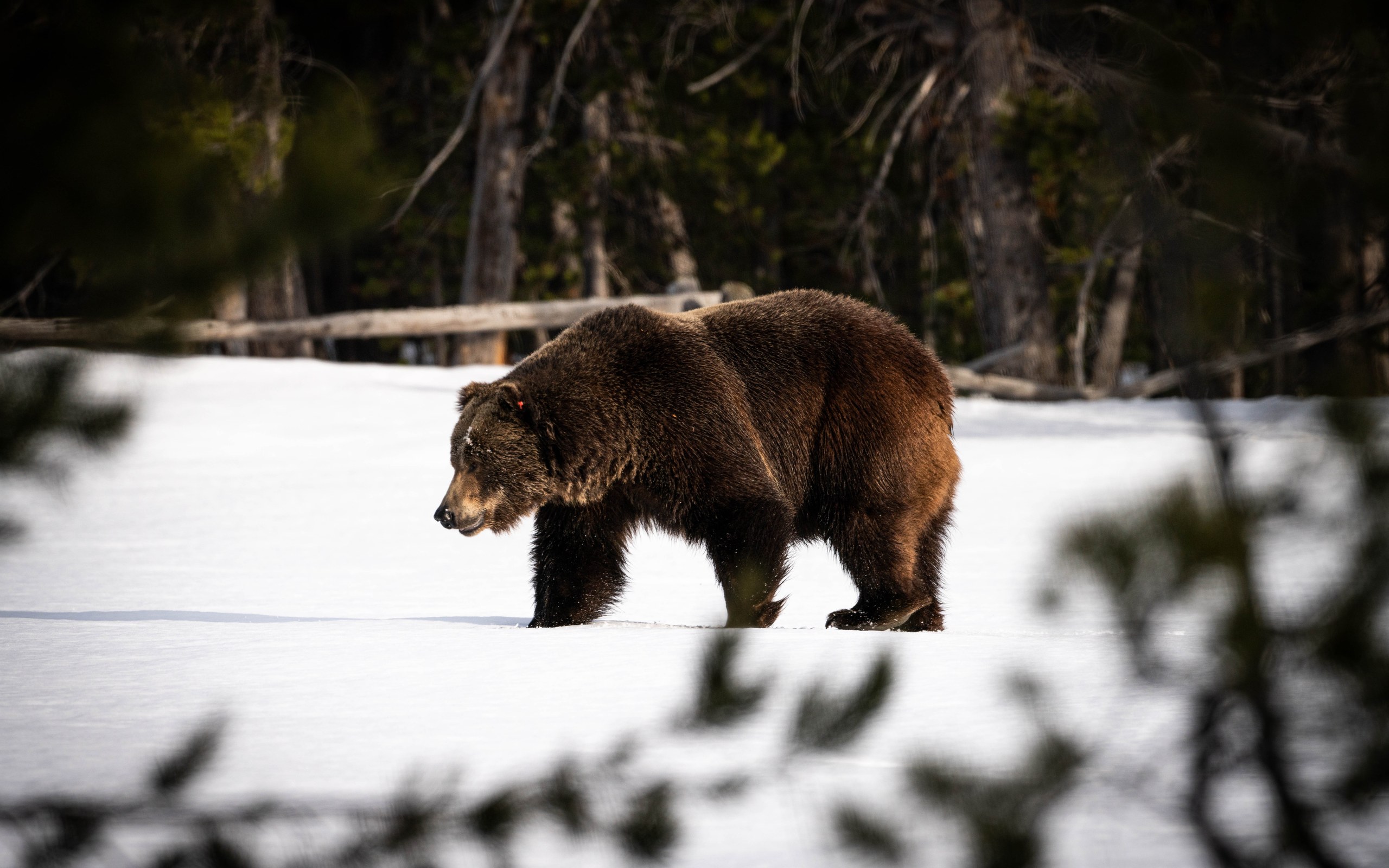
Hero photograph: NPS/Adams, Grand Teton National Park, "Grizzly Bear in the Snow" (a grizzly walking across spring snow, April 2019), Wikimedia Commons, public domain (work of the US National Park Service). Cropped for the Field Journal hero.

Questions people ask
Do grizzly bears pee or poop while hibernating?
Generally no. Hibernating bears usually don't eat, drink, urinate or defecate (NPS). Their bladder lets water and urea from the urine pass back into the blood, and the bear recycles that nitrogen into protein, which helps it keep its muscles and organs through the winter (González-Bernardo et al. 2020; NPS).
Do grizzly bears give birth while hibernating?
Yes. Grizzlies mate from mid-May to mid-July, but the embryo doesn't implant until late November or early December. Cubs are born in the winter den in late January or early February, one to four at a time (about two on average), and their eyes open at about 21 days (NPS).
What does a grizzly bear den look like?
Usually a hole the bear digs itself. In Greater Yellowstone, 91% of dens are dug, 6% are natural cavities and 3% are in snow. Bears often dig at the base of a large tree on a north-facing slope, where drifting snow insulates the den. Digging takes 3 to 7 days and can shift up to a ton of material, making an entrance, a short tunnel and a chamber lined with spruce boughs or duff (NPS; NPS fact sheet).
Do grizzly bears hibernate in captivity?
Yes, they can. Captive grizzlies at Washington State University's Bear Center hibernate, which lets researchers compare blood samples from the active and hibernating seasons. When the team fed the bears honey-water partway through hibernation, the extra sugar disrupted their hibernation behavior (WSU).
Sources
- National Park Service, Yellowstone: Yellowstone Grizzly Bear Facts (from Yellowstone Science 23(2): 44-45)
- National Park Service, Yellowstone: Bear Ecology (grizzly bear, hibernation)
- Haroldson, Ternent, Gunther & Schwartz (2002) Grizzly bear denning chronology and movements in the Greater Yellowstone Ecosystem, Ursus 13: 29-37 (USGS)
- Evans, Singh, Friebe et al. (2016) Drivers of hibernation in the brown bear, Frontiers in Zoology 13
- González-Bernardo, Russo, Valderrábano, Fernández & Penteriani (2020) Denning in brown bears, Ecology and Evolution 10(13): 6844-6862
- Washington State University: Bears' ability to regulate insulin narrowed down to eight proteins (21 Sep 2022)