Bald Eagle: Do Bald Eagles Really Mate for Life?
Species deep dive · bald eagle
Usually, yes, as long as both birds are alive and keep their territory. Bald eagles generally mate for life, but if one of a pair dies or disappears, the survivor finds another mate (Missouri Department of Conservation). The American Eagle Foundation adds a twist: now and then an intruding adult battles a resident bird for the territory and takes over. Either way, the remaining eagle usually stays put and carries on in the same territory with its new partner (American Eagle Foundation).
So "mate for life" is true, but it's a bond to a partner and a place, and the place often outlasts the partner.
A partnership built around a nest
An eagle pair typically returns to the same territory and nest site every breeding season. The territory can cover more than a square mile and hold more than one nest, and a pair may switch between them from year to year or keep adding to a single nest (Pennsylvania Game Commission). Bald eagles usually pick a breeding territory near where they themselves fledged (American Eagle Foundation).
The bond gets renewed every year. Courtship can be as quiet as two eagles perching side by side or rearranging twigs and dried grass at the nest, with occasional dramatic display flights, and it often begins in winter. Where eagles stay local all year, nest building and repairs can start as early as November or December, one to three months before the female lays (Pennsylvania Game Commission). That's exactly the season we're in now.
What a ten-year banding study found
Biologists rarely get to follow known individuals for long, but one study did. Mark Jenkins and Ronald Jackman banded 20 resident adult bald eagles in ten nesting territories along the Pit River in northern California and followed them from 1983 to 1993 (Jenkins & Jackman 1993). They found:
Pairs were stable. Every color-banded pair stayed together for as many breeding seasons as it was watched. The two pairs that broke up did so because the female was killed.
Nobody switched territories. No banded adult ever switched territories. Males were even more faithful to their site than females: 8 of the 12 females died or left their territories, against just 1 of the 8 males, which was shot.
Widowed eagles didn't stay single for long. The team recorded seven replacements of breeding adults, and in territories where a bird vanished between checks, a new adult was in place in less than a year. Two females were killed by other eagles, judging by their wounds, and both were replaced immediately. One of them had bred on her territory for 10 years, and her replacement raised young with the widowed male the very next season.
Re-pairing isn't always smooth. In one case the old female died while there were eggs in the nest. The male kept trying to incubate, but the new female didn't help, and the embryos died. The authors suggest that good nesting territories were in short supply there, with a surplus of adults waiting for a vacancy (Jenkins & Jackman 1993).
Shadow, Jackie and a new female at Big Bear
Millions of people have watched one famous pair for years on a live nest camera (CDFW), and they are now watching this play out. Jackie, the first documented bald eagle chick hatched in California's Big Bear Valley (in 2012), raised eaglets with her mate Shadow from 2018, and for several years the two were the only year-round bald eagle residents at Big Bear Lake. She died in the night of 9 August 2026 at the Ojai Raptor Center, after more than three weeks of intensive care (California Department of Fish and Wildlife).
Since then, Friends of Big Bear Valley, which runs the nest camera, has documented Shadow with a banded young female called KD1, or Kaydee. She hatched in 2022 about 70 miles away in the Prado Basin and is almost five years old, around the age bald eagles reach maturity. In November the two have been seen rearranging sticks on the old nest together and chasing off an intruding eagle. Whether they'll breed this season isn't known yet, and any eggs there are generally laid in January (Popular Science; MDC).
It's a sad story, but it's also what biologists would expect: the territory stays, and a widowed eagle looks for a new partner to share it.
Why stay together at all?
Studies of many birds suggest that breeding with the same partner in the same place pays off. A familiar partner and a proven nest site can make breeding more efficient, and re-mated pairs often raise more and better young than first-time nesters. Long-lived birds in stable environments, such as bald eagles, have been predicted to be especially faithful to sites and mates (Jenkins & Jackman 1993, summarizing earlier work). Bald eagles take four or five years to mature and use the same nests for years (MDC), so a good territory is worth holding on to.
For more on the species, read about the bald eagle's white head, DDT and comeback and why hunting season is lead-poisoning season for eagles. Its mountain cousin the golden eagle is in Wilder too.
How the bald eagle plays in Wilder
The Bald Eagle (Haliaeetus leucocephalus) is a Mythic Aves card in the Water element. It costs 5 Energy, with Attack 5 and Health 6, and has Ambush, plus the activated ability Swoop: spend 2 Energy to deal 2 damage to an enemy creature. Flavour text: "Snatches lunch from the surface without getting its talons wet."
Wilder is a free browser collectible card game about real animals, and you can play it free in your browser with no signup.
Photo credit
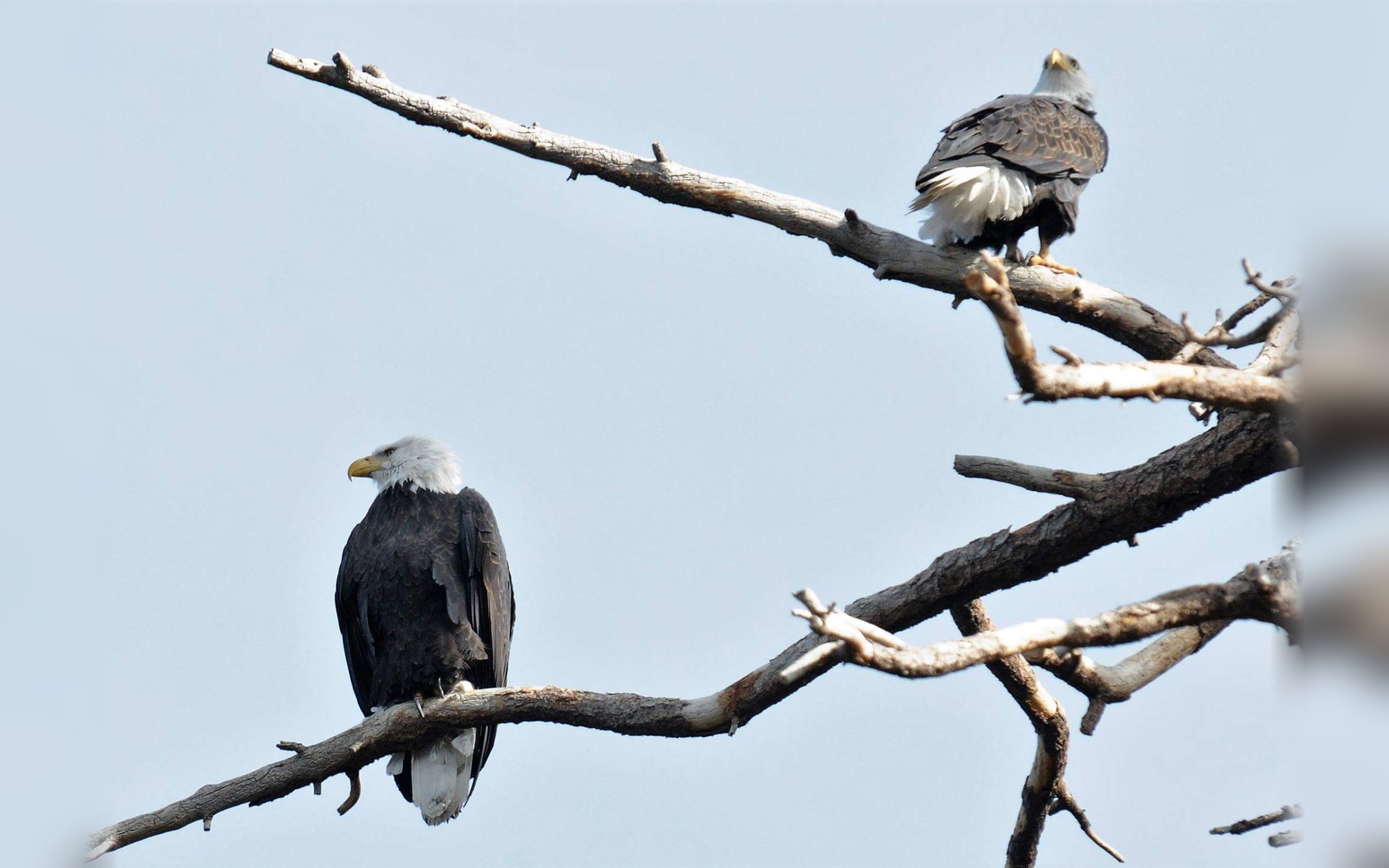
Hero photograph: San Bernardino National Forest (USDA Forest Service), "Bald eagles" (a male and a female bald eagle perched at Big Bear Lake, California, 9 December 2017), Wikimedia Commons, public domain. Padded to fit the Field Journal hero.

Questions people ask
Why do bald eagles lock talons and spin through the air?
For several reasons, not just romance. Talon-grappling happens between mates, unpaired adults and young birds alike, so it probably serves pair bonding, aggression and play. It can be dangerous: birds sometimes can't unlock and crash to the ground together (American Eagle Foundation). In courtship, a pair may plummet with locked talons and split apart seconds before impact (Pennsylvania Game Commission).
How big is a bald eagle nest?
Huge, and it grows over the years. A typical nest is five to six feet (1.5 to 1.8 m) wide and more than three feet high, but an old nest can exceed eight feet wide, 12 feet high and two tons. It's the largest nest of any North American bird, usually built 40 to 100 feet up near the top of a big tree, and some get so heavy they bring the tree down (Pennsylvania Game Commission).
Do male bald eagles help raise the chicks?
Yes. Both parents incubate the eggs, although the female spends more time on them, and both tear up fish to feed the eaglets (Pennsylvania Game Commission). While there are young in the nest, the male usually travels farther and does more of the hunting, and the female stays closer to the nest (American Eagle Foundation).
How many eggs do bald eagles lay, and how long do they take to hatch?
One to three eggs, about 35 days each. The female lays the clutch over three to six days and incubation starts with the first egg, so the eggs hatch one at a time, one to four days apart. That gives the oldest eaglet a head start over its siblings, especially when food is short (Pennsylvania Game Commission).
Sources
- Missouri Department of Conservation: Bald Eagle (field guide)
- American Eagle Foundation: Bald Eagle Behavior
- Pennsylvania Game Commission: Bald Eagle Nesting
- Jenkins & Jackman (1993) Mate and nest site fidelity in a resident population of Bald Eagles, The Condor 95: 1053-1056
- California Department of Fish and Wildlife: State officials and wildlife partners provide update on beloved bald eagle known as Jackie (Aug 2026)
- Popular Science: Bald eagles Shadow and Kaydee take on a 'nestoration' project (12 Nov 2026)