Oceanic Whitetip Shark: Did It Really Attack USS Indianapolis Survivors?
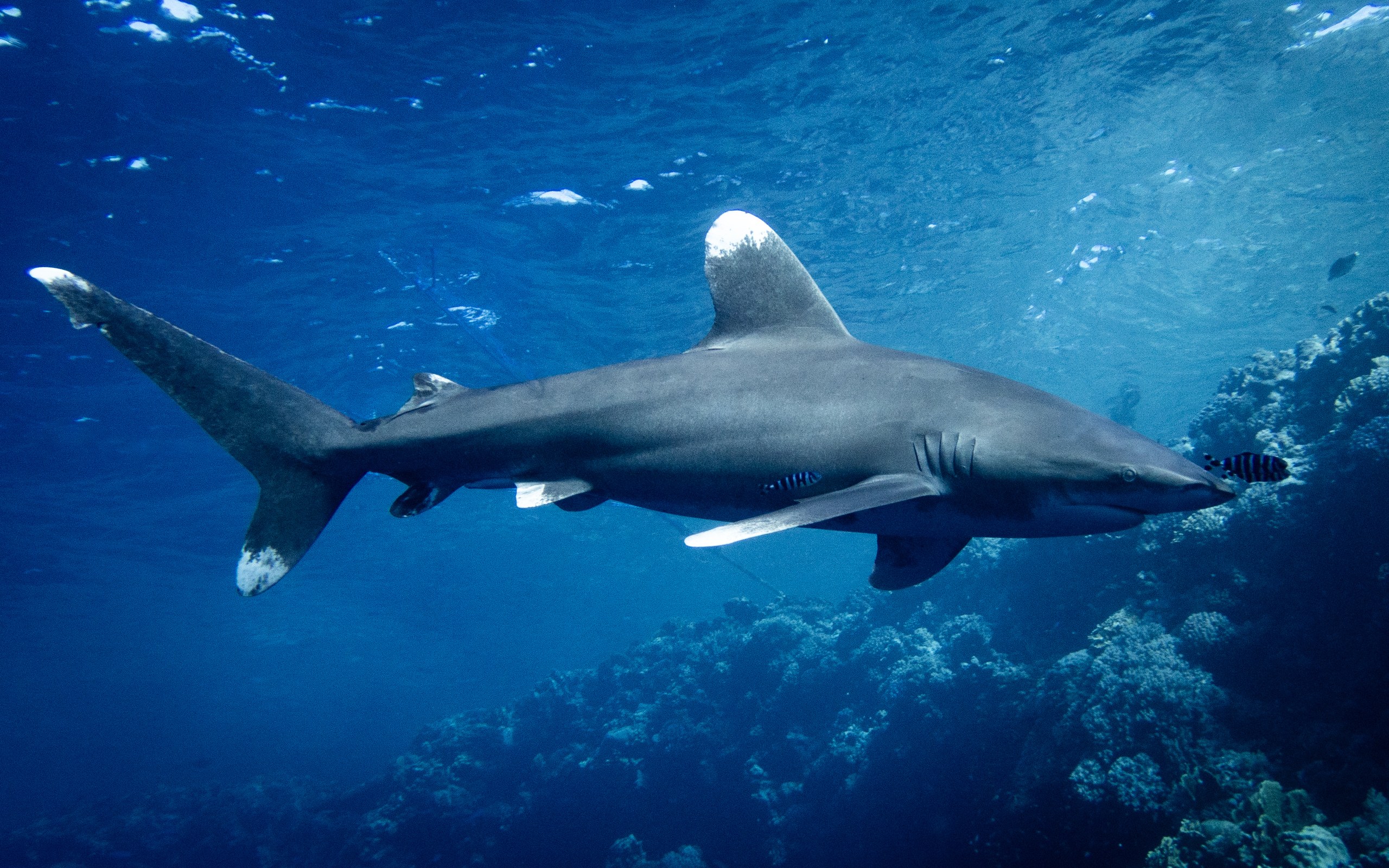
Species deep dive · oceanic whitetip shark
Yes, most likely, though nobody knows how many men the sharks actually killed. The Florida Museum's International Shark Attack File names the oceanic whitetip as the primary species implicated in the shark bites after USS Indianapolis sank in 1945, an episode often called the "worst shark attack in history" (Florida Museum). The US Navy's own historians are careful to add that many of the crew died from dehydration and exposure, not from sharks (NHHC).
So the oceanic whitetip earned its grim reputation, but the full story is about where this shark lives, how it hunts, and why it so often reached the scene of a sinking first.
What happened to USS Indianapolis
Shortly after midnight on 30 July 1945, the Japanese submarine I-58 hit the heavy cruiser USS Indianapolis with two torpedoes in the Philippine Sea. The ship had just delivered atomic bomb components to Tinian. It sank in about 12 minutes, and around 330 of the crew went down with it (NHHC, 2024).
Somewhere between 800 and 900 men went into the water, most with only a life jacket or a floater net. The sinking was so fast, and the radio damage so bad, that no distress call got out, and a misunderstanding about reporting overdue ships meant nobody went looking. The survivors were finally spotted from a plane on 2 August, and after four to five days in the open ocean only 316 were still alive (NHHC; NHHC casualty figures).
The Navy's documentary history describes how the men died: probably around 100 in the first hours from wounds received in the explosions, and the rest slowly, from dehydration, exposure and exhaustion, from drinking seawater, from hallucination-driven fights, and from shark attacks (NHHC, A Grave Misfortune). Sharks were part of the horror, but there's no reliable count of how many deaths they caused, and any precise number you read online is a guess.
Why scientists point at the oceanic whitetip
Nobody in the water was identifying sharks by species, so the blame rests on what we know about who lives in the deep, warm open ocean. That's exactly the oceanic whitetip's home. It lives offshore in tropical and subtropical seas worldwide, and although it can dive deep, it spends most of its time in the top 200 metres, in warm surface water above about 20 °C (NOAA Fisheries). The Florida Museum says it is often the first species seen around mid-ocean disasters and was a major worry for the crews of torpedoed ships and downed planes in both World Wars (Florida Museum).
Indianapolis wasn't the only case. When the steamship Nova Scotia was torpedoed by a German submarine off the coast of South Africa, close to 1,000 men were on board and only 192 survived. Eyewitnesses described a "feeding frenzy," and many of the dead are believed to have been victims of oceanic whitetips (Florida Museum, citing Bass et al. 1973).
A shark built to check out everything
The open ocean is a hard place to find food. Prey is scarce and patchy, so a predator out there can't afford to ignore anything that might be a meal. A 2018 biologging study fitted oceanic whitetips with motion sensors and cameras and found that they cruise at slow, energy-saving speeds with shallow dive angles, just as theory predicts for a predator searching sparse water. The authors estimated that an adult needs only about 1 to 1.5 kg of prey a day, and described the species as living "a life of energy speculation": spend as little as possible while searching, then gamble on whatever turns up (Papastamatiou et al. 2018).
That fits its menu. NOAA describes it as an opportunist that eats mostly bony fish and squid but also tuna and marlin, seabirds, other sharks and rays, marine mammals and even garbage (NOAA Fisheries). Satellite tags on sharks off Cat Island in the Bahamas showed them spending 99.7% of their time shallower than 200 m, with short dives as deep as 1,082 m, made more often at night and probably to feed (Howey-Jordan et al. 2013).
Divers see the same personality up close. Oceanic whitetips show little fear and often circle persistently, and the Florida Museum says the species should be treated with extreme caution because of its opportunistic feeding, size and unpredictability around people in the water (Florida Museum). A slow, curious surface shark that investigates anything floating is exactly the animal you'd expect to find among shipwreck survivors.
How dangerous is it to swimmers today?
Not very, mostly because it lives far from beaches. The International Shark Attack File lists the oceanic whitetip in 15 confirmed unprovoked bites, 3 of them fatal (ISAF). That table leaves out air and sea disasters, so the shipwreck deaths aren't in it. For comparison, the same table lists 351 unprovoked bites for the great white shark, 142 for the tiger shark and 119 for the bull shark. Read more about why the bull shark may be underestimated in our bull shark piece.
Now it's the one in danger
The shark that frightened sailors is now among the most threatened open-ocean sharks. The Florida Museum notes it was once one of the three most abundant oceanic sharks, alongside the blue shark and the silky shark, but is now only occasionally reported (Florida Museum). Its habit of staying near the surface, plus its curiosity, makes it easy to catch on longlines, in purse seines and in gillnets, and its big fins are valuable in the fin trade (IUCN Red List; NOAA Fisheries).
- The IUCN lists it as Critically Endangered (assessed 2018, published 2019) and estimates a global decline of more than 98% over three generations, about 61 years (IUCN Red List).
- NOAA Fisheries listed it as threatened under the US Endangered Species Act in 2018 and estimates declines of roughly 80 to 95% across the Pacific since the mid-1990s (NOAA Fisheries).
- In November 2025, CITES member countries voted to move it to Appendix I, which bans commercial international trade in the species (WCS).
How the oceanic whitetip plays in Wilder
The Oceanic Whitetip Shark (Carcharhinus longimanus) is an Uncommon Pisces card in the Water element. It costs 4 Energy, with Attack 4 and Health 5, and has Relentless and Feast (Feast bonus +1 Attack / +1 Health), a fitting pair for a shark that keeps circling and eats whatever the ocean offers. Flavour text: "Often the first shark at a shipwreck, and usually the boss at any feeding frenzy."
Wilder is a free browser collectible card game about real animals, and you can play it free in your browser with no signup.
Photo credit
Hero photograph: Polygonia c-album, "Oceanic Whitetip Shark (Carcharhinus longimanus) at Elphinstone Reef, Egypt" (15 December 2023), Wikimedia Commons, CC BY-SA 4.0. Cropped for the Field Journal hero.

Questions people ask
How big do oceanic whitetip sharks get?
Up to about 3.5 metres (11 feet). The IUCN gives a maximum total length of 350 cm, and NOAA Fisheries lists the species at up to 11 feet. It's a stocky, heavy-bodied shark for its length, with a big rounded first dorsal fin and very long, paddle-shaped pectoral fins (IUCN Red List; NOAA Fisheries).
Is an oceanic whitetip the same as a whitetip reef shark?
No, they're different species. The whitetip reef shark (Triaenodon obesus) is a small, slender reef shark, rarely over about 1.8 m, that rests in caves by day and hunts at night, and it rarely shows aggression to people (Florida Museum). The oceanic whitetip is a larger open-ocean shark with mottled white tips on long, rounded fins (Florida Museum).
How many pups do oceanic whitetip sharks have?
Usually about six, born live. NOAA Fisheries says litters range from 1 to 14 pups, averaging 6, after a pregnancy of 10 to 12 months. Females mature at 6 to 9 years old and probably give birth only every other year, which is one reason the species recovers so slowly from fishing (NOAA Fisheries).
How long do oceanic whitetip sharks live?
Roughly 25 to 36 years at most. NOAA Fisheries estimates the maximum age of oceanic whitetips at 25 to 36 years, which makes them long-lived, late-maturing sharks with low to moderate productivity (NOAA Fisheries).
Sources
- Florida Museum of Natural History, Discover Fishes: Oceanic Whitetip Shark (species profile)
- Florida Museum, International Shark Attack File: Species Implicated in Attacks
- Naval History and Heritage Command: Documents Relating to Loss of Indianapolis
- Naval History and Heritage Command: Navy History Matters, 23 July 2024 (USS Indianapolis)
- Naval History and Heritage Command: Survivors and Casualty Numbers, USS Indianapolis
- Naval History and Heritage Command: A Grave Misfortune: The USS Indianapolis Tragedy (2019, PDF)
- NOAA Fisheries: Oceanic Whitetip Shark (species directory)
- Rigby et al. (2019) Carcharhinus longimanus, IUCN Red List of Threatened Species (Critically Endangered A2bd)
- Howey-Jordan et al. (2013) Complex movements, philopatry and expanded depth range of a severely threatened pelagic shark, the oceanic whitetip, in the western North Atlantic, PLOS ONE 8: e56588
- Papastamatiou et al. (2018) Optimal swimming strategies and behavioral plasticity of oceanic whitetip sharks, Scientific Reports 8: 551
- Wildlife Conservation Society: Oceanic whitetips upgraded to Appendix I at CITES (27 Nov 2025)
- Florida Museum of Natural History, Discover Fishes: Whitetip Reef Shark (species profile)