
Common Krait
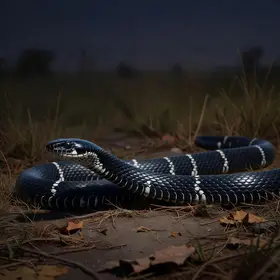
Bungarus caeruleus
Common Krait: The Snake That Bites People in Their Sleep
The common krait (Bungarus caeruleus) is a slender, glossy black snake with thin white bands, found across South Asia. It hunts other snakes at night and often enters homes, where it bites people sleeping on the floor. The bite can go almost unnoticed, but its neurotoxic venom can paralyse the muscles used for breathing.
- Habitat
- Scrub, grassland, farmland, villages and gardens; often near water
- Size
- Usually about 0.9 m long, up to 1.75 m; slender body
- Diet
- Mainly other snakes; also rodents, lizards and frogs
- Range
- India, Pakistan, Bangladesh, Sri Lanka and Nepal
- Activity
- Nocturnal; hides by day in burrows, termite mounds and debris
- Status
- Least Concern (IUCN 2021)
Habitat & range
The common krait lives across South Asia, in India, Pakistan, Bangladesh, Sri Lanka and Nepal (Wikipedia). It uses scrub, grassland, farmland, rocky ground and gardens, and is common in rural areas where rats are plentiful. It is often found near water, such as streams, canals and ponds (Wikipedia). By day it hides in rat burrows, termite mounds or under debris, and in the monsoon it often enters houses looking for shelter or prey (Wikipedia). It is glossy black or bluish-black with about 40 thin white crossbands, which are clearest toward the tail, and a white belly. Common Krait appears as a Reptilia creature card in Wilder, a free browser collectible card game.
Diet & hunting
Kraits are snake-eaters. The common krait feeds mainly on other snakes, including other kraits and vipers, and also takes rodents, lizards and frogs (Wikipedia). It hunts on the ground at night and spends the day hidden, so most people never see one in daylight.
Behavior & adaptations
By day the common krait is shy and slow to bite. When disturbed it coils loosely and hides its head under its body instead of striking (Wikipedia). At night it is far more active, and that is when almost all bites happen. Females lay about 5 to 15 eggs and stay with them until they hatch, roughly two months later, which is unusual among snakes (Wikipedia).
Bite & danger to people
The common krait is one of India's Big Four, the snakes behind most serious bites on the subcontinent (Wikipedia). In Indian studies from 2000 to 2019 that identified the snake, kraits as a group (*Bungarus* species, not the common krait alone) caused 18% of bites, second only to Russell's viper (Suraweera et al. 2020). Victims are usually bitten at night while asleep on the floor (Kularatne 2002). In one Indian hospital, 140 of 141 krait-bite patients arrived between midnight and 5 am, and most woke with stomach cramps rather than from the bite itself (Bawaskar et al. 2014). The neurotoxic venom causes drooping eyelids and paralysis that can stop breathing: 48% of 210 bitten farmers in a Sri Lankan study needed a ventilator, and 7.6% died (Kularatne 2002).
Conservation
The IUCN lists the common krait as Least Concern because it is widespread and does well in farmland (IUCN 2021). Many are killed on sight or on roads. For people, the best protection is simple: in a study in southeastern Nepal, sleeping under a bed net strongly protected against snakebites while asleep indoors (Chappuis et al. 2007).
Fun facts about Common Krait
- The species name caeruleus means blue, for the bluish sheen on its glossy black scales (Wikipedia).
- A row of enlarged, six-sided scales runs along the middle of its back (Wikipedia).
- Young common kraits have clear white bands all the way to the head; in older snakes the bands near the head fade (Wikipedia).
- Male common kraits wrestle each other in combat displays (Wikipedia).
Common Krait vs King Cobra
The king cobra wins; a krait-sized snake is just a meal to it.
Both are snake-eaters, and their ranges overlap in parts of India. King cobras feed mainly on other snakes, including venomous ones (Animal Diversity Web), and can grow several times longer than a common krait, which is usually about 0.9 m long (Wikipedia). The krait has strong neurotoxic venom of its own, but it is a small, shy snake that tends to hide its head when attacked. The king cobra is bigger, longer and built for exactly this fight.
Read more about King Cobra.
Common questions about Common Krait
Is the common krait the most dangerous snake in India?
It is one of the four most dangerous, but not the top one. In Indian studies from 2000 to 2019 that identified the snake, kraits as a group (Bungarus species, not the common krait alone) caused 18% of bites, second to the Russell's viper at 43% (Suraweera et al. 2020). Krait bites are rarer but very serious: in a Sri Lankan hospital study, 48% of 210 bitten farmers needed a ventilator and 7.6% died (Kularatne 2002).
Why do kraits bite people while they sleep?
Because they hunt at night and often enter homes. Common kraits hide by day and move about after dark, and victims are usually bitten while asleep on the floor (Kularatne 2002). In one Indian hospital, 140 of 141 krait-bite patients arrived between midnight and 5 am (Bawaskar et al. 2014). In southeastern Nepal, sleeping under a bed net strongly protected against snakebites while asleep indoors (Chappuis et al. 2007).
Does a common krait bite hurt?
Often not much, which is what makes it dangerous. Many victims sleep through the bite and wake hours later with stomach cramps: 85% of patients in an Indian study woke with abdominal pain, and 89% had drooping eyelids by the time they reached hospital (Bawaskar et al. 2014). The neurotoxic venom can then paralyse the breathing muscles, so anyone who may have been bitten needs hospital care at once.
What is the difference between a common krait and a banded krait?
The pattern. The common krait (Bungarus caeruleus) is glossy black or bluish-black with about 40 thin white crossbands and a white belly (Wikipedia). The banded krait (Bungarus fasciatus) has broad black and yellow bands that circle the whole body, and grows to over 2 m (Wikipedia). Both are dangerously venomous.
Featured in the Field Journal
- Common Krait: Why It Comes Indoors and Bites at Night
- Russell's Viper: Why It Bites More People in India Than Any Other Snake
More Reptilia animals
Reptilia · Grassland · Cost 3