Common Krait: Why It Comes Indoors and Bites at Night
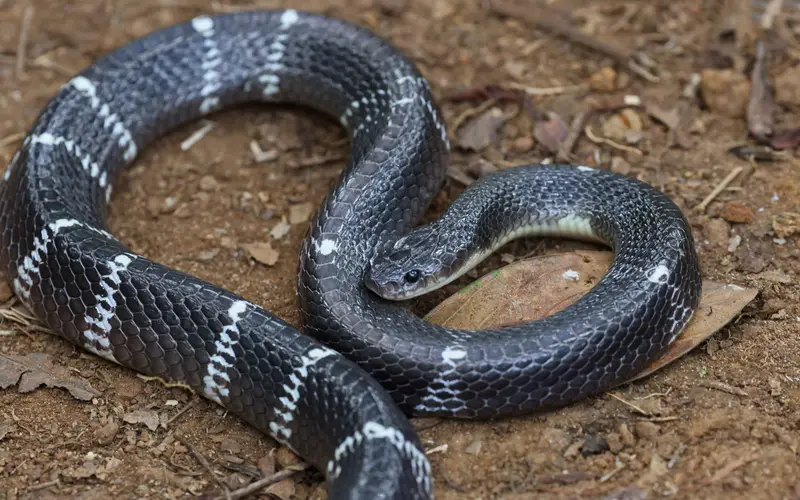
Common kraits hunt at night, follow prey into homes and bite sleepers on the floor. The bite can go unnoticed, but paralysis can follow within hours.
Play Common Krait in Wilder, free in your browser
Species deep dive · common krait Play this card
*Because a krait is a night hunter that follows its prey into homes, and in much of South Asia people sleep on the floor. The World Health Organization's South-East Asia office says that in South Asia almost all krait (Bungarus) bites are inflicted on people sleeping in their homes, usually on the floor and sometimes even in beds (WHO South-East Asia 2016). The common krait (Bungarus caeruleus) doesn't go looking for people. It is looking for frogs, rodents and other snakes, and a sleeper happens to be in the way. The bite can be so slight that the victim sleeps on, and the danger is the paralysis that follows hours later.*
The common krait lives in Afghanistan, Pakistan, India, Sri Lanka, Bangladesh and Nepal (Reptile Database). It is a slender, glossy dark snake with narrow white bands and a pure white belly (WHO South-East Asia 2016).
A night hunter that follows its food indoors
WHO describes kraits as mainly nocturnal, night hunters (WHO South-East Asia 2016). Why one ends up inside a house is a question about food. Researchers in Nepal opened the stomachs of 61 preserved common kraits: three had eaten frogs, three snakes, one a bird and five rodents, and most stomachs were empty. They concluded that the chance of a meal is probably what draws kraits into homes, where frogs, rodents and other snakes are common (Pandey et al. 2020).
Snakes are a real part of the menu. The common krait is described as mainly a snake-eater, and in Maharashtra, India, researchers watched one swallow a common sandboa at about 10:45 pm in a cowshed, and another krait swallow a smaller krait in a house compound (Kulkarni and Gurav 2022). A house that attracts rats, frogs and small snakes can attract a krait.
The bite you may not feel
Hospital studies from Sri Lanka and India paint the same picture:
- The bite happens in the night. In 210 farmers bitten in Anuradhapura, Sri Lanka, the bite occurred at night while they were asleep on the floor, and the main symptom was abdominal pain starting within hours (Kularatne 2002).
- Victims wake with stomach pain, not a wound. In a hospital at Mahad in India, 140 of 141 krait-bite patients arrived between midnight and 5 am. Most had woken with abdominal colic (85%) and chest pain (72%), and by arrival 89% had drooping eyelids (Bawaskar et al. 2014).
- Paralysis comes quickly. In a Sri Lankan study of 33 patients with confirmed common krait bites, 17 developed severe paralysis spreading down from the eyelids to the face, throat and neck, and all of them needed a ventilator within seven hours of the bite (Silva et al. 2016).
- Breathing support saves lives. In the Anuradhapura study 48% of patients needed a ventilator, for anything from 12 hours to 29 days, and 7.6% died. The authors concluded that early, free access to mechanical ventilation could keep deaths down (Kularatne 2002).
Those figures come from patients who reached hospitals, so they describe severe cases rather than every krait bite. In the Mahad series about a quarter of patients died, 12.5% of them on the way to hospital (Bawaskar et al. 2014).
A small dose of a nerve-targeting venom
Krait venom is mainly a nerve toxin. It attacks the junction where nerves meet muscles, with both pre-synaptic and post-synaptic neurotoxic effects shown in laboratory tests on common krait venom (Galappaththige et al. 2025). That is why paralysis, not a painful wound, is the story. And the common krait doesn't carry a lot of it: in a study of 338 snakes of India's "big four" (cobra, Russell's viper, common krait and saw-scaled viper), the cobra and Russell's viper gave the highest average venom yields, while the krait and saw-scaled viper produced much lower amounts (Gond et al. 2025).
Where it fits in India's snakebite picture
In Indian studies that identified the snake, kraits as a group (Bungarus species, not the common krait alone) caused 18% of bites, behind Russell's viper at 43% (Suraweera et al. 2020). The same study's authors warn that painless night bites ending in "early morning paralysis" may not be recorded as snakebite at all, so death counts could be too low, although they think that bias is small. For the snake that tops that list, see our piece on Russell's viper.
What keeps kraits out of your bed
WHO's advice is simple: sleep on a raised bed under a well-tucked-in, insecticide-treated mosquito net, keep rubbish and undergrowth away from the house, avoid wall cracks and gaps that give snakes hiding places, and keep livestock and food out of the home so you don't draw in rodents (WHO South-East Asia 2016). Anyone who wakes with unexplained abdominal pain or heavy eyelids in krait country should go to a hospital at once, even with no visible bite.
On the Wilder card
In Wilder the Common Krait is an Uncommon Reptilia card in the Grassland element. It costs 3 Energy, with Attack 3 and Health 2, and carries Venom, so combat damage it deals to another creature destroys it; Ambush, which lets it attack the turn it's played, like a night hunter striking from nowhere; and Basking, which gives it +1 Attack permanently at the end of your turn if it didn't attack (up to +2). Its flavour text reads: "By day it hides its head under its coils. By night it bites people asleep on the floor." For the species that causes more bites in India, play the Russell's Viper, and for a viper with a huge toll in Africa, the West African Carpet Viper.
Wilder is a free browser collectible card game about real animals, and you can play it free in your browser with no signup.
Photo credit
Hero photograph: Davidvraju, "Common krait (Bungarus caeruleus)-Wayanad" (a common krait in Wayanad, Kerala, India), via Wikimedia Commons, CC0 1.0 (public domain dedication). Cropped for the Field Journal hero.

Play Common Krait in Wilder, free in your browser
Questions people ask
Is there an antivenom for common krait bites?
Yes, but it doesn't always reverse the paralysis. India's polyvalent antivenoms cover the common krait (Suraweera et al. 2020), with an initial dose of 10-20 vials (WHO South-East Asia 2016). In a Sri Lankan study of 17 severely affected patients, antivenom cleared venom from the blood, yet paralysis still worsened and all needed a ventilator (Silva et al. 2016).
Does a mosquito net really protect against kraits?
It can, if it is well tucked in. In a study in southeastern Nepal, people bitten by a snake indoors while asleep were far less likely to have used a bed net than matched neighbours (odds ratio 0.02) (Chappuis et al. 2007). WHO recommends a raised bed and a well-tucked-in, insecticide-treated net. Kraits have been reported to bite even under mosquito nets, so a loose net isn't enough (Pandey et al. 2020).
How long does it take to recover from a krait bite?
Severe cases need days on a ventilator and about a week in hospital. In a Sri Lankan study of 17 patients with severe paralysis, the median time on a ventilator was 96 hours (range 54 to 216) and the median hospital stay was 8 days. Mild nerve-muscle abnormalities were still measurable at six weeks but gone by 6 to 9 months (Silva et al. 2016).
Are common kraits endangered?
No. The IUCN lists the common krait as Least Concern (assessed in 2010 and published in 2021, with a note that it needs updating), and it is widespread across South Asia (IUCN Red List). You can read more about the species on its Wilder Common Krait card page.
Sources
- World Health Organization, Regional Office for South-East Asia (2016). Guidelines for the Management of Snakebites, 2nd edition
- Kularatne SAM (2002). Common krait (Bungarus caeruleus) bite in Anuradhapura, Sri Lanka: a prospective clinical study, 1996-98. Postgraduate Medical Journal 78: 276-280
- Bawaskar HS, Bawaskar PH (2014). Premonitory signs and symptoms of envenoming by common krait (Bungarus caeruleus). Tropical Doctor
- Silva A, Maduwage K, Sedgwick M, et al. (2016). Neuromuscular effects of common krait (Bungarus caeruleus) envenoming in Sri Lanka. PLoS Negl Trop Dis 10(2): e0004368
- Pandey DP, Bhattarai P, Piya RC (2020). Food spectrum of common kraits (Bungarus caeruleus): an implication for snakebite prevention and snake conservation. Journal of Herpetology 54(1): 87-96
- Kulkarni P, Gurav Y (2022). Feeding behavior and prey of common kraits, Bungarus caeruleus, from Western Maharashtra, India. Reptiles & Amphibians 29: 250-251
- Chappuis F, Sharma SK, Jha N, et al. (2007). Protection against snake bites by sleeping under a bed net in southeastern Nepal. Am J Trop Med Hyg
- Galappaththige J, Isbister GK, Maduwage K, et al. (2025). Neurotoxicity of Sri Lankan krait and common krait venoms and their neutralisation by commercial antivenoms in vitro. Toxins 17(9): 439
- Gond PG, Kumar M, Unawane A, Sunagar K (2025). Hiss and tell: what influences venom yields of India's big four snakes? PLoS Negl Trop Dis
- Suraweera W, Warrell D, Whitaker R, et al. (2020). Trends in snakebite deaths in India from 2000 to 2019 in a nationally representative mortality study. eLife 9: e54076
- The Reptile Database: Bungarus caeruleus
- IUCN Red List: Bungarus caeruleus (Mohapatra et al. 2021)