Convolvulus Hawk-moth: The Migrant Moth With a 10 cm Tongue
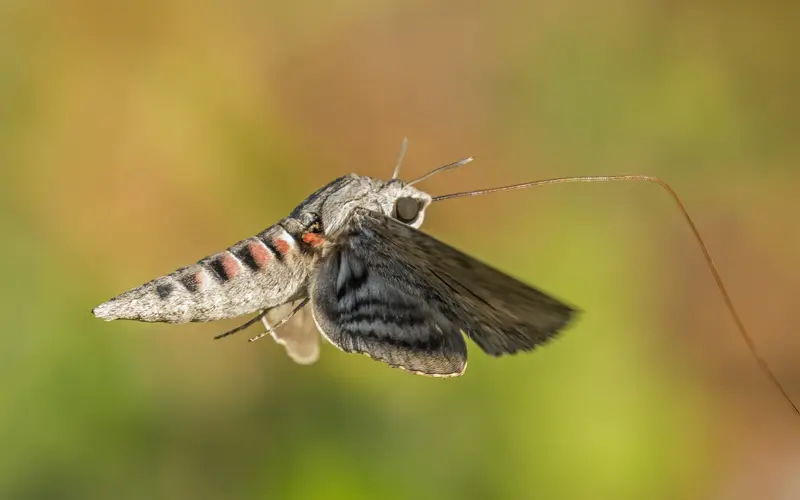
A big grey moth with a pink-banded body, seen on autumn nights, is likely a convolvulus hawk-moth: a migrant whose tongue can reach 10 cm.
Play Convolvulus Hawk Moth in Wilder, free in your browser
Species deep dive · convolvulus hawk moth Play this card
*A very large grey moth with a banded pink-and-black abdomen, seen on a late-summer or autumn night, is most likely a convolvulus hawk-moth (Agrius convolvuli). It has a wingspan of 80 to 120 mm and is a migrant: in Britain it arrives from southern Europe, can't survive the winter, and turns up mostly from late August to late November (Butterfly Conservation). Its party trick is its tongue. In South Africa the average proboscis measured 10.1 cm (Johnson and Raguso 2016), and Butterfly Conservation gives about 7.5 cm for the moths that reach Britain (Butterfly Conservation 2015). That lets it drink from deep, trumpet-shaped flowers that many moths can't reach.*
How to recognise one
It is one of the largest moths in Europe (Butterfly Conservation 2015). The forewings are long, ashen grey and marbled with darker streaks, and the abdomen is segmented with white, pink and black bands, which is the feature that makes it easy to tell apart from other hawk-moths (Derbyshire Moth Group). By day it rests on walls, rocks and tree trunks with its wings held close to its body; at night it comes to lights and flowers. Males have thicker, longer antennae than females (Butterfly Conservation).
A tongue built for deep flowers
The tongue isn't just long for a moth, it is long for a hawk-moth. When researchers in South Africa measured the proboscis of hawk-moths they trapped, the lengths fell into two groups. The long group was almost entirely convolvulus hawk-moths, averaging 10.1 cm and reaching up to about 15 cm; the short group, made up of many other hawk-moth species, averaged about 3.8 cm (Johnson and Raguso 2016).
The flowers match. The same study found that plants pollinated by this moth tend to have narrow tubes about 10 cm long, white flowers and a lot of dilute nectar, and estimated that more than 70 grassland and savanna plant species in Africa belong to this moth's pollination guild. The authors call it the most important pollinator of African plants with very long-tubed flowers (Johnson and Raguso 2016).
In gardens the same tongue works on tubular flowers such as tobacco plants (Nicotiana), petunias, lilies and phlox, which many other moths can't feed from. It hovers in front of the bloom with pin-point precision to drink the nectar (Butterfly Conservation 2015). Butterfly Conservation has even asked gardeners to plant tobacco plants to draw it in (Butterfly Conservation 2015).
A migrant on the move
The convolvulus hawk-moth is an immigrant to Britain. It pupates underground and can't overwinter there, so every moth you see has flown in (Butterfly Conservation). It isn't only a British story. Convolvulus hawk-moths and death's-head hawk-moths have been caught on mountain passes in the Alps, and researchers say both regularly use mountain passes in their movements between central and southern Europe (Stefanescu 2025). In Sierra Leone, trapping showed strong seasonal swings in its numbers that may also reflect migration (Johnson and Raguso 2016).
A moth that scientists study
Because it is big and a good flier, the convolvulus hawk-moth has also been a lab animal. In Japan, researchers used it to study how a flying hawk-moth steers: they recorded wing movements and flight-muscle activity in free-flying males as they turned towards the scent of a female (Wang et al. 2008). Others have mapped nerve cells in its antennal lobe, the part of the brain that processes smell (Nirazawa et al. 2017). In 2026 the moth's genome was published as part of Project Psyche, a programme sequencing European butterflies and moths; the assembly is 438 megabases long and almost all of it is scaffolded into 28 chromosomes (Vila et al. 2026).
On the Wilder card
In Wilder the Convolvulus Hawk-moth is a Common Insecta card in the Air element. It costs just 1 Energy, with Attack 1 and Health 2, and has two keywords: Ambush, which lets it attack the turn it's played, like a moth that appears out of the dusk, and Camouflage, so enemy Actions, Signatures and abilities can't target it until it attacks, a fair picture of a moth that blends into bark by day. Its flavour text reads: "Hovers at dusk, probing bindweed trumpets with a needle-thin tongue." For another long-distance insect traveller, read Monarch Butterfly: Migration and Milkweed.
Wilder is a free browser collectible card game about real animals, and you can play it free in your browser with no signup.
Photo credit
Hero photograph: Charles J. Sharp, "Convolvulus hawk moth (Agrius convolvuli), Gorski kut, Rila Monastery, Bulgaria" (30 July 2017), via Wikimedia Commons, CC BY-SA 4.0. Cropped for the Field Journal hero.

Play Convolvulus Hawk Moth in Wilder, free in your browser
Questions people ask
Is the convolvulus hawk-moth rare in Britain?
Not rare in a good year, but it never settles. Butterfly Conservation says a few hundred are spotted in the UK annually, mainly in late summer and early autumn (Butterfly Conservation 2015). Of 6,576 records on the NBN Atlas, 3,782 were in September, 1,633 in August and 932 in October, with only 10 in November (UKmoths). It does not regularly breed in Britain.
What do convolvulus hawk-moth caterpillars eat?
Bindweed and its relatives. Larvae are usually found on wild or cultivated bindweed, plants in the morning-glory family (Convolvulaceae), which gives the moth its name (Butterfly Conservation). In Asia the species is also known to researchers as the sweet potato hornworm (Dai et al. 2017).
How can I attract hawk-moths to my garden?
Plant tubular flowers. Butterfly Conservation has asked gardeners to plant ornamental tobacco (Nicotiana) to attract the convolvulus hawk-moth, which also feeds on petunias, lilies and phlox (Butterfly Conservation 2015; Butterfly Conservation). Look in the evening in late summer, because the moth is nocturnal, hovers at flowers and also comes to lights.
Do hawk-moths migrate over mountains?
Yes, some do. Convolvulus hawk-moths and death's-head hawk-moths regularly use mountain passes on their journeys between central and southern Europe. Researchers caught both at Col de Bretolet, 1,923 m up in the Alps near the Swiss-French border, and suggest a network of light traps in passes could help track migrating insects (Stefanescu 2025).
Sources
- Butterfly Conservation: Convolvulus Hawk-moth (Agrius convolvuli)
- Butterfly Conservation (10 September 2015). Cigarettes and alcohol ... and moths
- UKmoths: Convolvulus Hawk-moth (Agrius convolvuli), records from the NBN Atlas
- Derbyshire Moth Group: 69.004 BF1972 Convolvulus Hawk-moth
- Johnson SD, Raguso RA (2016). The long-tongued hawkmoth pollinator niche for native and invasive plants in Africa. Annals of Botany 117(1): 25-36
- Stefanescu C (2025). Millions of insects migrate across the Pyrenees: heavy transit and conflicting ecological roles. Proceedings of the Royal Society B
- Wang H, Ando N, Kanzaki R (2008). Active control of free flight manoeuvres in a hawkmoth, Agrius convolvuli. Journal of Experimental Biology
- Nirazawa T, Fujii T, Seki Y, et al. (2017). Morphology and physiology of antennal lobe projection neurons in the hawkmoth Agrius convolvuli. Journal of Insect Physiology
- Vila R, Rindos M, Wright CJ, et al. (2026). The genome sequence of the Convolvulus Hawk-moth, Agrius convolvuli (Linnaeus, 1758). Wellcome Open Research
- Dai LS, Li S, Yu HM, et al. (2017). Mitochondrial genome of the sweet potato hornworm, Agrius convolvuli (Lepidoptera: Sphingidae), and comparison with other Lepidoptera species. Genome