Humpback Whale: Where Did All the Calves Go in 2026?
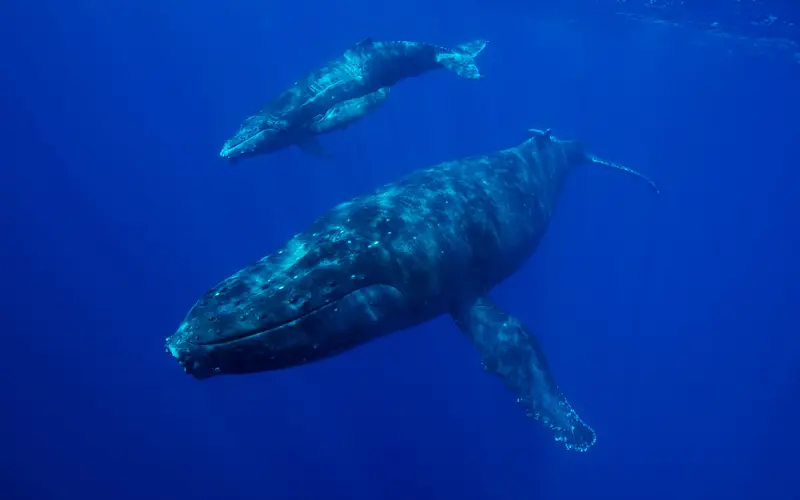
Humpback whale calves were scarce across the Southern Hemisphere in 2026. Scientists think many mothers were too thin on krill to carry a pregnancy.
Play Humpback Whale in Wilder, free in your browser
Species deep dive · humpback whale Play this card, antarctic krill Play this card, orca Play this card
Far fewer humpback whale calves than usual turned up on the Southern Hemisphere's breeding grounds in 2026. Off Ningaloo in Western Australia, the number of calves seen each day fell from a 12-year average of about ten to fewer than two; in Queensland's Moreton Bay calf numbers were down 90% on 2025; and around Réunion Island only one calf was sighted all season (Bengtson Nash & Totterdell, The Conversation, 18 Nov 2026). The leading explanation is hunger: researchers think many females did not build up enough fat on Antarctic krill the summer before to carry a pregnancy, a sign of change in the sea-ice ecosystem that krill depend on. It isn't proven yet, and the scientists are still working through the data.
Humpback whales (Megaptera novaeangliae) are one of conservation's great comebacks. After centuries of whaling, as few as 5,000 were left in the Southern Hemisphere; since the 1985 whaling moratorium the east Australian population alone has grown to around 50,000 migrating whales (The Conversation). That's why a season with almost no calves has whale scientists worried.

What people saw in 2026
The reports came from almost every Southern Hemisphere breeding ground:
- Western Australia: the number of whales seen migrating north along the coast dropped by 60%, with fewer calves and more strandings and entanglements. Mothers with calves were scarce on the return trip south from the Kimberley calving grounds. Griffith University scientist Olaf Meynecke said some mothers looked "quite thin" (ABC News, 11 Nov 2026).
- Brazil: by September, calves made up just 3.35% of the whales counted by Brazil's Humpback Whale Institute, against an average of 9.98% since 2014 and 10.7% in 2025 (Agência Brasil, 8 Nov 2026).
- Ecuador, New Caledonia and Réunion: low calf numbers too, with unusually warm water off Ecuador (The Conversation).
Entanglements in fishing gear also rose. Meynecke counted 60 across Australia in 2026, about 20% more than before (ABC News).
Why a calf depends on last summer's meals
A humpback mother pays for her calf in advance. Southern Hemisphere humpbacks feed on swarms of krill around Antarctica in summer, then swim thousands of kilometres to warm tropical waters to breed, and they usually don't eat on the way (The Conversation). Pregnancy lasts about 11 months, and a calf stays close to its mother for up to a year before weaning (NOAA Fisheries). All of that runs on the fat she stored while feeding.
So a female only becomes pregnant and makes the trip if her summer went well. Females without enough reserves may cut the migration short or skip it altogether, while males are thought to migrate to breed whatever their condition (The Conversation). The Brazilian researchers put it simply: whales that don't feed properly are less fertile when they arrive, and pregnant ones risk losing their calves (Agência Brasil).
The warning came a year early
This is where the 2026 story starts in 2025. Scientists track the ratio of males to females in the migration as an early sign of how many calves to expect the next year. Off Queensland in 2025, males outnumbered females by more than ten to one, compared with a 17-year average of 2.7 to one. Fewer females migrating to breed in 2025 matches the low Queensland calf count in 2026 (The Conversation).
Krill, sea ice and a whale as a sentinel
The scientists behind these figures run the Humpback Whale Sentinel Programme, which samples five humpback populations, each feeding in a different part of Antarctica. They check fat stores, diet and how many females are pregnant, using the whales as a living gauge of the Antarctic sea-ice ecosystem (The Conversation).
The link is Antarctic krill. Larval krill shelter under sea ice in winter and feed on the microbes that grow there, so less sea ice can mean less krill. The programme's results point to a long-term shift to low sea ice around Antarctica after record lows in 2017, and the authors say the 2026 breeding failure comes almost a decade into that shift (The Conversation). Meynecke also points to earlier sea-ice melt, which gives the whales less time on their feeding grounds (ABC News). For how much krill a big whale needs, read How Much Krill Does a Blue Whale Eat? Antarctic Krill Facts
Humpbacks may not be the only ones affected. The same authors note that hundreds of southern right whale calves stranded and died in Argentina in 2026, and that South African researchers have found southern right whales having fewer calves (The Conversation).
It has happened before, in the North Pacific
The North Pacific shows what a food crash can do to humpbacks. A study using the largest photo-ID dataset ever assembled for a whale found the North Pacific population grew from about 16,900 in 2002 to a peak of about 33,500 in 2012, then fell about 20% to around 26,700 by 2021. The authors linked the turn to the 2014–2016 marine heatwave, the strongest recorded at the time, which cut the food supply on the whales' feeding grounds (Cheeseman et al. 2024).
Hawaiʻi's humpbacks were hit hardest. A 2026 study estimated that the number using the main Hawaiian Islands fell 37%, from about 14,700 in the 2014/15 season to about 9,300 in 2021/22, with a possible small rise to about 9,900 in 2022/23. Survival dropped sharply during the heatwave and was still lower afterwards than before it (Barber-Meyer et al. 2026; Sanctuary Ocean Count). The researchers think most of the drop reflects whales that died, not whales that went elsewhere (Hawaiʻi Public Radio, 19 Nov 2026).
Should we worry?
One bad year isn't a collapse. Humpbacks are listed as Least Concern worldwide, with a rising trend at the last IUCN assessment (IUCN Red List), and some people who watch them every year expect a rebound: a veteran Broome whale-watch operator told the ABC that numbers have thinned for a few years before and then bounced back (ABC News). The Sentinel Programme scientists are more cautious. They call the downturn in breeding a warning that the species, after a long recovery from whaling, may now face climate-driven change in the ecosystem it feeds in (The Conversation). The 2027 calf counts will say a lot.
On the Wilder card
In Wilder the Humpback Whale is a Rare Mammalia card in the Water element. It costs 6 Energy, with Attack 4 and a sturdy Health of 9, and has Guardian, so enemies must attack it first, and Herd, a strength-in-numbers keyword for animals that live in groups. Guardian suits a whale known for charging in when orcas attack other animals (Pitman et al. 2017). Its flavour text reads: "Its flippers are a third as long as its body, and orcas learn to respect them." The tiny Antarctic Krill is a 1-cost Common with Swarm, a fair picture of the food the whole story hangs on. For the giant that eats the same food, read Blue Whale: Largest Animal, Lunge Feeding and Songs, and for the hunter humpbacks stand up to, see the Orca.
Wilder is a free browser collectible card game about real animals, and you can play it free in your browser with no signup.
Photo credit
Hero photograph: NOAA Hawaiian Islands Humpback Whale National Marine Sanctuary, "HIHWNMS -- Whale And Calf" (a humpback mother and calf in the sanctuary, Hawaiʻi, 6 March 2013), Wikimedia Commons, public domain (work of the US government). Taken in the North Pacific, not in the 2026 Southern Hemisphere season. Cropped for the Field Journal hero.

Play Humpback Whale in Wilder, free in your browser
Questions people ask
Where do humpback whales give birth?
In warm tropical waters, far from where they feed. Brazil's humpbacks swim nearly 4,000 km from Antarctica to the Abrolhos Archipelago off southern Bahia, where about 90% of the whales reaching Brazil gather to mate and give birth (Agência Brasil). In the North Pacific, about half of all humpbacks breed around Hawaiʻi in winter (HPR).
How big is a newborn humpback whale calf?
About 4 to 5 m (13 to 16 feet) long, according to NOAA Fisheries. Mothers are protective, swimming close to their calves and often touching them with their flippers. Calves don't keep long-term bonds with their mothers after weaning, but they are more likely to use the same feeding and breeding areas.
Are Hawaiʻi's humpback whales still endangered?
Not under US law: they were taken off the endangered species list in 2016. Researcher Shannon Barber-Meyer told Hawaiʻi Public Radio that the decision came less than a year after a steep drop in numbers, before the marine heatwave's impact was understood (HPR). Worldwide the species is Least Concern (IUCN Red List).
Can my whale photos help scientists count humpbacks?
Yes. Humpbacks can be told apart by the pattern under their tail flukes, and the Hawaiʻi and North Pacific population studies were built on photos in the online database Happywhale, many sent in by the public (Barber-Meyer et al. 2026). In Hawaiʻi, the Pacific Whale Foundation and the national marine sanctuary also run volunteer whale counts each winter, with registration opening in December (HPR).
Sources
- Bengtson Nash S, Totterdell J (18 Nov 2026). This year's humpback whale migration was missing something vital: the calves and their mothers. The Conversation (Griffith University / Flinders University; Humpback Whale Sentinel Programme)
- ABC News (11 Nov 2026). Humpbacks sounding warning for declining whale numbers off Western Australia
- Agência Brasil (8 Nov 2026). Brazil's humpback whale season ends with fewer calves (Humpback Whale Institute data)
- Cheeseman T, Barlow J, Acebes JM, et al. (2024). Bellwethers of change: population modelling of North Pacific humpback whales from 2002 through 2021 reveals shift from recovery to climate response. Royal Society Open Science 11: 231462
- Barber-Meyer SM, Cheeseman T, Barlow J, et al. (2026). Humpback highs and lows amid shifting seas and a Northeast Pacific marine heatwave: whale demographics in the Main Hawaiian Islands, 2002-2023. Marine Mammal Science
- Sanctuary Ocean Count. Hawaii's humpback whale decline, 2015-2021, explained
- Hawaii Public Radio (19 Nov 2026). Could climate change jeopardize the recovery of Hawaiian humpback whales?
- NOAA Fisheries. Humpback whale species profile
- IUCN Red List: Megaptera novaeangliae (Cooke 2018)
- Pitman RL, Deecke VB, Gabriele CM, et al. (2017). Humpback whales interfering when mammal-eating killer whales attack other species: mobbing behavior and interspecific altruism? Marine Mammal Science 33: 7-58