
Black Mamba
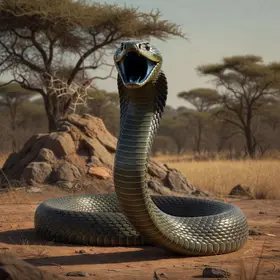
Dendroaspis polylepis
Black Mamba: How Dangerous Is Africa's Most Feared Snake?
The black mamba (Dendroaspis polylepis) is a long, fast, grey to olive-brown elapid of African savanna and woodland. It is Africa's longest venomous snake, and its neurotoxic bite is often fatal without antivenom, but it avoids people and bites far fewer of them than carpet vipers do.
- Habitat
- Light woodland, scrub, rocky outcrops and dry savanna; also moist savanna and lowland forest
- Size
- Usually 2 to 3 m; reports of 4.3 to 4.5 m
- Diet
- Rodents, squirrels, hyraxes and other small mammals, and birds
- Range
- Sub-Saharan Africa, from Eritrea, Ethiopia and Somalia through East Africa to Angola, Namibia and South Africa
- Breeding
- Lays 6 to 17 eggs; hatchlings are 40 to 60 cm long
- Status
- Least Concern (IUCN)
Habitat & range
The black mamba lives across much of sub-Saharan Africa, from Eritrea, Ethiopia and Somalia through Kenya, Tanzania and Zambia to Angola, Namibia, Botswana and South Africa (Reptile Database; Wikipedia). It prefers fairly dry country: light woodland, scrub, rocky outcrops and semi-arid savanna, and it also lives in moist savanna and lowland forest (Wikipedia). It shelters in termite mounds, old burrows, rock cracks and hollow trees, and may return to the same basking spot every day (Wikipedia). Black Mamba appears as a Reptilia creature card in Wilder, a free browser collectible card game.
Diet & hunting
The black mamba hunts by day, usually from a home lair it returns to again and again (Wikipedia). It eats mostly small warm-blooded animals such as rodents, squirrels, hyraxes and birds, and sometimes other snakes (Branch et al. 1995, via Wikipedia). It bites, lets go and waits for the venom to work before swallowing its prey whole (Wikipedia). The venom mixes two kinds of nerve toxins, alpha-neurotoxins and dendrotoxins, which researchers describe as a dual strategy for stopping prey fast (Laustsen et al. 2015).
Behavior & adaptations
Despite its name, the black mamba is not black. It is grey, olive, khaki or brown with a pale grey-white belly, and the name comes from the inky blue-black inside of its mouth (Wikipedia). It is long and slender with a coffin-shaped head, and it is the longest venomous snake in Africa and the second longest in the world after the king cobra (Wikipedia). It can move at up to about 16 km/h over short distances, though tales of it chasing people are exaggerated (Wikipedia). When cornered it rears up, gapes its black mouth, spreads a narrow neck flap and hisses (Wikipedia).
Bite & danger to people
Black mamba venom is mainly neurotoxic. Symptoms often start within 10 minutes, and untreated bites usually lead to paralysis, breathing failure and death (Wikipedia; Hodgson and Davidson 1996). A South African survey from 1957 to 1979 recorded 2,553 venomous snakebites, of which 75 were confirmed black mamba bites, and 21 of those patients died (Christensen 1981, via Wikipedia). Effective antivenom and breathing support save most patients today (Laustsen et al. 2015). It is shy and usually flees, so it bites far fewer people than carpet vipers. Nigeria is estimated to lose about 1,927 people a year to snakebite (Habib et al. 2015), many of them to carpet vipers like the West African carpet viper. In rural Zimbabwe, black and green mambas together caused 18% of 274 hospital snakebite cases, behind cobras and puff adders (Nhachi and Kasilo 1994).
Conservation
The black mamba is listed as Least Concern by the IUCN because of its huge range and no known decline (IUCN 2021).
Fun facts about Black Mamba
- The name mamba comes from the Zulu word imamba (Wikipedia).
- Dendroaspis means tree asp, and polylepis means many scales (Wikipedia).
- Young black mambas can grow to about 2 m in their first year (Wikipedia).
- Rival males wrestle by twisting their bodies together, which people once mistook for courtship (Wikipedia).
Black Mamba vs Honey Badger
The honey badger usually wins, thanks to its tough skin and venom-resistant body.
Honey badgers and black mambas share the savannas and woodlands of sub-Saharan Africa, and, like mongooses, the badger has some resistance to mamba venom (Wikipedia). It has thick, loose skin and muscle receptors that snake nerve toxins bind to poorly, so it can shrug off bites that would kill most mammals its size (Drabeck et al. 2015). The mamba is no pushover. It is fast, up to 3 m long and can bite again and again (Wikipedia; Laustsen et al. 2015).
Read more about Honey Badger.
Common questions about Black Mamba
Why is it called a black mamba if it is not black?
Because of its mouth, not its body. The black mamba is grey, olive, khaki or brown with a pale belly, and is rarely black. The name comes from the inky blue-black inside of its mouth, which it gapes open as a warning when cornered (Animal Diversity Web). The word mamba comes from the Zulu imamba.
How long do you have after a black mamba bite?
Minutes to hours, so get to hospital at once. Its venom attacks the nerves, and symptoms often start within 10 minutes. A person can collapse within 45 minutes, and without antivenom breathing failure and death usually follow, often within 7 to 15 hours (Wikipedia). Fast antivenom and breathing support are the treatment (Hodgson and Davidson 1996; Laustsen et al. 2015).
Is the black mamba the most dangerous snake in Africa?
It is the most feared, but not the biggest killer. Untreated bites are often fatal, but the shy black mamba bites fewer people than other snakes. In a South African survey of 2,553 snakebites, 75 were confirmed black mamba bites and 21 of those people died (Christensen 1981). Nigeria alone is estimated to lose about 1,927 people a year to snakebite (Habib et al. 2015), many of them to carpet vipers like the West African carpet viper.
How fast can a black mamba move?
Up to about 16 km/h, in short bursts. That makes it one of the fastest snakes, but its speed is often exaggerated, and it cannot go faster than about 20 km/h (Wikipedia). It uses that speed to escape: in the wild it rarely lets people come closer than about 40 m before it slips away into brush or a hole (Wikipedia).
What animals eat black mambas?
Mainly eagles, mongooses and honey badgers. Adult black mambas have few predators. Brown snake eagles kill mambas up to at least 2.7 m long, and mongooses and the honey badger will attack them too (Wikipedia). Honey badgers and mongooses have muscle receptors that snake nerve toxins bind to poorly, which helps them survive bites (Drabeck et al. 2015).
Featured in the Field Journal
More Reptilia animals
Reptilia · Grassland · Cost 4