Black Mamba: How Dangerous Is It to People, Really?
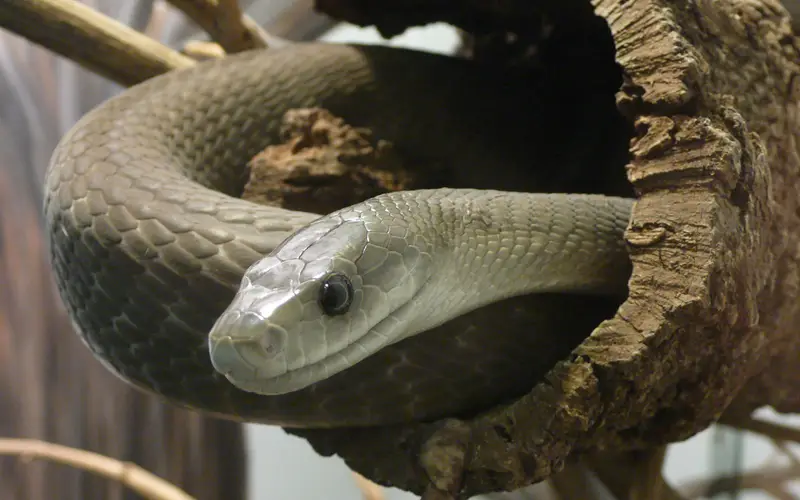
Its venom can stop a person breathing within hours, yet it is shy and bites fewer people than Africa's vipers. Antivenom and breathing support save most.
Play Black Mamba in Wilder, free in your browser
Species deep dive · black mamba Play this card
The black mamba is one of the most dangerous snakes in Africa if it bites you: its venom attacks the nerves, symptoms usually start within an hour, and without treatment a bitten person can stop breathing. The World Health Organization ranks it among the snakes of highest medical importance in sub-Saharan Africa (Erulu et al. 2018). But the black mamba is also shy, it bites far fewer people than Africa's vipers, and in published cases most people who got antivenom and breathing support survived (Aalten et al. 2021). Feared, yes. The biggest killer, no.
Why a bite is a medical emergency
Black mamba venom is a cocktail built to shut down nerves. When scientists first catalogued it, they found over 40 different proteins. Most of it is made of two groups: dendrotoxins, which are found only in mambas, and α-neurotoxins. The α-neurotoxins turned out to be the most lethal part (Laustsen et al. 2015). They block the signal from nerve to muscle, which causes the floppy paralysis that makes breathing hard and can kill (Erulu et al. 2018).
A 2021 review gathered 29 well-documented black mamba bites in people. Symptoms usually began within 60 minutes. The most common were breathing trouble, heavy sweating and paralysis (Aalten et al. 2021). Other reports describe drooping eyelids, drooling, a strange taste and tingling. Some victims stay awake but cannot speak, because the muscles of the throat and voice stop working (Erulu et al. 2018). There is often little swelling at the bite, so a serious bite can look harmless at first.
So why doesn't it kill more people?
Because it would rather leave. The Animal Diversity Web describes black mambas as shy and secretive. They usually turn aggressive only when cornered, often when someone blocks the way back to their refuge. A cornered mamba rears up, gapes its inky mouth, spreads a narrow hood and hisses before it strikes. If the intruder slowly moves away, the snake will usually retreat (Animal Diversity Web). The IUCN Red List assessment also describes it as a shy snake that prefers to avoid people (IUCN).
The trouble starts where homes and mambas overlap. Black mambas sometimes shelter in house roofs or farm pumphouses, so in rural areas encounters happen, and bites far from a hospital are often fatal (Animal Diversity Web).
Still, the snakes that bite the most people in Africa are vipers that sit still beside paths and fields, not a fast snake that flees. That is why the little West African carpet viper (read why it kills so many people) and the puff adder (why it bites so many people) rank above the black mamba when you rank snakes by danger to people rather than by venom alone. WHO estimates 435,000 to 580,000 snakebites a year in Africa that need treatment (WHO), and nobody counts them species by species across the continent.
Oddly, much of the recent medical writing on black mamba bites comes from Europe, where snake keepers have been bitten by captive mambas in Switzerland, Germany and the Czech Republic (Erulu et al. 2018).
What saves people
Two things: antivenom and help with breathing. In the 2021 review, 26 of the 29 patients received antivenom and 25 of the 29 survived (Aalten et al. 2021). Lab tests show that polyvalent antivenoms made in South Africa and India neutralise black mamba venom, though not equally well (Laustsen et al. 2015).
A case from Kenya shows how much breathing support matters. A 13-year-old boy bitten near Watamu arrived at a small eight-bed hospital barely breathing. Staff gave four vials of South African polyvalent antivenom and took turns squeezing a hand-held bag to breathe for him for hours. His heart stopped twice and was restarted. The next day he was breathing on his own with no lasting nerve damage, and he later volunteered at the local snake farm (Erulu et al. 2018).
It doesn't always end that way. In a South African case, a man was bitten by a single fang just after the snake's venom had been milked. He received antivenom in hospital and intensive care, stayed in a coma for three days and died. The pathologists noted how hard it can be to tell venom effects apart from a reaction to the antivenom itself (Blumenthal et al. 2019).
Not black, and not a villain
The black mamba is grey, olive or brown, not black, and adults usually reach 2.2 to 2.7 m (Animal Diversity Web). It lives across much of sub-Saharan Africa from Senegal to Eritrea and south to north-eastern South Africa (IUCN). It eats mostly small rodents, which helps keep pests in check (Animal Diversity Web).
On the Wilder card
In Wilder the Black Mamba is a Rare Reptilia card in the Grassland element. It costs 4 Energy, with Attack 4 and Health 3, and has three keywords: Venom, so combat damage it deals to another creature destroys it; Ambush, which lets it attack the turn it's played; and Basking, which gives it +1 Attack permanently at the end of your turn if it didn't attack (up to +2). A fast, deadly striker that is fragile when hit is a fair picture of a snake that would rather flee than fight. Its flavour text reads: "Grey, not black. The name comes from the inky mouth it flashes when it is cornered." The card page answers how fast it moves and what eats it. For a snake with even stronger venom by the numbers, play the Inland Taipan, and for Africa's biggest killers, the West African Carpet Viper and Puff Adder.
Wilder is a free browser collectible card game about real animals, and you can play it free in your browser with no signup.
Photo credit
Hero photograph: TimVickers, "Dendroaspis polylepis (9)" (a black mamba coiled in a hollow log, photographed in captivity), via Wikimedia Commons, public domain. Cropped for the Field Journal hero.

Play Black Mamba in Wilder, free in your browser
Questions people ask
Should you use a tourniquet on a black mamba bite?
No. Tight tourniquets, cutting the wound, sucking out venom, ice and snake stones are all advised against (Erulu et al. 2018). An arterial tourniquet risks gangrene, and if one has been put on, removing it fast in hospital can release a rush of venom that stops breathing, so doctors take it off slowly while giving antivenom (Pelle et al. 2021). Keep the person calm and still and get them to hospital.
Is a baby black mamba dangerous?
Yes. Black mambas hatch from eggs fully able to fend for themselves, with working venom glands, and are dangerous just minutes after hatching. A female lays about 6 to 17 eggs and leaves them, so the young never get any parental care (Animal Diversity Web).
Is the black mamba endangered?
No. The IUCN Red List lists it as Least Concern, because it has a very large range across sub-Saharan Africa and a stable population with no major threats reported. The assessment dates from 2014 and is marked as needing an update (IUCN Red List).
Are scientists making a better antivenom for mamba bites?
Yes, but it is still experimental. In 2025 researchers built a recombinant antivenom from eight nanobodies, tiny antibodies from an alpaca and a llama. In mice it prevented death from the venoms of 17 African elapid snakes, including mambas and cobras, and did better than a plasma-based antivenom in use today (Ahmadi et al. 2025). These were animal tests, not trials in people.
Sources
- Aalten et al. (2021), The clinical course and treatment of black mamba (Dendroaspis polylepis) envenomations: a narrative review, Clinical Toxicology
- Erulu et al. (2018), Revered but Poorly Understood: a case report of black mamba envenomation in Watamu, Kenya, and a review of the literature, Tropical Medicine and Infectious Disease
- Laustsen et al. (2015), Unveiling the nature of black mamba (Dendroaspis polylepis) venom through venomics and antivenom immunoprofiling, Journal of Proteomics
- Pelle, Engelbrecht & Lalloo (2021), Case report: safe tourniquet removal in black mamba bites, American Journal of Tropical Medicine and Hygiene
- Blumenthal, Scholtz & Shuttleworth (2019), Black mamba death: venom versus antivenom?, American Journal of Forensic Medicine and Pathology
- Ahmadi et al. (2025), Nanobody-based recombinant antivenom for cobra, mamba and rinkhals bites, Nature
- IUCN Red List: Dendroaspis polylepis (Branch et al. 2021)
- Animal Diversity Web (University of Michigan Museum of Zoology): Dendroaspis polylepis
- The Reptile Database: Dendroaspis polylepis
- World Health Organization: Snakebite envenoming fact sheet