Puff Adder: Why It Bites So Many People in Africa
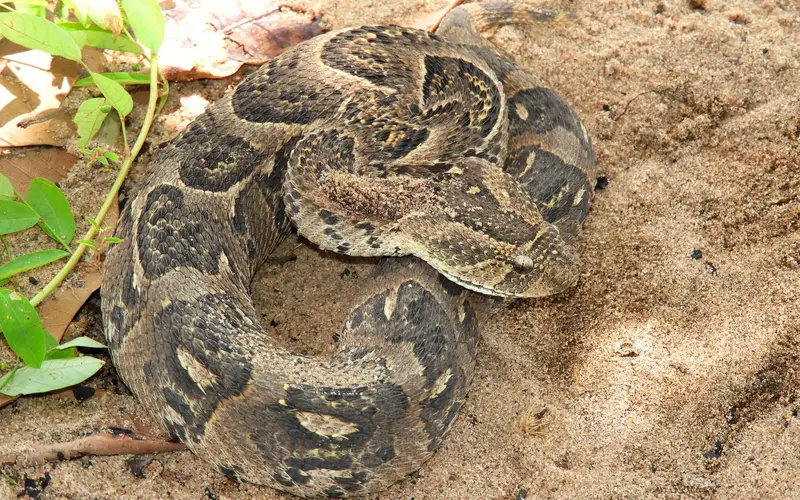
Puff adders don't chase anyone. They lie still for weeks beside paths, hidden from eyes and noses, and freeze instead of fleeing, so people step on them.
Play Puff Adder in Wilder, free in your browser
Species deep dive · puff adder Play this card
*Because it doesn't get out of the way. The puff adder (Bitis arietans) is an ambush hunter that can sit at the same spot for weeks, and when it hears footsteps it goes still and hisses instead of fleeing, as most snakes do (Smithsonian's National Zoo; Alexander 2025). It lives across most of sub-Saharan Africa and the south-west of the Arabian Peninsula, in savanna, grassland and farmland (IUCN Red List), so people walk right up to it. It is commonly stepped on by accident, which is why so many bites are to the feet and legs (Tianyi et al. 2025). The World Health Organization lists it among the snakes behind most of the world's bites, "causing many snakebites that result in permanent disability and death" (WHO).*
The puff adder is a short, heavy viper that rarely grows longer than about 1 metre, built for camouflage and ambush (Smithsonian's National Zoo). It is found from sea level up to 3,500 metres and is common throughout its core range (IUCN Red List).
A snake that barely moves
Wild puff adders travel less than 10 metres a day on average, usually move fewer than five times a month, and may wait in ambush at the same site for weeks (Alexander 2025). Researchers at Wits University radio-tracked 86 puff adders for three years in Dinokeng Game Reserve, north of Johannesburg, and filmed snakes in ambush for more than 4,600 hours (University of the Witwatersrand via ScienceDaily).
Sitting still has a cost: a puff adder's strike reaches only one or two head lengths, about 5 to 10 cm, so prey has to come very close. The videos showed how it closes the gap. Puff adders held out and wriggled their tongues for up to 30 seconds, apparently imitating a small invertebrate, but only when frogs or toads were nearby, and they also waved their tails as a lure (Glaudas and Alexander 2017; ScienceDaily). A snake that waits for prey to walk up to it is also a snake that waits while a person walks up to it.
Hidden from eyes and noses
A puff adder's patterned, earth-coloured body makes it hard to see in leaf litter and dry grass. It is hard to smell too. In a study in South Africa, trained dogs and meerkats correctly picked out five actively hunting snake species by scent but failed to pick out the puff adder, which the authors describe as the first demonstration of "chemical crypsis" used as a defence against predators (Miller et al. 2015). Camouflage that fools a meerkat's nose easily fools a person on a footpath at dusk.
What hospital records show
No one has an honest continent-wide death count for the puff adder, partly because the snake is rarely identified. In a Kenyan case series of 15 suspected puff adder bites, only two were objectively confirmed (Tianyi et al. 2025). But where hospitals have recorded the species, the puff adder keeps coming up:
- Zimbabwe, 1990-92. At Mpilo Central Hospital in Bulawayo, the puff adder was responsible for three quarters of 83 snakebites. Antivenom was out of stock at the time, and 4 of the 83 patients died (Muguti et al. 1994).
- Zimbabwe, eight hospitals. Of 273 snakebite admissions, the snake was recorded in only 40, and the puff adder was the species most often named. Over 60% of bites were to the feet (Tagwireyi et al. 2011).
- KwaZulu-Natal, South Africa. In 879 snakebite patients at Ngwelezane Hospital over five years, 98% of envenomed patients had painful progressive swelling from tissue-damaging venom. The puff adder and the Mozambique spitting cobra are the two snakes most often responsible for serious bites in the province (Wood et al. 2016).
- Kenya. In Baringo and Kitui counties, 11 of 15 puff adder bites were to the legs or feet, and herding was the most common job among patients (Tianyi et al. 2025).
What the venom does
Puff adder venom mostly attacks tissue and blood. In a review of 37 published cases, every patient had swelling and 95% had pain, and in the Kenyan series 60% had bleeding on admission (Tianyi et al. 2025). The lasting harm is often to the limb rather than the whole body. In a 2026 study of 20 patients bitten by puff adders or zebra spitting cobras in Namibia, puff adder bites showed little whole-body involvement, but 15% of all patients needed amputations and no one died (Ndongi et al. 2026). WHO notes that this kind of severe local tissue destruction can cause permanent disability and limb loss (WHO fact sheet).
How people avoid stepping on one
The advice for any ambush viper applies. Wear proper shoes or boots and long trousers instead of going barefoot or in sandals, especially in the dark or in undergrowth; use a torch at night; and step onto logs or rocks rather than straight over them, where a snake may be lying on the far side (WHO South-East Asia 2016). A puff adder gives one warning: a loud, sighing hiss (Smithsonian's National Zoo). Anyone bitten should get to a hospital with antivenom as fast as possible.
On the Wilder card
In Wilder the Puff Adder is an Uncommon Reptilia card in the Grassland element. It costs 4 Energy, with Attack 3 and Health 4, and carries three keywords that read like its field notes: Camouflage, so enemy Actions, Signatures and abilities can't target it until it attacks; Basking, which gives it +1 Attack permanently at the end of your turn if it didn't attack (up to +2), a sit-and-wait hunter getting more dangerous the longer it waits; and Venom, so combat damage it deals to another creature destroys it. Its flavour text reads: "It does not chase anyone. It lies still by the path and waits to be stepped on." For Africa's other big bite-causer, play the West African Carpet Viper, and for Asia's counterpart, read why the Russell's viper bites so many people in India.
Wilder is a free browser collectible card game about real animals, and you can play it free in your browser with no signup.
Photo credit
Hero photograph: Marius Burger, "Bitis arietans 95756225" (a puff adder coiled in sand in Mozambique), via Wikimedia Commons from iNaturalist, CC0 1.0 (public domain dedication). Cropped for the Field Journal hero.

Play Puff Adder in Wilder, free in your browser
Questions people ask
When do most puff adder bites happen?
Mostly at night and in the rainy season. In a study of 83 snakebite patients at Mpilo Central Hospital in Zimbabwe, where the puff adder caused three quarters of bites, 61% of bites happened at night and most fell in the rainy season, November to April (Muguti et al. 1994). That is southern Africa's summer, when snakes are most active.
Are puff adder bites worse in children?
Often, yes. At Ngwelezane Hospital in KwaZulu-Natal, where the puff adder is one of the two main causes of serious bites, 74% of children under 12 who came in with a snakebite were envenomed, against 57% of older patients. Being a child was one of the predictors of a severe bite (Wood et al. 2016).
Are bites from pet puff adders different from wild ones?
Yes, they tend to be on the hands. In a review of 37 published puff adder bites, 77% were to the hands or fingers, mostly snake keepers outside Africa, while wild bites in Africa are mainly to the legs. Amputations were more common after bites by captive snakes (Tianyi et al. 2025).
How big do puff adders get?
Usually under about 1 metre, but very thick. The Smithsonian's National Zoo describes puff adders as relatively short, heavy snakes that rarely grow longer than about 1 m (3 feet), with a broad head and a body built for camouflage and ambush (Smithsonian's National Zoo).
Is the puff adder endangered?
No. The IUCN lists the puff adder as Least Concern with a stable population, because it is widespread and faces no range-wide threats (assessed 2014, published 2021, flagged as needing an update). It is very rare in Morocco, though, and probably gone from the Essaouira region (IUCN Red List).
Sources
- Smithsonian's National Zoo and Conservation Biology Institute: Puff adder
- IUCN Red List: Bitis arietans (Wagner et al. 2021, assessed 2014)
- World Health Organization: Snakes gallery (snakebite envenoming)
- World Health Organization: Snakebite envenoming fact sheet
- Alexander GJ (2025). Factorial scope of ingestion and the potential functional response of puff adders (Bitis arietans) to high prey abundance. Scientific Reports
- Glaudas X, Alexander GJ (2017). A lure at both ends: aggressive visual mimicry signals and prey-specific luring behaviour in an ambush-foraging snake. Behavioral Ecology and Sociobiology 71: 2
- University of the Witwatersrand (2017). A lure at both ends: puff adders leave nothing to chance (via ScienceDaily)
- Miller AK, Maritz B, McKay S, Glaudas X, Alexander GJ (2015). An ambusher's arsenal: chemical crypsis in the puff adder (Bitis arietans). Proc R Soc B 282: 20152182
- Tianyi FL, Ngari C, Wilkinson M, et al. (2025). Clinical features of puff adder envenoming: case series of Bitis arietans snakebites in Kenya and a scoping review of the literature. PLoS Negl Trop Dis 19(2): e0012845
- Muguti GI, Maramba A, Washaya CT (1994). Snake bites in Zimbabwe: a clinical study with emphasis on the need for antivenom. Central African Journal of Medicine
- Tagwireyi D, Nhachi CF, Ball DE (2011). Snakebite admissions in Zimbabwe: pattern, clinical presentation and management. Central African Journal of Medicine
- Wood D, Sartorius B, Hift R (2016). Snakebite in north-eastern South Africa: clinical characteristics and risks for severity. South African Family Practice 58(2): 62-67
- Ndongi K, Nepolo E, Hunter CJ (2026). Clinicopathological features, management, and outcomes of zebra spitting cobra and puff adder snakebites in Namibia. BioMed Research International
- World Health Organization, Regional Office for South-East Asia (2016). Guidelines for the Management of Snakebites, 2nd edition
- The Reptile Database: Bitis arietans