Kulan: Why Kazakhstan's Returning Wild Asses Roam So Far
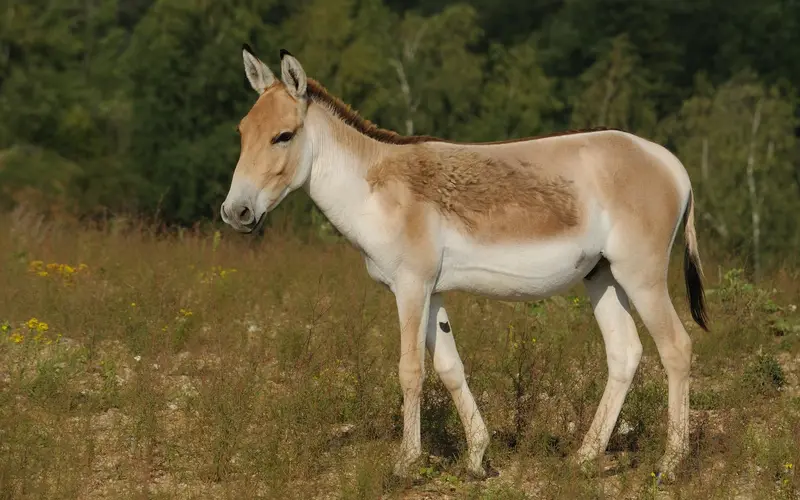
Kulans released on Kazakhstan's open steppe split up and roamed ranges 10 to 100 times larger than at home. How that shaped the 2026 release of 20 more.
Play Kulan in Wilder, free in your browser
Species deep dive · kulan Play this card
*Because nothing on the open steppe holds them in, and kulan herds are loose by nature. When nine wild kulans (Equus hemionus kulan) were flown to the Torgai steppe of central Kazakhstan in 2017, the four that wore GPS collars ended up using ranges of 48,680 to 136,953 km² each, 10 to 100 times bigger than kulans in their source populations, and travelled 36 to 51 km a day. The little group split up within months and its mares never met again (Kaczensky et al. 2021). That lesson shaped what came next: bigger groups, longer settling-in periods, and in August 2026 the release of 20 more kulans into the Altyn Dala reserve, nine of them with satellite collars (ACBK 2026).*
The kulan is a wild ass, the Central Asian subspecies of the Asiatic wild ass. The IUCN lists it as Endangered, with 2,400 to 2,800 mature animals and a rising trend, in just three locations: native in Turkmenistan and reintroduced in Kazakhstan and Uzbekistan. It describes the kulan as nomadic (IUCN Red List 2025).
Gone from Kazakhstan by the 1930s
Kulans were once a key grazer of the Eurasian steppes and deserts, alongside saiga antelope, gazelles and Przewalski's horses. Overhunting and habitat conversion cut the Asiatic wild ass to less than 3% of its historic range, and in Kazakhstan the kulan went extinct in the 1930s. Reintroductions began in the early 1950s and re-established kulans in two protected areas, Barsa-Kelmes in the south-west and Altyn-Emel in the south-east, but that is less than 1% of their former range in the country (Kaczensky et al. 2021).
Altyn-Emel became the success story. It started with 32 kulans in 1982, and by 2026 the national park counted 3,571, about 111 times as many (Tinfo.kz, October 2026). The empty space was further north, in the vast grasslands of central Kazakhstan.
The 2017 airlift and the great scattering
In October 2017, nine kulans (four mares, four foals and a young stallion) were caught in Altyn-Emel and airlifted by helicopter more than 1,300 km to a 55-hectare enclosure at Alibi, an abandoned village in the Torgai region. They spent five months there over the winter and were released in early April 2018. Two more came by truck from Barsa-Kelmes in 2019 (Kaczensky et al. 2021).
Inside the enclosure the nine stayed together as a tight group. Outside, they did at first too, making two exploration trips about 140 km south-east and coming back both times. Then the group began to break up in mid-May, and by mid-August every kulan was travelling alone. After the split, they rarely came within 10 km of each other again. There was no sign of foals, two of the four collared mares were killed by poachers, and one died of natural causes. At least one stallion survived in the wild (Kaczensky et al. 2021).
Why they wander so far
The researchers' best explanation lies in kulan society. Kulans live in fission-fusion groups that join and split again, with little coordination of movement between individuals, and the species needs to make migratory movements. Released into a strange landscape with no other kulans, animals like that can lose contact with each other, and the risk is greatest on open steppe, where there are no rivers, mountains or fences to channel movement (Kaczensky et al. 2021).
Their advice was to release larger groups and build up a free-ranging population quickly, so that kulans keep meeting other kulans, breed and survive (Kaczensky et al. 2021).
Trying again, with more kulans
The next moves went by road. In October 2024, 24 kulans were trucked more than 2,193 km from Altyn-Emel to the Alibi reintroduction centre, one of the longest overland wildlife transports on record. Nine died during the harsh winter that followed. The Frankfurt Zoological Society said the lesson was to manage the enclosure stay more like a zoo: a smaller area at first, intensive feeding and individual veterinary care (FZS 2025).
In September 2025 another group made the 2,136 km trip in containers, 45 hours on the road, and spent 11 months in a 56-hectare enclosure. One mare gave birth to a foal in May 2026. In August 2026, 20 kulans were released into the Altyn Dala reserve, nine of them wearing satellite collars (ACBK 2026). This time the early signs are different. The Association for the Conservation of Biodiversity of Kazakhstan (ACBK) says monitoring shows separate groups using the same areas and possibly merging into larger herds, and calls these kulans "pioneers of a future population". About 100 more are planned for the reserve in the coming years (Qostanai.Media, November 2026).
Altyn-Emel is sending kulans elsewhere too. Its director told 24KZ in October 2026 that 130 have gone to the Ile-Balkhash reserve, with 30 to 35 more to follow each year, partly because the dry park may soon run short of grazing (24KZ, October 2026).
Why the steppe needs big grazers
Large herbivores keep steppe ecosystems working, but they need huge areas for their seasonal movements (Kaczensky et al. 2021). The kulans at Alibi are no longer alone: Przewalski's horses from the Prague and Berlin zoos have been arriving since 2024, and the first foal was born there on 22 August 2026 (Qostanai.Media, November 2026). For that horse's own comeback, read how many Przewalski's horses are left.
On the Wilder card
In Wilder the Kulan is a Rare Mammalia card in the Desert element. It costs 3 Energy, with Attack 4 and Health 3, and has Herd and Resilient, a fair fit for an animal that lives in loose groups and came back from a few hundred survivors. Its flavour text reads: "About 200 left in the 1940s. Now they run the Kazakh steppe again." It pairs naturally with the Przewalski's Horse, its new neighbour at Alibi, and the African Wild Ass, the wild ancestor of the donkey.
Wilder is a free browser collectible card game about real animals, and you can play it free in your browser with no signup.
Photo credit
Hero photograph: Michael Oppermann, "Kulan" (a kulan in the Weilbacher Kiesgruben nature reserve, Germany), via Wikimedia Commons, CC BY-SA 3.0. Cropped for the Field Journal hero.

Play Kulan in Wilder, free in your browser
Questions people ask
How fast can a kulan run?
Up to about 70 km/h. Asiatic wild asses, the species the kulan belongs to, have been clocked at speeds of up to 70 km/h (43 mph) (Animal Diversity Web). That speed suits an animal of open plains, where running is the main defence.
What do kulans eat?
Mostly grass. Asiatic wild asses are strictly herbivorous and feed mainly on perennial grasses such as feather grasses (Stipa) and wheatgrasses (Agropyron), along with herbs and some bark (Animal Diversity Web).
How long is a kulan pregnant?
About 11 to 12 months, for a single foal. Asiatic wild asses breed between April and October, give birth to one foal, and wean it at 12 to 24 months. Females first breed at 3 to 4 years old (Animal Diversity Web).
How long do kulans live?
Most wild ones live only 4 to 8 years. The oldest Asiatic wild ass found in the wild was 12 to 14 years old, while one in captivity lived to 26 (Animal Diversity Web). The IUCN puts the kulan's generation length at 7.5 years (IUCN Red List).
Where can you see wild kulans?
Altyn-Emel National Park in south-east Kazakhstan is the best-known place. It holds the country's largest herd, and its 2026 festival, "Altyn-Emel, land of the kulans", took visitors to watch them in the wild (Tinfo.kz). Turkmenistan is the only country where kulans survive as a native population; Uzbekistan also has reintroduced kulans (IUCN Red List).
Sources
- Kaczensky P, et al. (2021). Post-release movement behaviour and survival of kulan reintroduced to the steppes and deserts of central Kazakhstan. Frontiers in Conservation Science 2: 703358
- IUCN Red List: Equus hemionus ssp. kulan (Kaczensky, King, Bykova and Marmazinskaya 2025, assessed 2024)
- ACBK (21 August 2026). A new group of kulans released in the Altyn Dala reserve (in Russian)
- Frankfurt Zoological Society (2025). Hope for Kulan: learning and moving forward
- Qostanai.Media (November 2026). Kulans and Przewalski's horses are being restored in Kostanay region (in Russian)
- Tinfo.kz (21 October 2026). Altyn-Emel national park reaches a 111-fold growth in kulans (in Russian)
- 24KZ (20 October 2026). Kulans from Altyn-Emel are being moved to other reserves (in Russian)
- Animal Diversity Web: Equus hemionus