
Puff Adder
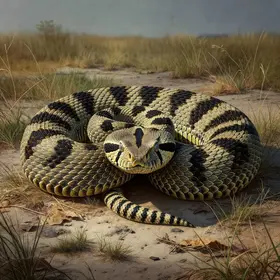
Bitis arietans
Puff Adder: Africa's Most Common Dangerous Snake
The puff adder (Bitis arietans) is a thick, heavy viper found across most of Africa and parts of Arabia. It hunts by lying still and waiting, trusting its camouflage instead of fleeing, so people often step on it. Its venom destroys tissue, and it is widely described as causing more snakebite deaths than any other African snake.
- Habitat
- Savanna, grassland and rocky ground; absent from true desert and rainforest
- Size
- Usually about 1 m long and very stout; up to 1.9 m and over 6 kg
- Diet
- Rodents, birds, frogs, lizards and other snakes
- Range
- Most of sub-Saharan Africa, Morocco and south-west Arabia
- Breeding
- Live young; litters of 50 to 60 are common, record 156
- Status
- Least Concern (IUCN 2021)
Habitat & range
The puff adder may be the most common and widespread snake in Africa (Wikipedia). It lives in most of the continent south of the Sahara, in Morocco and on parts of the Arabian Peninsula, in every habitat except true desert, rainforest and high mountains, and is most often found in rocky grassland (Wikipedia). It is straw-yellow, brown or grey with a row of dark, backward-pointing chevrons along its back. Puff Adder appears as a Reptilia creature card in Wilder, a free browser collectible card game.
Diet & hunting
The puff adder is a sit-and-wait ambush predator. It is mostly active at night and rarely searches for food, waiting instead for rodents, birds, frogs, lizards and other snakes to pass by (Wikipedia). It strikes fast and lets go at once, and its long fangs go in so deep that small prey can be killed by the strike alone (Wikipedia).
Behavior & adaptations
Instead of fleeing, a puff adder relies on camouflage and usually stays put. If disturbed it hisses loudly and continuously, which gives it its name, and pulls into a tight S-shaped coil ready to strike (Wikipedia). It is hard to smell as well as hard to see: trained dogs and meerkats picked out other snakes by scent but failed to find puff adders (Miller et al. 2015). Females give birth to live young, often 50 to 60 at a time, and a female in a Czech zoo had 156, the largest litter known for any snake (Wikipedia).
Bite & danger to people
The WHO says the puff adder causes many snakebites across sub-Saharan Africa and Arabia that end in permanent disability or death (WHO). It is often said to cause more snakebite deaths than any other African snake, because it is common, widespread and lives near people, has long fangs and large venom yields, and basks by footpaths and stays still when approached (Wikipedia). There is no reliable death count for the species. The venom destroys tissue, causing severe pain, swelling, blistering and necrosis that can cost fingers or limbs (Wikipedia). In the Nigerian savanna, the carpet viper is the bigger killer (Habib 2013).
Conservation
The IUCN lists the puff adder as Least Concern because it is widespread and faces no major threats across its range (IUCN 2021). People kill puff adders whenever they find them, and in parts of Arabia they are over-collected for venom (IUCN 2021).
Fun facts about Puff Adder
- The name arietans comes from Latin and means striking violently (Wikipedia).
- Puff adders are good swimmers and climbers; one was found 4.6 m up a tree (Wikipedia).
- Juveniles can launch their entire bodies forward when they strike (Wikipedia).
- Males wrestle each other with their necks in combat dances, and one female in Kenya was followed by seven males (Wikipedia).
Puff Adder vs Honey Badger
The honey badger wins; in the Kalahari, puff adders are regular badger food.
This fight really happens. In a study of honey badgers in the Kalahari, they ate 21 puff adders, which made up about 12% of all the prey weight the badgers ate (Begg et al. 2003). The badgers ate whole snakes, heads and all. The puff adder has long fangs and tissue-destroying venom, and its camouflage and lack of scent hide it from many hunters (Miller et al. 2015). Even so, the badgers in that study found, caught and ate them regularly.
Read more about Honey Badger.
Common questions about Puff Adder
Is the puff adder the deadliest snake in Africa?
It is often called that, but no one has an exact count. The puff adder is widely said to cause more snakebite deaths than any other African snake, since it is common and lives near people (Wikipedia). The WHO says many of its bites end in permanent disability or death (WHO). In the Nigerian savanna, the West African carpet viper kills more people (Habib 2013).
Why do people step on puff adders?
Because puff adders stay still instead of moving away. They rely on camouflage and often bask beside footpaths, so walkers come very close before seeing them (Wikipedia). They are hard to smell too: trained dogs and meerkats found other snakes by scent but failed to find puff adders (Miller et al. 2015).
What does a puff adder bite do to a person?
It destroys tissue around the bite. Puff adder venom causes severe pain, rapid swelling, blood blisters and bruising, and untreated necrosis can lead to the loss of fingers or limbs (Wikipedia). Deaths usually come days later from complications, and most are linked to poor or late treatment, so anyone bitten needs hospital care at once (Wikipedia).
Why is it called a puff adder?
Because of the loud hiss it makes when disturbed. A threatened puff adder hisses loudly and continuously while pulling into a tight S-shaped coil, ready to strike forward or to the side (Wikipedia). The species name arietans means striking violently.
How many babies does a puff adder have?
Often 50 to 60, and sometimes far more. Puff adders give birth to live young, and litters of over 80 have been reported. A female from Kenya in a Czech zoo gave birth to 156 young, the largest litter known for any snake (Wikipedia).
More Reptilia animals
- Russell's Viper
- Saltwater Crocodile
- Spectacled Cobra
- Thorny Devil
- West African Carpet Viper
- Western Banded Gecko
Reptilia · Grassland · Cost 4