Humpback Whale: Why Do Humpbacks Breach?
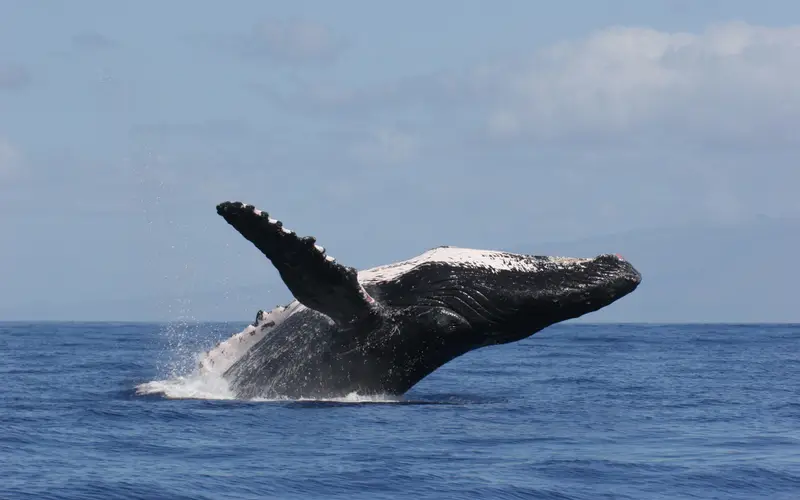
Breaching looks like play, but research points to a long-distance signal. One full leap can cost a big humpback the energy a runner burns in a marathon.
Play Humpback Whale in Wilder, free in your browser
Species deep dive · humpback whale Play this card
Humpback whales most likely breach to communicate. The best evidence is that a breach works as a long-distance signal: the huge splash and boom carry farther than a slap or a call in noisy seas. Migrating humpbacks off Australia were much less likely to breach when another group was within 4 km, and more likely to when the nearest whales were farther away (Kavanagh et al. 2017). Breaching is also very expensive, which suggests it matters to the whales. Play and shaking off parasites are other possible reasons.
This month a clip of two humpbacks breaching side by side drew millions of views online (Outdoors.com). Here is what science knows about why they do it.
A splash that says "we're over here"
Ailbhe Kavanagh and colleagues at the University of Queensland watched 94 groups of humpbacks migrating past the coast of eastern Australia while recording the sea with underwater microphones (Kavanagh et al. 2017). They wrote down every breach, fin slap and tail slap, along with what else was going on around each group. The pattern for breaching was clear: the chance of a breach dropped significantly when the nearest other group was within 4,000 m.
The whales were also more likely to leap and splash when it was windy (Hakai Magazine). That fits the idea of a signal. When wind and waves drown out calls, a whale weighing tens of tonnes crashing into the sea is hard to miss. Earlier studies found the same thing: humpbacks breach more in noisy conditions, and leaping and splashing increase when groups join up or split (Segre et al. 2020). Kavanagh compared it to drumming: the whales use their bodies as mallets to beat the water (Hakai Magazine).
How much does a breach cost?
A lot. In 2020 a team led by Paolo Segre attached tags with motion sensors and cameras to whales and recorded 187 breaches, 152 of them by 28 humpbacks (Segre et al. 2020). The tags show how a breach works. The whale dives, turns and powers upward, holding its long flippers out for steering and stability. Humpbacks left the water at anything from 1.1 to 8.9 m per second. The fastest is about 32 km/h, close to the top speed these animals can reach.
The researchers then worked out the energy. A single full breach cost a 7.8 m humpback about 0.9 megajoules. For a 14.8 m adult the cost rose to 10.3 MJ, about what a 60 kg person burns running a marathon. One 14.7 m, 46-tonne whale put out an average of 300 kilowatts of mechanical power during its 8.5-second breach, roughly the pulling power of 25 draft horses (Segre et al. 2020).
That price is part of the message. A whale that breaches again and again is showing it is fit and well fed, so repeated breaching may be an "honest signal" of body condition to rivals and mates (Segre et al. 2020). The cost is even more striking on the breeding grounds. There mothers are fasting and nursing, yet mothers and calves are often seen breaching side by side. Energy spent there can't be refilled until they get back to their feeding grounds months later (Segre et al. 2020).
Play and parasites
Communication is not the only idea. Young whales breach often, which hints at play. Dolphins seem to leap partly to shake off skin parasites, and that could apply to whales too (Segre et al. 2020). Scientists treat these as possible reasons alongside communication, not instead of it. What the tags did show is that the most powerful breaches come close to the limits of what vertebrate muscle can do (Segre et al. 2020).
Humpbacks pay for all this from their blubber. They spend the warmer months feeding and building up fat stores (NOAA Fisheries), and breeding females fast while they nurse their calves (Segre et al. 2020). For what happened when that food ran short, read Humpback Whale: Where Did the Calves Go?.
On the Wilder card
In Wilder the Humpback Whale is a Rare Mammalia card in the Water element. It costs 6 Energy, with Attack 4 and Health 9, and has two keywords: Guardian, so enemies must attack it before your other creatures or your Den, and Herd, a strength-in-numbers keyword for animals that live in groups. A huge, tough body that shields its friends fits a whale known for swimming in to break up orca attacks. Its flavour text reads: "Its flippers are a third as long as its body, and orcas learn to respect them." The card page explains why humpbacks sing and why they protect other animals from orcas. Pair it with the Blue Whale, the largest animal ever, or face it against the Orca.
Wilder is a free browser collectible card game about real animals, and you can play it free in your browser with no signup.
Photo credit
Hero photograph: Hawaiian Islands Humpback Whale National Marine Sanctuary (HIHWNMS/NOAA, under NOAA permit #14097), "HIHWNMS - Humpback Whale Breach" (a humpback whale breaching in the sanctuary, Hawaiʻi), via Wikimedia Commons, public domain (work of the US government). Cropped for the Field Journal hero.

Play Humpback Whale in Wilder, free in your browser
Questions people ask
How close can you get to a breaching humpback whale?
Stay at least 91 m (100 yards) away. NOAA Fisheries asks everyone to watch large whales from at least 91 m (100 yards) by sea or land. In Hawaiʻi and Alaska it is illegal to approach a humpback within 91 m (100 yards) (NOAA Fisheries). Boats can be badly damaged in a collision with a whale, and passengers can be hurt.
Why don't blue whales breach like humpbacks?
They are probably too big. In 156 tag deployments on blue whales, researchers recorded no breaches, and 59 tag deployments on fin whales produced only one. To leap as high as a humpback, a large blue whale would have to swim at about 10.9 m per second and spend about four times the energy. It isn't clear a blue whale can even swim that fast (Segre et al. 2020). Read more about the blue whale.
Why do humpback whales slap their fins and tails on the water?
Mostly to communicate at close range. In a study of 94 migrating groups off eastern Australia, fin, tail and tail-stock slapping were linked to groups joining or splitting. Breaching, by contrast, seemed aimed at whales farther away (Kavanagh et al. 2017).
How far do humpback whales migrate?
Up to about 8,000 km (5,000 miles) each way. Humpbacks have one of the longest migrations of any mammal. Some travel between cold feeding grounds and tropical breeding and calving waters, and North Pacific whales can swim from Alaska to Hawaiʻi, about 4,800 km (3,000 miles) (NOAA Fisheries).
How big is a humpback whale?
Up to about 18 m (60 ft) long and about 36 tonnes (40 tons). NOAA Fisheries gives those maximums, and a lifespan of about 80 to 90 years (NOAA Fisheries).
Sources
- Kavanagh et al. (2017), Evidence for the functions of surface-active behaviors in humpback whales (Megaptera novaeangliae), Marine Mammal Science
- Segre et al. (2020), Energetic and physical limitations on the breaching performance of large whales, eLife
- NOAA Fisheries: Humpback whale species profile
- Hakai Magazine (2017), Why whales leap into the air