Spectacled Cobra: How Dangerous Is the Indian Cobra?
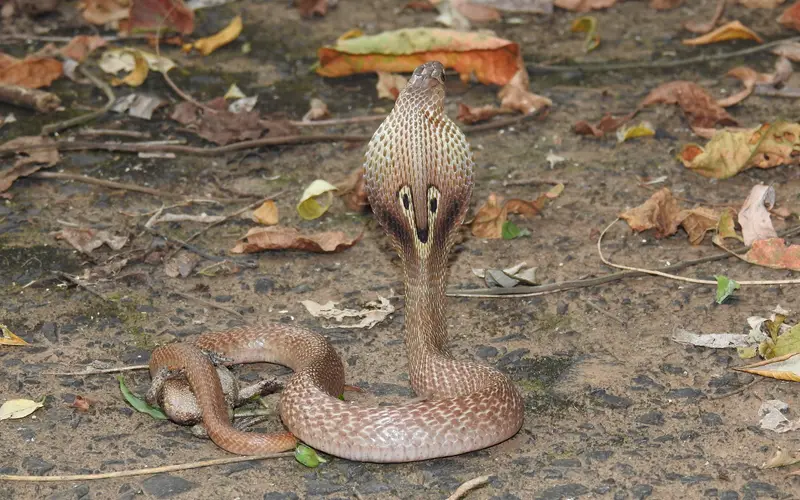
Its bite can stop breathing and kill flesh, and antivenom works unevenly across India. Yet cobras are only fourth among snakes identified in Indian bites.
Play Spectacled Cobra in Wilder, free in your browser
Species deep dive · spectacled cobra Play this card
*Very dangerous, but it is not India's top killer. A spectacled cobra (Naja naja) bite can paralyse the muscles used for breathing and destroy the flesh around the bite. In the first series of proven cobra bites from Sri Lanka, 2 of 25 patients died, 4 needed a ventilator and 8 had severe tissue death (Kularatne et al. 2009). Across Indian studies that identified the snake, though, cobras caused 12% of cases, behind the Russell's viper at 43% and kraits as a group (Bungarus species, not the common krait alone) at 18% (Suraweera et al. 2020). And its venom changes so much from region to region that Indian antivenom works well against some cobras and poorly against others (Senji Laxme et al. 2021).*
The spectacled or Indian cobra lives across Pakistan, India, Nepal, Bhutan, Bangladesh and Sri Lanka, from about 100 to 2,000 metres above sea level. The IUCN lists it as Least Concern because it is common, widespread and adaptable (IUCN Red List). That adaptability is exactly what puts it in contact with people.
Why it keeps meeting people
The cobra lives in forest, grassland and dry scrub, but also in rice paddies, other farmland and around houses. It is active by day, though often seen in the late evening, and it shelters in granaries, old termite mounds, earth dams and rock piles (IUCN Red List). It hunts rats, and rats live where people store grain.
The hospital record matches that picture. In the Sri Lankan series of 25 proven bites, 88% happened in daytime and 52% in the victim's own home compound, and 40% were on the arm or hand (Kularatne et al. 2009). That is a different pattern from the common krait, which bites people asleep at night, or the Russell's viper, which is usually stepped on in the fields.
What a cobra bite does
Cobra venom is dominated by three-finger toxins, small proteins that can block nerve signals, kill cells or affect the heart (Senji Laxme et al. 2021). Bites can show both effects. Among the 25 Sri Lankan patients:
- 5 (20%) were dry bites, with no venom injected.
- 20 (80%) had local reactions at the bite.
- 9 (36%) showed signs of paralysis, and 4 (16%) stopped breathing properly and needed a ventilator, a median of 2 hours after the bite.
- 8 (32%) had severe local necrosis (tissue death). Five needed the dead tissue removed and skin grafts.
- 2 died, both from rapidly spreading necrosis of the arm, not from paralysis.
The authors highlighted the scale of local necrosis, breathing paralysis and antivenom failure in these bites (Kularatne et al. 2009). Almost half the patients (48%) had also tied a tourniquet. WHO guidance warns that tight tourniquets can themselves add to tissue death in a bitten limb (WHO South-East Asia 2016).
One species, many venoms
India's antivenom is made against four snakes, the "Big Four": the spectacled cobra, the common krait, the Russell's viper and the saw-scaled viper. India has four cobra species, and the antivenom covers only this one (Suraweera et al. 2020). It turns out that even "this one" is not a single target.
In 2021, researchers compared venom from spectacled cobras in seven populations across six of India's biogeographic zones, more than 6,000 km apart. Neurotoxic three-finger toxins made up 80% of the venom of cobras from semi-arid Punjab and 73% of the venom from West Bengal, but only about 30% in cobras from the Rajasthan desert. The desert cobras instead had 2 to 4 times more of the cell-killing kind (41.7% of the venom). In laboratory and mouse tests, commercial antivenom did not neutralise the venoms effectively, and it completely failed to neutralise the desert population (Senji Laxme et al. 2021).
The problem crosses borders. A 2026 study of 17 spectacled cobras from Bangladesh found that venom varied between populations separated by rivers or different habitats, and that a polyvalent antivenom raised against India's Big Four, including southern Indian cobras, showed poor efficacy against the Bangladeshi cobra venoms (Chowdhury et al. 2026). Both teams call for antivenoms made from venom collected across the whole range.
Why it ranks fourth, not first
India is the world's snakebite hotspot (Senji Laxme et al. 2021), with an estimated 1.2 million snakebite deaths from 2000 to 2019, an average of about 58,000 a year. But most bites are never identified to species. In the published Indian studies that did try, Russell's viper made up 43% of cases, unknown snakes 21%, kraits as a group (Bungarus species, not the common krait alone) at 18% and cobras 12% (Suraweera et al. 2020). That 12% covers all cobras, not just this species, and it is a share of identified bites, not of deaths. Nobody has an honest species-by-species death count, so we won't invent one.
The cobra's ranking also says nothing about the strength of a single bite. It is fourth because the Russell's viper and the kraits turn up more often in the case records, not because a cobra bite is mild. Globally, WHO estimates that snakes kill 81,410 to 137,880 people a year and leave about three times as many with amputations or other permanent disabilities (WHO fact sheet).
How people avoid cobra bites
WHO's prevention advice fits a snake that follows rats into homes: don't keep livestock indoors or leave food unprotected, because both attract rodents; store food in rodent-proof containers; clear rubbish and undergrowth from around the house; and use a light at night and wear solid shoes or boots, especially for farm work. It also warns people to keep away from snakes, including those shown by snake charmers, who are often bitten. If someone is bitten, WHO advises against cutting, rubbing or putting herbs on the wound and recommends getting to hospital quickly (WHO South-East Asia 2016).
On the Wilder card
In Wilder the Spectacled Cobra is an Uncommon Reptilia card in the Grassland element. It costs 3 Energy, with Attack 3 and Health 3, and has two keywords: Venom, so combat damage it deals to another creature destroys it, and Basking, which gives it +1 Attack permanently at the end of your turn if it didn't attack (up to +2), so it gets more dangerous the longer it stays put. Its flavour text reads: "It spreads its hood to show the spectacles. Most of its bites happen in daylight, close to home." For a much bigger cobra that eats other snakes, play the King Cobra, and for India's top biter, the Russell's Viper.
Wilder is a free browser collectible card game about real animals, and you can play it free in your browser with no signup.
Photo credit
Hero photograph: Dr. Raju Kasambe, "Indian Cobra Naja naja by Dr Raju Kasambe DSCN4991 (2)" (a spectacled cobra with its hood spread, Mumbai, Maharashtra), via Wikimedia Commons, CC BY-SA 4.0. Cropped for the Field Journal hero.

Play Spectacled Cobra in Wilder, free in your browser
Questions people ask
How many eggs does a spectacled cobra lay?
Usually 12 to 50. Females lay them underground in burrows between April and July, and the eggs hatch 48 to 69 days later. The young disperse one or two weeks after hatching, and females can lay more than once a year (IUCN Red List).
Is the spectacled cobra protected in India?
Yes. It is protected under India's Wildlife (Protection) Act, 1972, and all cobras of the genus Naja are listed under CITES. India has controlled the export of cobra skins since 1973. Even so, the IUCN reports continuing skin trade, illegal collection for venom and use by snake charmers (IUCN Red List).
How long do spectacled cobras live?
More than 20 years in captivity. Animal Diversity Web gives a recorded captive lifespan of 23.9 years for a female, citing the Max Planck Institute for Demographic Research. Lifespan in the wild is not well documented (Animal Diversity Web).
Do spectacled cobras eat other snakes?
Sometimes. The IUCN lists rodents, lizards, other snakes, frogs, small birds and birds' eggs in its diet. Rodents are the main reason it lives so close to people, and the IUCN calls it an important pest controller on farmland (IUCN Red List). The king cobra is the true snake specialist.
Is spectacled cobra venom used in medicine?
Yes, in two ways. Venom from captive cobras is used to make antivenom, and the IUCN notes that the venom is also used medicinally for its anticoagulant properties (IUCN Red List). WHO warns that the venoms antivenom makers use may not reflect the geographic variation in widespread species (WHO fact sheet).
Sources
- IUCN Red List: Naja naja, Indian Cobra (de Silva et al. 2021, assessed 2019)
- Kularatne SA, Budagoda BD, Gawarammana IB, Kularatne WK (2009). Epidemiology, clinical profile and management issues of cobra (Naja naja) bites in Sri Lanka: first authenticated case series. Trans R Soc Trop Med Hyg 103(9): 924-930
- Suraweera W, Warrell D, Whitaker R, et al. (2020). Trends in snakebite deaths in India from 2000 to 2019 in a nationally representative mortality study. eLife 9: e54076
- Senji Laxme RR, Attarde S, Khochare S, et al. (2021). Biogeographical venom variation in the Indian spectacled cobra (Naja naja) underscores the pressing need for pan-India efficacious snakebite therapy. PLoS Negl Trop Dis 15(2): e0009150
- Chowdhury MAW, Müller J, Al Haidar IK, et al. (2026). Interspecific and intraspecific variability in venom composition of Naja naja and Naja kaouthia populations from different habitats in Bangladesh. Journal of Proteomics 322: 105544
- World Health Organization: Snakebite envenoming fact sheet
- World Health Organization, Regional Office for South-East Asia (2016). Guidelines for the Management of Snakebites, 2nd edition
- World Health Organization: Snakes gallery (snakebite envenoming)
- Animal Diversity Web: Naja naja (Indian cobra)
- The Reptile Database: Naja naja