Shortfin Mako: Is the Fastest Shark Recovering?
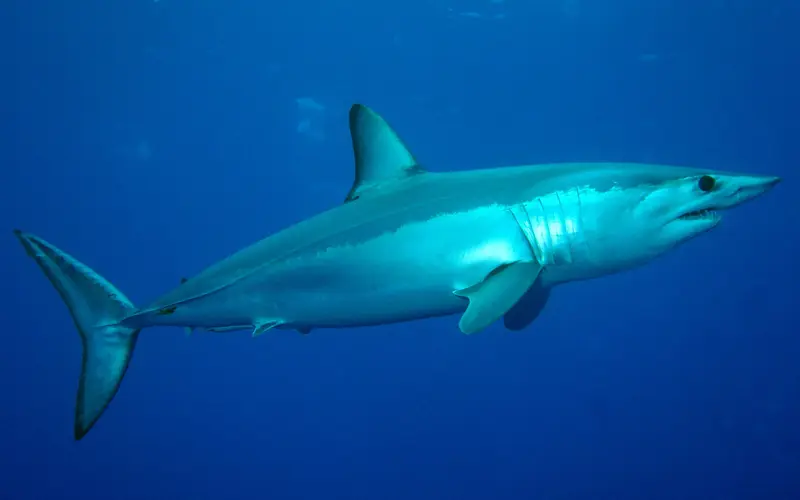
Overfishing of North Atlantic makos has stopped, but the population is still overfished, and fishing deaths remain three times the limit as ICCAT meets.
Play Shortfin Mako in Wilder, free in your browser
Species deep dive · shortfin mako Play this card
*Only partly. For the North Atlantic shortfin mako (Isurus oxyrinchus), the 2026 stock assessment by ICCAT, the commission that manages Atlantic tuna fisheries and the sharks caught in them, found that overfishing has stopped but the population is still overfished. In 2025 fishing still killed about 779 tonnes of North Atlantic makos, more than three times the 250-tonne limit ICCAT set in 2021 (ICCAT SCRS 2026). Worldwide, the IUCN lists the species as Endangered (IUCN Red List). This week ICCAT is meeting in Vilamoura, Portugal (16 to 23 November 2026), and one proposal on the table would let fleets start keeping makos again.*
The shortfin mako is the fastest shark known, with burst speeds of up to about 70 km/h (43 mph), and it often leaps clear of the water while hunting tuna, swordfish and other fast fish (Florida Museum). Speed was never its problem. Its slow life was.
Why makos crashed
A mako takes a long time to replace itself. Males mature at 7 to 9 years old, females not until 18 to 21, and females give birth only about every three years after a 15 to 18 month pregnancy (Florida Museum). An animal that breeds like that can't absorb heavy fishing.
And the fishing was heavier than anyone had measured. In a study published in 2017, researchers satellite-tagged 40 makos in the western North Atlantic. Over three years the sharks entered the waters of 19 countries, and 30% of them were caught and killed by fisheries in five countries. The fishing mortality rate the tags revealed was about 10 times higher than earlier estimates based on fishery data, and high enough to mean overfishing (Byrne et al. 2017). ICCAT's 2017 assessment put the probability that the North Atlantic stock was both overfished and still being overfished at 90% (ICCAT SCRS 2026).
What changed
In 2021 ICCAT adopted Recommendation 21-09, a rebuilding plan with a goal of a healthy stock by 2070. It banned keeping, transshipping or landing North Atlantic makos caught in ICCAT fisheries in 2022 and 2023, and capped total fishing mortality, including sharks that die after being thrown back, at 250 tonnes a year. The recommendation also recalled the scientists' advice that even with zero catch, the breeding population would keep falling until about 2035 before it could increase, because young makos take so long to grow up (ICCAT Rec. 21-09). The United States, for example, set a mako retention limit of zero for its Atlantic fisheries from July 2022 (NOAA Fisheries).
The 2026 assessment, using data up to 2024, found:
- Overfishing: no. The probability that the stock is still being overfished is now 19.6%, so the plan's first goal, ending overfishing, has been met.
- Overfished: yes. There is a 61.6% probability that the population is still below a healthy level.
- Why the picture changed: a very large drop in catches since 2015, updated fishery data, and new estimates of growth and natural death rates. With those, the scientists now estimate a mako generation lasts about 19 years rather than 25. An ICCAT-funded study to check makos' ages is still running (ICCAT SCRS 2026).
The catch: makos that die after release
A ban on keeping makos doesn't stop them from being hooked. Total fishing mortality averaged 1,046 tonnes a year from 2022 to 2025, roughly four times the 250-tonne limit, and was about 779 tonnes in 2025 (ICCAT SCRS 2026).
Many released makos don't survive. In the U.S. Atlantic pelagic longline fishery, observer records from 2000 to 2020 showed that 65% to 77% of makos were still alive when hauled to the boat, depending on the region, and an estimated 87% of makos released alive survived afterwards, based on 27 satellite tags. Overall, only about 59% to 64% of hooked makos survived the encounter, which the authors say may be low enough to hold back recovery (Schultz et al. 2025). Survival was lower with longer soak times, warmer water, longer lines and bigger sharks.
What ICCAT is deciding this week
Under the current plan's formula, ICCAT's scientists calculated that the amount of North Atlantic mako that may be kept in 2027 is again zero. The United States has proposed raising the total mortality limit from 250 to 1,400 tonnes and allowing makos above minimum sizes to be kept. Conservation groups attending the meeting have asked ICCAT to keep the ban at least until the age study is finished in 2027 (Pro Wildlife statement to ICCAT, PA4_818/2026; Gallifrey Foundation statement, PA4_820/2026). At the time of writing on 23 November 2026, ICCAT had not published a decision, and the existing rules stay in force until it does.
So the honest answer is that the North Atlantic mako has stopped falling as fast but has not recovered. With a slow-breeding shark, that takes decades, not a few years of good news.
Is a mako dangerous to people?
Rarely. The International Shark Attack File counts 10 confirmed unprovoked bites by shortfin makos, one of them fatal, which puts it seventh in our ranking of the most dangerous sharks. Hooked makos do often injure fishers and damage boats (Florida Museum). People are a far bigger danger to makos than makos are to people.
On the Wilder card
In Wilder the Shortfin Mako is an Uncommon Pisces card in the Water element. It costs 4 Energy, with Attack 5 and Health 3, and has Ambush, which lets it attack the turn it's played. High Attack, low Health and an instant strike suit the fastest shark: it hits hard and first but can't take much punishment, a bit like the real species under fishing pressure. Its flavour text reads: "Burst speed of up to 70 km/h, and it will leap clear of the sea to hunt." For a shark with a tougher record around people, try the Oceanic Whitetip Shark, and for one of the fast fish makos chase, the Yellowfin Tuna.
Wilder is a free browser collectible card game about real animals, and you can play it free in your browser with no signup.
Photo credit
Hero photograph: Patrick Doll, "Kurzflossen-Mako" (a shortfin mako in the North Atlantic at Condor Bank, Azores, 2011), via Wikimedia Commons, CC BY-SA 3.0. Cropped for the Field Journal hero.

Play Shortfin Mako in Wilder, free in your browser
Questions people ask
Where do shortfin mako sharks live?
In tropical and temperate oceans worldwide. The shortfin mako is a true open-ocean shark, found from Norway to South Africa and from Canada's Grand Banks to Argentina in the Atlantic, across the Indian Ocean and through much of the Pacific. It lives from the surface to about 500 m deep and usually in water warmer than 16°C (Florida Museum).
How many pups does a shortfin mako have?
Between 4 and 25 per litter. The pups are 60 to 70 cm long at birth. Before that they grow inside the mother, first on yolk and then by eating unfertilised eggs, a habit called oophagy; there is no placenta (Florida Museum).
What eats a shortfin mako?
Larger sharks may eat young makos, but adults have few enemies besides people. The Florida Museum notes that adult shortfin makos likely fall prey only to humans (Florida Museum).
Why is it called a mako?
"Mako" is a Māori word for shark. The species is also known as the blue pointer in English (Florida Museum).
Can you keep a shortfin mako caught in U.S. Atlantic waters?
No. Since 5 July 2022 the retention limit for shortfin makos in U.S. Atlantic highly migratory species fisheries, commercial and recreational, has been zero, so every mako caught must be released. NOAA says it could raise the limit only if ICCAT allows U.S. harvest in future (NOAA Fisheries).
Sources
- ICCAT SCRS (2026). Small tunas and sharks: report to Panel 4, 25th Special Meeting of the Commission (North Atlantic shortfin mako stock assessment)
- ICCAT Recommendation 21-09 on the conservation of the North Atlantic stock of shortfin mako caught in association with ICCAT fisheries
- Pro Wildlife statement to ICCAT Panel 4, PA4_818/2026
- Gallifrey Foundation statement to ICCAT Panel 4, PA4_820/2026
- IUCN Red List: Isurus oxyrinchus, Shortfin Mako (assessed 2018, Endangered)
- Florida Museum of Natural History: Shortfin mako (Isurus oxyrinchus) species profile
- Byrne ME, Cortés E, Vaudo JJ, et al. (2017). Satellite telemetry reveals higher fishing mortality rates than previously estimated, suggesting overfishing of an apex marine predator. Proc R Soc B 284: 20170658
- Schultz M, Hoffmayer ER, Sulikowski JA, Byrne ME (2025). Bycatch survival of shortfin mako sharks (Isurus oxyrinchus) in the U.S. Atlantic pelagic longline fishery. PLOS One 20(9): e0330999
- NOAA Fisheries: Zero Atlantic shortfin mako shark retention limit (final rule, effective 5 July 2022)
- Florida Museum: International Shark Attack File, species implicated