Yellowfin Tuna: Ram Ventilation, Warm Muscle, and Dolphin Schools
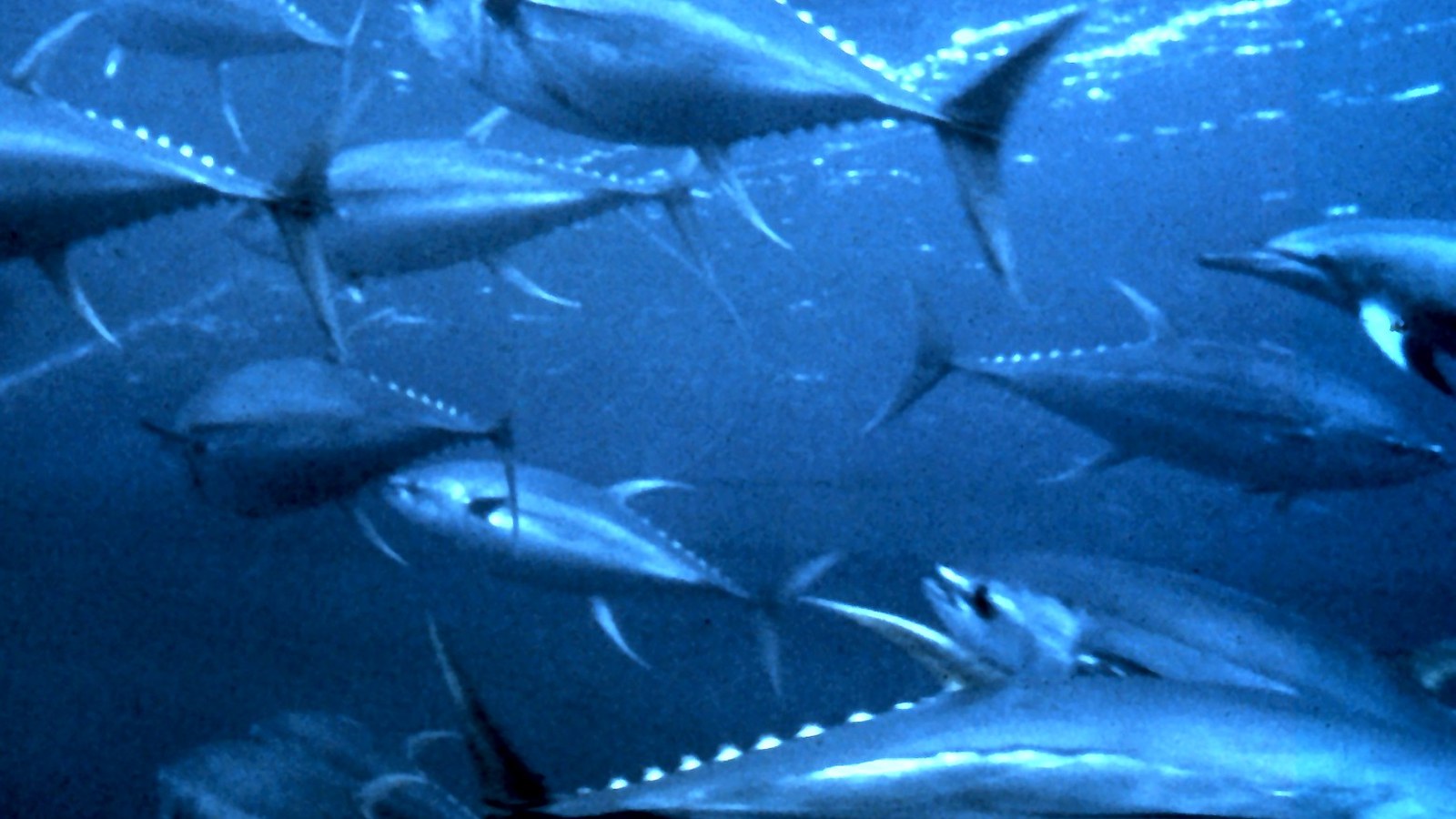
Species deep dive · yellowfin tuna
Search "ahi" on a sushi menu and you usually meet Thunnus albacares — yellowfin tuna, a metallic blue torpedo with sickle-yellow fins that never really gets to stop swimming. The biology underneath the fillet is stranger than the marketing: obligate ram ventilation, regionally warm muscle, and schools that sometimes ride with dolphins across the eastern tropical Pacific.
In Wilder TCG the Yellowfin Tuna is a Common Pisces creature with Flock. The card is shorthand for open-ocean teamwork — size-matched schools moving as one through blue water.
Taxonomy of a tropical speed specialist
Thunnus albacares (Bonnaterre, 1788) sits in Scombridae, the mackerels and tunas. It is one of the larger tunas, though smaller than bluefins: literature sizes reach on the order of ~2.4 m and ~200 kg, with IGFA all-tackle records near 200 kg. Adults show the namesake bright yellow second dorsal and anal fins — often dramatically elongated into scimitar shapes — plus yellow finlets and a dark metallic back fading to a silver belly with broken vertical lines.
English "yellowfin" and Hawaiian ʻahi both apply; French albacore for this species is a naming trap — English albacore is a different tuna (T. alalunga).
Wilder files the card under Pisces as a Water creature. Real yellowfin are epipelagic wanderers of tropical and subtropical oceans worldwide (roughly 50°N–50°S), mostly in the mixed surface layer above the thermocline, though tagged fish occasionally dive hundreds of meters — even past 1,000 m in rare records.
Ram ventilation: swim or suffocate
Like several other tunas, yellowfin are obligate ram ventilators. They do not pump water over the gills the way a resting goldfish does. Forward motion with the mouth open drives oxygenated water across enormous gill surfaces. Stop for long and gas exchange fails — perpetual motion is physiology, not personality.
That design pairs with a fusiform body, retractable fins that tuck into slots, peduncle keels, and finlets that tidy the wake. Burst speeds are commonly cited near 20 m/s (~45 mph) in the tuna literature; cruising is slower but relentless. High metabolic demand keeps them hunting fish, squid, and crustaceans in productive surface waters, often in schools sorted more by size than by species — mixed groups with skipjack or juvenile bigeye are routine.
Warm muscle in a cold ocean
Tunas are famous for regional endothermy: countercurrent heat exchangers (retia mirabilia) keep red swimming muscle warmer than the surrounding water. The point is power. Controlled comparisons with ectothermic relatives show that a ~10 °C elevation can roughly double maximum slow-muscle power output and the contraction frequency that produces it — a physiological turbo for sustained cruising and sudden chases. This is not whole-body "warm-blooded" mammal style; it is targeted heat retention where locomotion needs it.
Hydraulic fin control — lymphatic pressure adjusting fin stiffness and deployment — further polishes the hydrodynamic profile during acceleration. The package is built for blue-water distance work.
Dolphin schools, FADs, and a fishery asterisk
In the eastern tropical Pacific, larger yellowfin often associate with pantropical spotted, spinner, and other dolphins. The bond is facultative, not a permanent marriage: tracking and diet studies suggest shared predator-risk reduction in a habitat where warm surface water sits over a thick oxygen-minimum zone more than a shared buffet. Elsewhere — Atlantic, Indian Ocean, much of the Pacific — that dolphin–tuna purse-seine story is far weaker or absent; yellowfin still school under logs, sargassum, and fish-aggregating devices (FADs).
Industrial purse seines and longlines dominate landings. Mid-20th-century ETP "dolphin sets" drove famous cetacean mortality and the later "dolphin-safe" labeling fight. Setting on FADs reduces dolphin kill but raises juvenile tuna and other bycatch concerns. IUCN moved yellowfin from Near Threatened to Least Concern in 2021 after improved international quota management — a species-level win that does not erase regional stock pressure or bycatch debates. NOAA's Atlantic assessment (2024 context) reports that stock as not overfished and not subject to overfishing under U.S./ICCAT management; other oceans and gear types still need watching.
From open ocean to Wilder card
In the Yellowfin Tuna field guide you will find taxonomy, habitat, and in-game stats. On the board, Flock echoes size-matched schools — and the real-world habit of traveling with company, whether conspecifics, other tunas, or, in one famous ocean, dolphins overhead.
Play it in Wilder — then remember the next ahi plate started as a fish that literally cannot afford to idle.
Quick facts
- Scientific name: Thunnus albacares (Bonnaterre, 1788)
- Hook: obligate ram ventilation; regional endothermy; ETP dolphin-school associations; marketed as ahi
- Size: up to ~2.4 m / ~200 kg class; sickle-yellow dorsal/anal fins in large adults
- Diet: fish, squid, pelagic crustaceans; opportunistic schooling predator
- Range: tropical/subtropical Atlantic, Pacific, and Indian Oceans; highly migratory epipelagic
- Physiology: ram ventilation; red-muscle heat exchangers; high sustained and burst speed
- IUCN: Least Concern (2021 reassessment; formerly Near Threatened) — fisheries still matter regionally
- Wilder family: Pisces · Common · Flock · Water · Cost 5
Photo credit
Hero photograph: OAR/National Undersea Research Program (NURP), NOAA, "Yellowfin tuna nurp", yellowfin tuna in the Gulf Stream (Wikimedia Commons), public domain (U.S. government work). Cropped for the Field Journal hero.

Sources
- Wikipedia — Yellowfin tuna
- IUCN Red List news — tuna species recovering (2021)
- IUCN Red List — Thunnus albacares (Collette et al. 2021)
- NOAA Fisheries — Atlantic yellowfin tuna
- Scott et al. — Pelagic predator associations: tuna and dolphins in the ETP
- Altringham & Block (1997) JEB — elevated slow-muscle temperature and power
- LSU Sea Grant — Yellowfin tuna fact sheet
- Wilder TCG — Yellowfin Tuna field guide