West African Carpet Viper: Why a Small Snake Kills So Many People
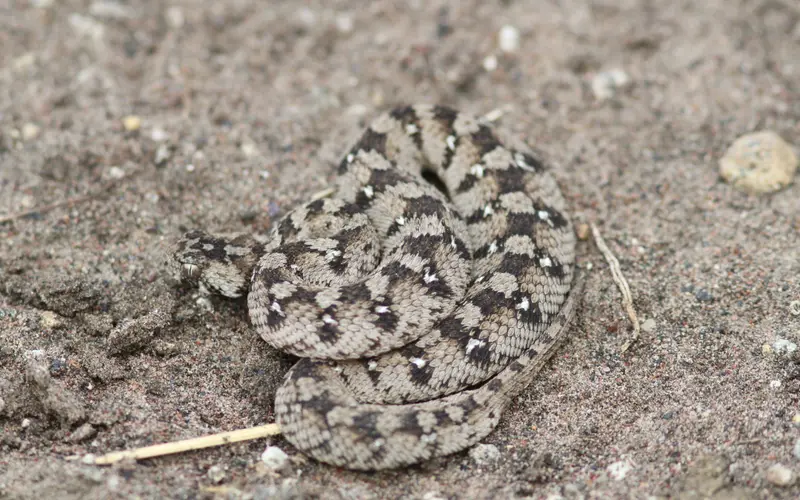
Rarely longer than 50 cm, it causes most snakebite deaths in West Africa. It lives by farms, bites hands at planting time and stops blood clotting.
Play West African Carpet Viper in Wilder, free in your browser
Species deep dive · west african carpet viper Play this card
*Because it is common exactly where people farm, it bites the hands of people working the fields, and its venom stops the blood from clotting. The West African carpet viper (Echis ocellatus) is rarely longer than 50 cm, yet researchers describe it as responsible for the majority of snakebite deaths in West Africa (Edge et al. 2025). Without antivenom, bites by carpet vipers (Echis) kill about 12 to 20% of the people bitten. Nigeria alone is estimated to lose about 1,927 people a year to snakebite, the highest toll of 16 West African countries (Habib et al. 2015).*
Size is not what makes a snake dangerous to people. Contact is. The carpet viper lives in the savannas of West Africa, from Senegal, Gambia and Mauritania east to Niger and Nigeria (Reptile Database). The IUCN lists it as Least Concern with a stable population (IUCN Red List). It is the most common cause of snakebite deaths in Senegal (Reptile Database, citing Trape et al. 2001).
A snake that lives where the farms are
The best picture of who gets bitten comes from the Snakebite Treatment and Research Hospital in Kaltungo, Gombe State, in north-eastern Nigeria. It sees about 2,500 snakebite patients a year and is the largest snakebite hospital in sub-Saharan Africa by number of patients. Of 1,022 patients treated there between January and June 2024 (Hamman et al. 2025):
| Share of patients | |
|---|---|
| Bitten by a carpet viper | 79% |
| Bitten on the hand | 78% |
| Male | 72% |
| Farmers | 46% |
| Bitten in April alone | 28% |
April is the start of the rainy season, when the hard farm work begins. People clearing ground and planting by hand reach into the grass and soil where a small, well-camouflaged viper is resting. Earlier studies in the Nigerian savanna found the same pattern: carpet viper bites peak in the rainy season along with farming (Hamman et al. 2025). An older estimate from north-eastern Nigeria put carpet vipers (Echis) behind at least 66% of all snakebites (Habib et al. 2015), a figure published under the name E. ocellatus before a 2018 split placed many of those snakes, including Kaltungo's, in Echis romani.
That is the same story as the puff adder and the Russell's viper: the snakes that kill the most people are not the most venomous ones. They are the ones that share the fields.
What the venom does
Carpet viper venom is haemotoxic: it causes severe failure of blood clotting and destroys tissue around the bite, so victims can bleed dangerously and may lose part of a limb (Hamman et al. 2025). Doctors at Kaltungo use a simple bedside test: if a blood sample has not clotted after 20 minutes, the venom has taken hold and the patient needs antivenom. In the 2024 series, 14% of patients clotted normally and needed none (Hamman et al. 2025).
Even with free antivenom, a bite is serious. Of the 1,022 patients, 931 recovered, 9 died, 78 lost part of a limb to amputation and 4 needed surgery to remove dead tissue. Adult men who took more than four hours to reach the hospital did worst (Hamman et al. 2025). Across Nigeria, snakebite is estimated to cause about 2,368 amputations a year on top of the deaths (Habib et al. 2015).
Antivenom is the difference
When the right antivenom arrives in time, it works. In a trial at Kaltungo with 400 patients whose blood would not clot, one starting dose of the antivenom EchiTAb-Plus-ICP restored clotting within six hours in 83.0% of patients, and EchiTAb G did so in 75.7% (Abubakar et al. 2010). Effective antivenom prevents at least 75% of snakebite deaths and is one of the cheapest life-saving treatments there is, at about US$100 per year of healthy life saved (Habib et al. 2015).
The problem has been getting it there. The same trial describes a crisis in the supply of effective, affordable antivenom in West Africa (Abubakar et al. 2010). WHO estimates 435,000 to 580,000 snakebites a year in Africa that need treatment (WHO), and many of those people live far from a hospital that has antivenom on the shelf.
One snake became two
In 2018 the carpet vipers of the east were split off as a separate species, Echis romani, found in south-western Chad, southern Niger, Nigeria, northern Cameroon and north-western Central African Republic (Reptile Database). So some Nigerian "carpet vipers" in older papers are now E. romani. The Kaltungo team records its carpet vipers as E. romani (Hamman et al. 2025).
That raised a practical question: does antivenom made for "E. ocellatus" still work on both? A 2025 study found that several of these antivenoms are actually made with E. romani venom. All three it tested (EchiTAb G, SAIMR Echis and Echiven) were judged effective against the lethal effects of both species in mice, but their strength differed. At the same comparative dose against Ghanaian E. ocellatus venom, SAIMR Echis and Echiven protected every mouse, while EchiTAb G did not prevent deaths beyond three hours (Edge et al. 2025). Those are lab results, not hospital ones, but they show why venom from the right snakes matters.
Don't confuse either one with the saw-scaled viper of India and the Middle East, Echis carinatus. It belongs to the same genus but is a different species, in a different part of the world.
On the Wilder card
In Wilder the West African Carpet Viper is an Uncommon Reptilia card in the Grassland element. It costs 2 Energy, with Attack 2 and Health 2, and has two keywords: Venom, so combat damage it deals to another creature destroys it, and Basking, which gives it +1 Attack permanently at the end of your turn if it didn't attack (up to +2). A 2-cost card that can take down anything it hits is a fair picture of a snake you can almost hold in two hands. Its flavour text reads: "It warns with a sizzle like water on a hot pan, then strikes." That sizzle comes from rubbing its saw-edged scales together, which the card page explains. For Africa's other big biter, play the Puff Adder, and for South Asia's, the Russell's Viper.
Wilder is a free browser collectible card game about real animals, and you can play it free in your browser with no signup.
Photo credit
Hero photograph: Peter Alfrey, "Echis ocellatus" (a West African carpet viper coiled on sand near Kumasi, Ghana), via Wikimedia Commons, CC0 1.0. Cropped for the Field Journal hero.

Play West African Carpet Viper in Wilder, free in your browser
Questions people ask
Where does the West African carpet viper live?
In the savannas of West Africa. The Reptile Database lists Senegal, Gambia, Mauritania, Mali, Guinea, Burkina Faso, Ivory Coast, Ghana, Togo, Benin, Niger and Nigeria. Since 2018, carpet vipers from Cameroon, Chad and the Central African Republic have been treated as a separate species, Echis romani (Reptile Database).
Are children at greater risk from carpet viper bites?
Yes. Children make up a large share of patients, and delays are deadly for them. Of 2,192 snakebite patients at Nigeria's Kaltungo snakebite hospital in 2024, 723 were under 18, and 21 of those children died. Children who arrived four or more hours after the bite, or who got no antivenom, were far more likely to die (Uppal et al. 2026). WHO notes that children often suffer worse effects because of their smaller bodies (WHO).
How do doctors know if a carpet viper bite needs antivenom?
With a simple blood clotting test. Carpet viper venom stops blood from clotting, so doctors check whether a blood sample clots within 20 minutes. At Kaltungo in 2024, patients whose blood clotted in under 20 minutes were not given antivenom, while those above it got antivenom within an hour of arriving (Hamman et al. 2025). The same test, repeated over 48 hours, was used to judge antivenom in a Nigerian trial (Abubakar et al. 2010).
Is the West African carpet viper endangered?
No. The IUCN Red List lists it as Least Concern, with a stable population trend. It was last assessed in 2019 and occurs in at least one protected area. The assessment also records international trade in the species as pets or display animals (IUCN Red List).
Does the West African carpet viper kill more people than the black mamba?
Very likely, though no one counts snakebite deaths by species across Africa. Researchers describe Echis ocellatus as behind most West African snakebite deaths (Edge et al. 2025). In north-eastern Nigeria, carpet vipers (Echis) caused at least 66% of bites (Habib et al. 2015), a figure published as E. ocellatus before a 2018 split placed many of those snakes, including Kaltungo's, in Echis romani. Black mamba venom is deadly too, but the carpet viper lives beside millions of farmers.
Sources
- Edge et al. (2025), Preclinical evaluation of three antivenoms against E. ocellatus and E. romani, PLoS Neglected Tropical Diseases
- Habib et al. (2015), Snakebite is under appreciated: appraisal of burden from West Africa, PLoS Neglected Tropical Diseases
- Hamman et al. (2025), Predicting snakebite envenoming outcomes at the Snakebite Treatment and Research Hospital, Kaltungo, Tropical Medicine and Infectious Disease
- Uppal et al. (2026), Predictors of in-hospital mortality among paediatric snakebite patients in north-eastern Nigeria, Wellcome Open Research
- Abubakar et al. (2010), Randomised trial of two antivenoms for carpet viper (Echis ocellatus) envenoming in Nigeria, PLoS Neglected Tropical Diseases
- IUCN Red List: Echis ocellatus (Luiselli, Chirio & Chippaux 2021)
- The Reptile Database: Echis ocellatus
- The Reptile Database: Echis romani
- World Health Organization: Snakebite envenoming fact sheet
- World Health Organization: Snakes gallery (venomous snakes of medical importance)