Saw-scaled Viper
Play the Saw-scaled Viper free
Echis carinatus
Saw-scaled Viper: The Smallest of India's Big Four Snakes
The saw-scaled viper (Echis carinatus) is a small, rough-scaled viper of dry country in South Asia, the Middle East and Central Asia. It is the smallest of India's Big Four snakes, the species that Indian antivenom is made against. It warns by rubbing its saw-edged scales together, and its venom stops blood from clotting.
- Habitat
- Dry open country: sand, rock, scrub and soft soil, up to about 2,000 m
- Size
- Usually under 60 cm long; range 38 to 80 cm
- Diet
- Rodents, lizards, frogs, scorpions, centipedes and large insects
- Range
- India, Sri Lanka, Pakistan, Bangladesh, the Middle East and Central Asia
- Breeding
- Live young; usually 3 to 15 per litter
- Status
- Least Concern (IUCN 2021)
Habitat & range
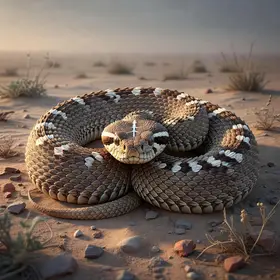
The saw-scaled viper lives in India, Sri Lanka, Bangladesh and Pakistan, and also in Oman, the eastern United Arab Emirates, Iraq, south-western Iran, Afghanistan and parts of Central Asia (Reptile Database). It lives on sand, rock, soft soil and scrubland and often hides under loose rocks (Wikipedia). It is buff, grey, reddish or pale brown, with pale dark-edged blotches along the back, a wavy white line on each side and a whitish cross or trident shape on top of the head (Wikipedia). Saw-scaled Viper appears as a Reptilia creature card in Wilder, a free browser collectible card game.
Diet & hunting
It is mostly active at dusk and at night, and spends the day in mammal burrows, rock cracks or rotting logs; on sand it may bury itself with only its head showing (Wikipedia). It eats rodents, lizards and frogs, and also scorpions, centipedes and large insects. This broad diet may help explain why it is so common in some areas (Wikipedia).
Behavior & adaptations
The scales on its flanks have saw-edged keels, which give the snake its name (Wikipedia). When threatened it pulls into C-shaped or figure-eight coils and rubs these scales past each other, making a rasping, sizzling sound as a warning (Gans and Maderson 1973). It moves mostly by sidewinding, and after rain many climb into bushes; around 20 were once found on a single cactus or small shrub (Wikipedia). Females give birth to live young, usually 3 to 15 per litter (Wikipedia).
Bite & danger to people
The saw-scaled viper is one of India's Big Four, and Indian polyvalent antivenom is made against it together with the spectacled cobra, common krait and Russell's viper (Suraweera et al. 2020). Most of its bites happen when it is stepped on at night by people in bare feet or sandals, or when people cut grass by hand (Suraweera et al. 2020). The venom stops blood from clotting and can cause bleeding, severe swelling and kidney failure (Wikipedia). In a Rajasthan study, all 12 people bitten by the northern form had clotting problems, and antivenom worked poorly (Kochar et al. 2007). There is no reliable death count for the species.
Conservation
The IUCN lists the saw-scaled viper as Least Concern because it is widespread and common across a large range (IUCN 2021). Like many venomous snakes, it is often killed when people find it near homes and fields.
Fun facts about Saw-scaled Viper
- Its venom was used to develop echistatin, an anticoagulant, and ecarin, a reagent used in a blood-clotting test (Wikipedia).
- When it rains, up to 80% of the adults in an area may climb into bushes and trees (Wikipedia).
- In sandy places it moves by sidewinding, touching the hot ground at only two points (Wikipedia).
- In the north of its range it hibernates through the winter (Wikipedia).
Saw-scaled Viper vs Honey Badger
The honey badger wins; a snake this small is badger food.
Honey badgers live in India, the Middle East and parts of Central Asia as well as Africa, so the two really can meet. Snakes, including venomous ones, are a regular part of a honey badger's diet, and its thick, loose skin helps protect it from bites (Animal Diversity Web). The saw-scaled viper strikes fast from its coils, and its venom stops blood from clotting. But it is usually under 60 cm long, and a badger that digs prey out of burrows does not back off from a small snake.
Read more about Honey Badger.
Common questions about Saw-scaled Viper
Is the saw-scaled viper one of India's Big Four snakes?
Yes, and it is the smallest of the four. Indian polyvalent antivenom is made against the venom of four species: the spectacled cobra, the common krait, Russell's viper and the saw-scaled viper (Suraweera et al. 2020). The saw-scaled viper is usually under 60 cm long (Wikipedia).
Why is it called a saw-scaled viper?
Because the scales on its sides have saw-edged keels. The flank scales of Echis carinatus carry serrated ridges (Wikipedia). When threatened, the snake folds into C-shaped or figure-eight coils and rubs these scales together, making a rasping, sizzling warning sound instead of hissing (Gans and Maderson 1973).
How do people get bitten by saw-scaled vipers?
Mostly by stepping on one in the dark. Most bites happen when the snake is stepped on at night by people in bare feet or sandals, or when people cut grass by hand with a short sickle (Suraweera et al. 2020). It is small, well camouflaged and active at night, and hides under rocks and in sand by day (Wikipedia).
What happens if a saw-scaled viper bites you?
The venom stops the blood from clotting. Bites cause pain and swelling within minutes, and can lead to bleeding and kidney failure (Wikipedia). In a Rajasthan study, all 12 people bitten by the northern form had abnormal clotting, 7 had bleeding, and antivenom worked poorly (Kochar et al. 2007). Anyone bitten needs hospital care and antivenom quickly.
Is the saw-scaled viper the same as the West African carpet viper?
No, they are different species in the same genus. The genus Echis is known as the saw-scaled or carpet vipers (WHO). Echis carinatus lives in South Asia, the Middle East and Central Asia (Reptile Database), while the West African carpet viper, Echis ocellatus, lives in West Africa.
More Reptilia animals
- Spectacled Cobra
- Terciopelo
- Thorny Devil
- West African Carpet Viper
- Western Banded Gecko
- Western Diamondback Rattlesnake
Reptilia · Desert · Cost 2