African Lion: Why Do Male Lions Have Manes?
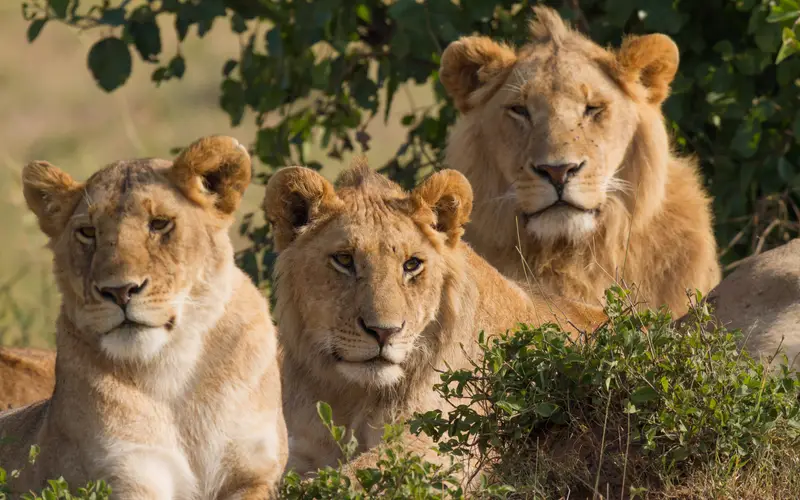
A dark mane tells lionesses a male is healthy and warns rivals off. Serengeti tests with toy lions showed how, and why heat keeps manes in check.
Play African Lion in Wilder, free in your browser
Species deep dive · african lion Play this card
A male lion's mane is mainly a signal, not a shield. A long-term study of Serengeti lions found that a dark mane shows a male is well fed and high in testosterone: lionesses prefer dark-maned males, and rival males avoid them. Mane length tells other males whether he is currently fit to fight. The price is heat, which is why manes are smaller where it is hot (West & Packer 2002).
Charles Darwin was the first to suggest the mane might help males win mates. The other old idea is that it protects the neck in fights. Lion researchers at the University of Minnesota tested that directly: if the mane were mainly armour, the neck should be a favourite target, or neck wounds should be more dangerous. In their records neither was true. Wounds landed no more often on the neck than on the rest of the body, in maned males or in bare-necked females and young males, and neck wounds were no more likely to kill (Lion Center, University of Minnesota).
The toy lion experiment
To find out what other lions read from a mane, Peyton West and Craig Packer set out pairs of life-sized plush lions in the Serengeti, identical except for the mane. The manes attached with Velcro so they could be swapped. The researchers played recordings of hyenas at a kill, the lion version of a dinner bell, and watched which dummy real lions walked up to (West 2005, American Scientist; EurekAlert! / University of Minnesota).
| Test | What real lions did |
|---|---|
| Males: short vs long mane | Approached the short-maned dummy 9 times out of 10 |
| Males: blond vs dark mane | Approached the blond dummy 5 times out of 5 |
| Females: blond vs dark mane | Approached the dark-maned dummy 9 times out of 10 |
| Females: short vs long mane | No clear preference |
The pride records agreed. When a lioness had a choice of males in the same coalition, she mated with the darkest-maned one in 13 of 14 cases (EurekAlert! / University of Minnesota).
What a mane says about a male
Colour is about quality. In sedated Serengeti males, darker manes went with higher testosterone. Dark-maned males were also more likely to recover from injury, stayed resident with prides for longer and had more cubs survive (Lion Center; West & Packer 2002). A lioness choosing a dark mane is choosing a male more likely to keep her cubs alive.
Length is about right now. Mane length was not linked to testosterone, but males with shorter manes had often been recently injured or sick. That makes length a quick read of current fighting condition, which is why rival males pay attention to it and lionesses mostly don't (EurekAlert! / University of Minnesota).
The cost: a hot coat
If dark, long manes win fights and mates, why doesn't every male have one? Because a mane is like wearing a scarf on the equator. Infrared cameras showed that maned males were hotter than females, and dark-maned males hotter than blond ones. In Tsavo, where males have little mane, males and females were the same temperature. Dark-maned males also had more abnormal sperm and ate smaller meals in hot weather (Lion Center; EurekAlert! / University of Minnesota). Only a male in top condition can afford that burden, which is exactly what makes the signal honest. Across seasons, years and habitats, Serengeti males had lighter or shorter manes when it was hotter (West & Packer 2002).
Zoo lions show the same rule. A study of captive lions across 12 degrees of latitude in North America found that longer, thicker manes grew where winters were colder. January temperatures mattered more than July ones, and climate explained up to half of the variation in mane size, though not mane colour (Patterson et al. 2006). That is one reason a lion in a cold-country zoo can look far shaggier than his wild relatives.
Tsavo's "maneless" lions
Tsavo in Kenya is famous for lions without manes. A 2002 survey of Tsavo National Park found adult males with only sparse blond crests, beards, chest tufts or sideburns, and no fully maned males. These males still held territories, roared, scent-marked, hunted and mated (Kays & Patterson 2002).
A wider study of the greater Tsavo ecosystem then found that the full story is slower manes, not missing ones. Some 87% of full-grown Tsavo males had manes and 49% had good ones. On the cooler equatorial plains, mane growth started early and reached a full mane by about age 4 to 5. In Tsavo it began later and grew more slowly, matching the consistently hot climate. Poorly maned males were still sexually mature and mated actively (Gnoske et al. 2006). Young males in general start to grow fuzz around the neck at about a year old (San Diego Zoo Wildlife Alliance).
Lionesses with manes
Very rarely, a female grows one. In 2016 researchers reported five maned lionesses in the Moremi Game Reserve in Botswana's Okavango Delta (Gilfillan et al. 2016). They took on male habits too, roaring and scent-marking more often and even mounting other females; the best-studied is known as SaF05. Some were seen mating, but none became pregnant, which suggests unusually high levels of male hormones such as testosterone. Because all five come from the same region, experts suspect a genetic cause in that population (PBS NOVA).
On the Wilder card
In Wilder the African Lion is a Mythic Mammalia card in the Grassland element. It costs 5 Energy, with Attack 6 and Health 5, and has Ambush, so it can attack the turn it's played, and Herd, a strength-in-numbers keyword for animals that live in groups. Its ability, Pride Roar, costs 3 Energy and gives another friendly creature +1/+1, a good fit for a male whose mane and roar both tell everyone around him who is in charge. Its flavour text reads: "One roar, and the whole savanna knows who owns the night." For how that roar works, see Which Big Cats Can Actually Roar, and for how many lions are left, this piece.
Wilder is a free browser collectible card game about real animals, and you can play it free in your browser with no signup.
Photo credit
Hero photograph: Benh LIEU SONG, "Lions Family Portrait Masai Mara" (a lioness and two young males with growing manes, Maasai Mara, Kenya), via Wikimedia Commons, CC BY-SA 3.0. Cropped for the Field Journal hero.

Play African Lion in Wilder, free in your browser
Questions people ask
How many lions are in a pride?
Anywhere from 3 to 30. A pride is built around related lionesses (mothers, sisters and cousins) and their cubs, plus a few unrelated adult males. Where food is scarce, prides are smaller, with about two adult lionesses; where food and water are plentiful, a pride can have four to six adult females (San Diego Zoo Wildlife Alliance).
At what age do young male lions leave the pride?
At about two years old. Mothers generally raise their sons until then and then send them off. Young males sometimes form bachelor groups and roam together until they are big enough to challenge older males for a pride (San Diego Zoo Wildlife Alliance).
How fast can a lioness run?
Up to about 53 km/h (33 mph) in a sprint. A lioness often kills prey by clamping her jaws over its nose and mouth (San Diego Zoo Wildlife Alliance). That is well short of a cheetah, so lions rely on stalking close before they charge.
How many hours a day do lions rest?
Up to about 21 hours. Lions have short bursts of intense activity followed by long bouts of lying around, and they sometimes rest in trees, perhaps to catch a breeze or escape flies (San Diego Zoo Wildlife Alliance).
Are African lions endangered?
They are listed as Vulnerable, not Endangered, by the IUCN, with about 22,000 to 25,000 left in Africa. Some populations have declined fast enough to meet the criteria for Endangered, and habitat loss is the biggest threat (San Diego Zoo Wildlife Alliance). Our piece on how many lions are left has the details.
Sources
- West & Packer (2002), Sexual selection, temperature, and the lion's mane, Science 297: 1339-1343
- The Lion Center, University of Minnesota: Mane research
- University of Minnesota news release via EurekAlert! (2002): A mane is a pain, but worth it for male lions
- West (2005), The lion's mane, American Scientist (University of Minnesota PDF)
- Patterson, Kays, Kasiki & Sebestyen (2006), Developmental effects of climate on the lion's mane, Journal of Mammalogy 87: 193-200
- Kays & Patterson (2002), Mane variation in African lions and its social correlates, Canadian Journal of Zoology 80: 471-478
- Gnoske, Celesia & Kerbis Peterhans (2006), Dissociation between mane development and sexual maturity in lions: solution to the Tsavo riddle?, Journal of Zoology 270: 551-560
- Gilfillan et al. (2016), Rare observation of the existence and masculine behaviour of maned lionesses in the Okavango Delta, Botswana, African Journal of Ecology 55: 383-385
- PBS NOVA (2016): Five Botswanan lionesses grow manes, start acting like males
- San Diego Zoo Wildlife Alliance: Lion
- Smithsonian's National Zoo: Lion