Trail Camera Gift Guide: The Best Christmas Gift for the Man Who Has Everything
Trail camera gifts for the man who has everything: seven wildlife cameras from $57, five accessories, and how to set one up without bothering the animals.
Play Red Fox in Wilder, free in your browser
Species deep dive · red fox Play this card, european badger Play this card, white tailed deer Play this card, gray wolf Play this card
A trail camera is the rare gift that is still giving in July: every morning there is a new reason to check what walked past in the night. For the dad, granddad or outdoorsy friend who already owns every gadget, a motion-triggered wildlife camera turns a garden, cabin plot or patch of woodland into his own nature documentary. He will find out whether the red fox really crosses the lawn at 3 am, where the European badger gets in under the fence, and how often the white-tailed deer visit the apple tree. It is also a gift the animals don't mind, as long as the camera is set up with a little care (more on that below).
As an Amazon Associate, Wilder earns from qualifying purchases. Other links are plain links with no commission.
Here are seven cameras and five accessories we checked on 24 November 2026. The picks lean on published field tests by Outdoor Life and Field & Stream, the makers' own spec sheets and, for the first one, a camera that has spent most of a year on the property of the person who makes Wilder. Prices are what each page showed that day; it is Black Friday week, so they will move. Most of the shops are in the US, while the first pick is sold in the Nordic countries, so check shipping before you order.
Our hero pick: the camera on Julian's land
1. Biltema Åtelkamera för simkort (4G trail camera), 1,299 SEK. This one is personal. Julian, who makes Wilder, has run one of these on his own property since March to film the animals around it, and his verdict is that it's "fantastic": "easy setup, great quality, insane battery life". He put eight AA batteries in it in March, and they are only just starting to run out now, in late November. That is one owner's experience, and battery life always depends on how often the camera fires, how cold it gets and how many videos it records, but it is a remarkable run.
On paper, Biltema lists 48 MP photos, 2.7K video at 30 frames per second, a 0.2–0.6 second trigger, an infrared flash range of 19.8 m (65 ft), a 100° field of view, a 5 cm (2-inch) screen, IP66 weatherproofing and an operating range of −20 to 60 °C (−4 to 140 °F). It runs on eight AA batteries or a 6 V external supply, records to a microSD card of up to 128 GB, and has a microphone and speaker (Biltema). With a nano-SIM that has mobile data (you supply it, with the PIN code turned off), it sends photos to the free TrailCam Go app. Biltema says photos reach the app with no subscription fee, while video clips need a paid plan in the app. Neither the SIM nor the memory card is in the box.
This is a Biltema / Nordic pick: Biltema is a Nordic chain, and the link goes straight to its Swedish shop with no commission. We looked for the same camera on amazon.com. Other 4G cameras also use the TrailCam Go app, but we couldn't confirm that any of them is the identical unit, so there is no Amazon version here. Biltema: Åtelkamera för simkort
Cellular cameras: new photos straight to his phone
2. Moultrie Edge 4 Solar. One of Field & Stream's two joint winners in its 2026 cellular trail camera test, and the pick for a man who never wants to change a battery. The solar panel sits on top of the camera and swivels to catch the sun. The tester ran two of them on Colorado deer ground for two months, and with the panel (plus Moultrie's add-on Power Mag II battery) the charge never dropped below 80%. He measured the 30 m (100 ft) detection range as accurate, and four Edge 4 cameras produced only 32 blank images in 60 days. The 40 MP photos were excellent; the weak spot is a poorly designed door latch (Field & Stream; Field & Stream). About $130 on Amazon. Amazon: Moultrie Edge 4 Solar
3. Tactacam Reveal Pro 4.0 Solar. Outdoor Life's best overall trail camera of 2026. In its walk-through test, the camera caught the tester every time at 3 m and 18 m (10 and 60 ft), by day and by night, though nothing at 34 m (110 ft), which is normal. You can switch the flash between low-glow and no-glow in the app, it can take a photo and a video on the same trigger, and the kit includes the camera, a solar panel and an R5 rechargeable battery (Outdoor Life). Field & Stream named the Reveal Pro 4.0 its stealthiest camera, with a 0.35 second trigger (Field & Stream). We didn't find it on Amazon from Tactacam itself, so this is a plain link to the maker. $159.99 on sale (regular price $199.99). Tactacam: Reveal Pro 4.0 Solar
4. Stealth Cam Deceptor MAX 3.0. Field & Stream's pick for the best photo quality, and a good choice where you don't want anyone, deer or passer-by, to see the camera at night: its 42 infrared LEDs work at 940 nm, the invisible "no-glow" end of the range. After 60 days, 723 photos and 23 videos, the tester's camera (running on an add-on battery pack) was still at 90%, deer never spooked, and the false-trigger filter meant only three photos without a deer reached his phone. The antenna is its weak point (Field & Stream). About $100 on Amazon. Amazon: Stealth Cam Deceptor MAX 3.0
5. Stealth Cam Fusion MAX 3.0. Outdoor Life's best-value trail camera of 2026. Aimed at a stand of oaks dropping acorns, it took 1,600 photos of deer, squirrels, raccoons and wild turkeys in a month, and its battery was still full (the tester used Stealth Cam's optional lithium cartridge). The night photos were especially good, and the app can sort pictures by species, even telling does from bucks. Its motion sensor was only "just OK" (Outdoor Life). About $70 on Amazon, the cheapest way into a cellular camera from this list. Amazon: Stealth Cam Fusion MAX 3.0
6. Browning Defender Pro Scout MAX HD DV. The other joint winner in Field & Stream's 2026 test. It is light and compact, its folding antenna is built so it doesn't snap off in a backpack, and the battery life was outstanding. The app is the weak spot (Field & Stream). Browning lists a 0.25 second trigger and 30 m (100 ft) detection, and it ships with AT&T and Verizon SIM cards, picking whichever signal is stronger (Browning). The Amazon listings we found were from third-party sellers, so this link goes straight to Browning. $159.99. Browning: Defender Pro Scout MAX HD DV
No subscription: an SD-card camera
7. GardePro A3S. For a garden or a cabin he visits every weekend, a camera with no SIM and no monthly fee is often all he needs: he swaps the memory card and looks at the night's haul on a laptop. The A3S has a no-glow 940 nm flash, a Starvis low-light sensor, and GardePro lists a 0.1 second trigger with a 26 m (85 ft) detection range across 120° (GardePro). One catch from OptiqueNature's test: the motion sensor sees 120°, but the lens only films 63° of that, so aim it carefully (OptiqueNature). Amazon had it at the same price, but from a third-party seller, so this is a plain link to GardePro. $56.99. GardePro: A3S
Accessories that make it work (and fill a stocking)
SanDisk Extreme 128 GB microSDXC card with SD adapter. Every camera here needs or takes a memory card, and none of them comes with one. A microSD card with an adapter fits both microSD slots like the Biltema's (128 GB maximum) and full-size SD slots. Check the camera's maximum card size first. About $39. Amazon: SanDisk Extreme 128 GB microSDXC
Energizer Ultimate Lithium AA batteries. Outdoor Life's battery pick for trail cameras. Energizer rates them from −40 to 60 °C (−40 to 140 °F), which matters on a January night (Energizer). The Amazon listings we checked didn't show a buy box, so this is a plain link to the maker. Energizer: Ultimate Lithium
Master Lock Python 8418D cable lock. A 1.8 m (6 ft) adjustable cable lock that loops round the tree and through the camera. Both Stealth Cam picks have a built-in slot for this type of cable. About $18. Amazon: Master Lock Python 8418D
Stealth Cam tree screw mounts, 3-pack. Outdoor Life's tree-mount pick: they let you tilt the camera down a path instead of strapping it flat to a trunk. Use them only on your own trees. About $21. Amazon: Stealth Cam tree screw mounts
Moultrie Edge Series Security Box II. A 1.5 mm (16-gauge) steel box that fits the Edge, Edge 2, Edge 3, Edge 4 and Edge Solar, so it goes with pick 2. It takes a padlock or a cable lock, and it also keeps curious bears from swatting the camera off a tree. About $40. Amazon: Moultrie Edge Series Security Box II
If he wants solar power, picks 2 and 3 already include a panel. Add-on solar panels for the other cameras are mostly brand-specific, so match the panel to the camera brand.
What actually matters when you buy one
- Trigger speed. The time between something moving and the photo being taken. The cameras here list between 0.1 and 0.6 seconds. Faster is better for animals on the move: a slow camera photographs a tail leaving the frame.
- Detection range versus flash range. These are different numbers. The motion sensor might reach 26 m (85 ft) while the flash lights up 30 m (100 ft), as on the GardePro. Plan around the shorter one.
- Low-glow, no-glow or white flash. Low-glow infrared shows a faint red glow when it fires and usually gives brighter night photos. No-glow (940 nm) is invisible to people and much less noticeable to animals, but the night photos are usually darker, though the best no-glow cameras close the gap. White flash gives colour night photos but is rare (Outdoor Life).
- Cellular or SD card. A cellular camera sends photos to his phone, so he doesn't disturb the spot to check it, but it needs mobile coverage where it hangs and a data plan. Outdoor Life says US plans typically cost $4–15 a month, with extra charges for full HD video or high-resolution photos (Outdoor Life). An SD-card camera has no running costs.
- Battery life. It depends far more on settings and traffic than on the box: video, instant sending and cold nights all drain batteries faster. Solar panels and lithium cells help most.
- Megapixels. Big numbers are often upscaled. TechGearLab notes that one budget camera's 48 MP rating "comes from upscaling, not from a true 48MP sensor system" (TechGearLab). The sensor, lens and flash matter more than the headline figure.
Where to put it, and what not to do
Go low and go sideways. Suffolk Wildlife Trust suggests setting a garden camera as low as possible, since most visitors are hedgehog-height, and aiming it at the routes animals use: gaps in fences, the edges of lawns and flower beds, a water bowl. Keep waving plants out of the frame (they trigger it endlessly), and note that cheaper cameras need the animal at least 2 m (6.5 ft) away so the night flash doesn't overexpose it (Suffolk Wildlife Trust). Biltema adds that animals walking across the frame are caught better than ones walking straight at the lens (Biltema).
Leave dens, setts and nests alone. Don't put a camera at a burrow entrance, a badger sett or a bird's nest, and don't bait animals in to pose. In England, disturbing badgers in a sett is a crime that can bring up to six months in prison (GOV.UK). A camera on a path a few metres away tells the same story without the stress. Our piece on whether badgers really hibernate explains what is going on underground in winter.
Point it away from the neighbours. A trail camera is a camera, so the same privacy rules as home security cameras can apply. In the UK, the Information Commissioner's Office says cameras should capture only your own property where possible, and that data protection law applies once they record beyond your boundary, into a neighbour's garden, a street or a footpath (ICO). Rules differ by country, so check your own, and in the US, check your state's rules before using a cellular camera for hunting: some states restrict them (Outdoor Life).
One more for the animal lover
When the first photos come in, he'll want to know who's who. Wilder is a free browser collectible card game where every card is a real animal with its own field-guide page, including the red fox, European badger, pine marten, eastern gray squirrel, white-tailed deer and gray wolf. If a fox screams on the camera's microphone at midnight, our piece on why foxes scream at night has the answer. You can play Wilder free with no signup, and it costs a lot less than a trail camera.
Photo credit
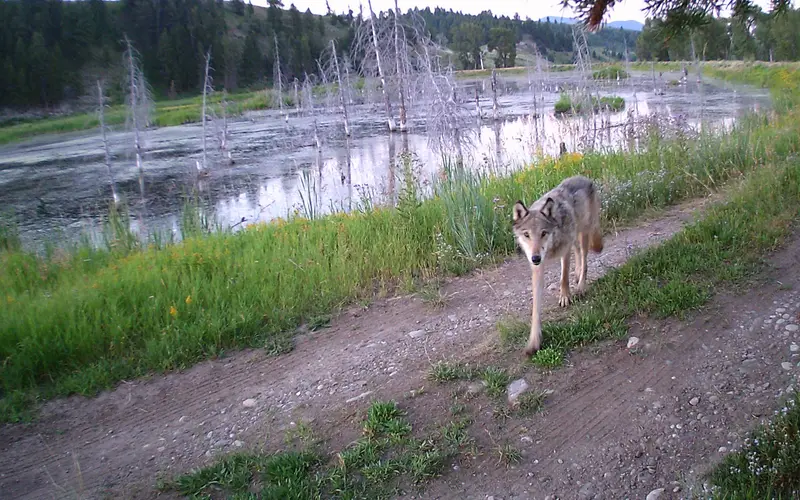
Hero photograph: Kari Cieszkiewicz / U.S. Fish and Wildlife Service, "Wolf on Trail Camera" (a grey wolf on a U.S. Fish and Wildlife Service trail camera, 7 August 2020), Wikimedia Commons, public domain. Cropped for the Field Journal hero.

Play Red Fox in Wilder, free in your browser
Questions people ask
How long do trail camera batteries last?
From a few weeks to most of a year, depending on the camera and settings. Julian's Biltema camera ran from March to late November on eight AA batteries. Outdoor Life got a little over a month from a Tactacam R5 battery with instant sending (Outdoor Life). Field & Stream's Moultrie Edge 4 cameras on 16 AAs fell below 50% in two months, while the solar models stayed above 80% (Field & Stream).
What size memory card does a trail camera need?
8 GB or more is enough for most garden cameras, which is what Suffolk Wildlife Trust recommends so the card doesn't fill up and miss activity (Suffolk Wildlife Trust). Check the camera's limit before buying a big card: the Biltema 4G camera takes microSD cards up to 128 GB and Biltema recommends class 10 or faster (Biltema).
Do trail cameras record sound?
Many do, in video mode. The Biltema 4G camera has a built-in microphone (Biltema), and Field & Stream praised the audio on the Moultrie Edge 4 and Stealth Cam Deceptor MAX 3.0 (Field & Stream). That is how people catch a red fox screaming at night.
Is it fair chase to hunt with a cellular trail camera?
Not if you use it to react in real time. Since 2022, the Boone and Crockett Club's rules say technology that delivers real-time location data to guide a hunter to an animal for an immediate response is not permitted, though waiting several days or until the next season is treated differently (Outdoor Life). Some US states also restrict cellular cameras for hunting, so check local rules.
Sources
- Biltema: Åtelkamera för simkort (art. 244401), product page and specifications
- Outdoor Life: The Best Trail Cameras of 2026, Tested and Reviewed
- Field & Stream: The Best Cellular Trail Cameras of 2026
- Field & Stream: Moultrie Edge 4 review
- Tactacam: REVEAL Pro 4.0 Solar
- Browning Trail Cameras: Defender Pro Scout Max HD DV
- GardePro: A3S Non-Cellular Trail Camera
- OptiqueNature: GardePro A3S trail camera test and review
- Amazon: Stealth Cam Deceptor MAX 3.0 listing
- Amazon: Moultrie Edge Series Security Box II listing
- Energizer: Ultimate Lithium batteries
- TechGearLab: WOSPORTS G600 review
- Suffolk Wildlife Trust: How to set up a trail camera
- GOV.UK: Badgers: protection, surveys and licences
- ICO: Home CCTV systems
- Wikimedia Commons: Wolf on Trail Camera (Kari Cieszkiewicz/USFWS), public domain