
American Crocodile
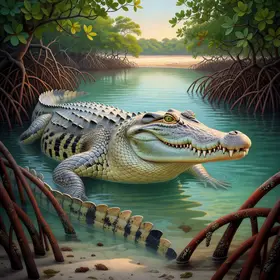
Play the American Crocodile free
Crocodylus acutus
American Crocodile: The Saltwater Crocodile of the Americas
The American crocodile (Crocodylus acutus) is a large, pale grey crocodile of coastal mangroves, estuaries, lagoons and islands from southern Florida and the Caribbean to Peru and Venezuela. Apart from the saltwater crocodile, it is the only crocodile that commonly lives in salt water, and it has the most recorded attacks on people of any crocodilian in the Americas.
- Habitat
- Mangrove swamps, estuaries, coastal lagoons, cays and river mouths; also rivers and salt lakes
- Size
- Adult males usually 2.9 to 4.1 m; females rarely over 3.8 m
- Diet
- Fish, crabs, birds, turtles and mammals; hatchlings eat insects and crabs
- Range
- Southern Florida, the Greater Antilles, both coasts of Mexico and Central America, to Venezuela and Peru
- Breeding
- Nests of sand and mud; 30 to 70 eggs; incubation 75 to 80 days
- Status
- Vulnerable (IUCN); Threatened in the US
Habitat & range
The American crocodile is the most widespread of the four crocodile species of the Americas. It lives mainly on coasts: in brackish lakes, mangrove swamps, lagoons, river mouths, cays and small islands, and it also enters rivers. Apart from the saltwater crocodile, it is the only crocodile that commonly lives and thrives in salt water, and it turns up on beaches and islets with no fresh water at all. One of its largest populations lives in Lago Enriquillo, a hypersaline lake in the Dominican Republic (Wikipedia). It ranges from southern Florida and the Greater Antilles along both coasts of Mexico and Central America to Colombia, Venezuela, Ecuador and Peru. In the USA it is found only in southern Florida, where it is limited by cold winters, and south Florida is the only place where it lives alongside the American alligator (CrocAttack; National Park Service). American Crocodile appears as a Reptilia creature card in Wilder, a free browser collectible card game.
Diet & hunting
Young American crocodiles eat insects, snails and crabs; in Haiti fiddler crabs made up most of the diet of juveniles by weight. Adults take fish, crabs, birds, turtles and mammals, and large adults can kill animals as big as cattle (Wikipedia). In southern Florida most of their food comes from the sea, and most of the water they need comes from their prey rather than from drinking. Like most crocodilians they ambush animals that come to the water's edge and drag them under. In Costa Rica they have been recorded killing adult olive ridley sea turtles that come ashore to nest, mostly in the first hours after nightfall (Wikipedia).
Behavior & adaptations
Adults are greyish green to grey-tan above with white to yellowish undersides, paler than the dark American alligator. The snout is long, narrow and triangular, and the fourth tooth on each side of the lower jaw stays visible when the mouth is closed (National Park Service). There is a raised bump on the snout in front of the eyes, and the back armour is the most reduced of any living crocodilian. Juveniles have distinct dark crossbands that mostly fade with age (Wikipedia). Females build nests of sand, mud and plant matter at the water's edge and lay 30 to 70 eggs. Both parents guard the nest during the 75 to 80 day incubation, and nest temperature decides the sex of the hatchlings (Wikipedia).
Danger to people
According to CrocAttack, the American crocodile causes the fourth-highest number of attacks on people of any crocodilian and the highest in the Americas, but there is a massive drop-off after the mugger crocodile, the third-ranked species. It kills only about 1 to 6 people a year, and over the past decade it has caused more deaths than any other New World crocodilian. Mexico has by far the most attacks, with 120 incidents (16 fatal) over the past decade, and Costa Rica is second, with 25 (5 fatal). Florida has had just one non-fatal incident (CrocAttack). It is usually shy and tends to flee from people (Wikipedia).
Conservation
The IUCN lists the American crocodile as Vulnerable (IUCN). Hide hunting, habitat loss and pollution made it endangered in parts of its range. In 2007 the US Fish and Wildlife Service moved the Florida population from Endangered to Threatened, and it is still protected under the Endangered Species Act. In southern Florida about two thirds of recorded crocodile deaths are from road collisions. The world population of mature adults was estimated at about 5,000 in 2020, and poaching for meat has hit Jamaica's crocodiles hard (Wikipedia).
Fun facts about American Crocodile
- It was first described in 1807 as the 'sharp-snout alligator' (Wikipedia).
- Hatchlings are only about 27 cm long and weigh about 60 g (Wikipedia).
- Genome sequencing has shown that female American crocodiles can sometimes reproduce without a male, by facultative parthenogenesis (Wikipedia).
- One of Florida's largest crocodile populations lives in the cooling canals of the Turkey Point nuclear power plant (CrocAttack).
American Crocodile vs Tiger Shark
In open water the tiger shark usually wins; in the shallows by the mangroves, back the crocodile.
Both are big predators of warm coastal seas. The American crocodile lives in the mangroves, lagoons and cays of the Caribbean and Florida, and tiger sharks hunt in tropical and temperate waters around the world, taking prey as varied as fish, sea turtles and birds (Wikipedia). In the shallows, the crocodile's ambush and armoured body give it a real chance. In open water, a tiger shark over 5 m long is faster, turns more easily and can bite from any angle.
Read more about Tiger Shark.
Common questions about American Crocodile
How dangerous are American crocodiles to people?
Less dangerous than Old World crocodiles, but the most dangerous in the Americas. It has the fourth-most attacks of any crocodilian and the most in the New World, yet only about 1 to 6 people die a year. Over the past decade Mexico recorded 120 attacks (16 fatal) and Costa Rica 25 (5 fatal) (CrocAttack). Compare the saltwater crocodile.
Are there crocodiles in Florida?
Yes, American crocodiles live in southern Florida. They live along the coast in southern Everglades National Park, Biscayne Bay, the Florida Keys and the cooling canals of the Turkey Point power plant. Cold winters keep them out of the rest of the US (CrocAttack). South Florida is the only place where crocodiles and alligators live side by side (NPS).
What is the difference between an American crocodile and an alligator?
The crocodile is paler, with a narrow, pointed snout and a lower tooth that shows. American crocodiles are greyish green with a triangular snout, and the fourth lower tooth on each side is visible with the mouth closed. Alligators are darker, with a broader snout, and usually live in fresh water, while crocodiles prefer brackish and salt water (NPS).
How big do American crocodiles get?
Adult males are usually 2.9 to 4.1 m long; females rarely exceed 3.8 m. A 4.83 m male from Costa Rica weighed about 538 kg. Animals approaching 6 m are thought to exceed 1,000 kg, but claims of 6 to 7 m giants are unverified (Wikipedia).
Is the American crocodile endangered?
It is listed as Vulnerable by the IUCN. In the US, the Florida population was moved from Endangered to Threatened in 2007 and is still protected. Hide hunting, habitat loss, pollution, road traffic and poaching are the main threats, and about 5,000 mature adults were estimated in 2020 (IUCN; Wikipedia).
More Reptilia animals
Reptilia · Water · Cost 4