
Black Caiman
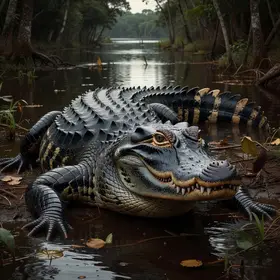
Melanosuchus niger
Black Caiman: The Largest Predator of the Amazon
The black caiman (Melanosuchus niger) is the largest living member of the alligator family and the biggest predator in the Amazon basin. Most adults are 2.2 to 2.9 m long, but old males can pass 5 m. Its near-black skin hides it on night hunts in slow rivers, lakes and flooded savannas, and it kills more people than any other alligatorid.
- Habitat
- Slow-moving rivers, lakes, swamps and seasonally flooded savannas
- Size
- Most adults 2.2 to 2.9 m; old males over 5 m and up to about 750 kg
- Diet
- Fish, snails, birds, turtles, capybaras, peccaries and other caimans
- Range
- Amazon basin: Brazil, Peru, Ecuador, Colombia, Bolivia, Guyana and French Guiana
- Breeding
- Mound nest in the dry season; usually 30 to 60 eggs; female guards nest and young
- Status
- Least Concern (IUCN, 2025); formerly Conservation Dependent
Habitat & range
The black caiman lives mainly in Amazonia: in rivers, swamps, wetlands and lakes in Brazil, eastern Ecuador and Peru, northern Bolivia, Colombia, southern Guyana and French Guiana (Wikipedia; CrocAttack). It prefers slow-moving rivers, lakes and seasonally flooded savannas. In Brazil it is found throughout Amazonia, with important populations in the Mamirauá reserve, along the Rio Araguaia and around Ilha do Bananal (CrocAttack). Females nest at the end of the dry season, so the eggs hatch at the start of the wet season, when newly flooded marshes give the young plenty of cover (Wikipedia). Black Caiman appears as a Reptilia creature card in Wilder, a free browser collectible card game.
Diet & hunting
Hatchlings eat small fish, frogs, snails, crustaceans and insects, and snails often dominate the diet of young caimans. As they grow they move on to bigger fish such as piranhas and catfish. Adults are generalist apex predators that can take almost any animal in their range, including turtles, birds, monkeys, capybaras, peccaries, deer, anacondas and smaller spectacled caimans, mostly when prey comes to the riverbank to drink (Wikipedia). Compared with smaller caimans, black caimans more often hunt on land at night, using sharp hearing and sight. Like other crocodilians they cannot chew, so they swallow food whole or store large carcasses until they soften (Wikipedia).
Behavior & adaptations
Adults are dark greenish black, sometimes almost jet black, with grey to brown bands on the lower jaw and pale yellow or white bands across the flanks that are brightest in juveniles. The dark skin helps camouflage it on night hunts and may help it absorb heat. Like other caimans it has a bony ridge running from above the eyes down the snout, and its brown eyes are larger than those of other caimans. Its skull is deep and heavy; a 3 m, 103 kg animal had a measured bite force of 4,310 N. Females build a nest mound about 1.5 m across, guard it, and help the chirping young out of their eggs, then carry them to water in their mouths (Wikipedia).
Danger to people
According to CrocAttack, the black caiman has been responsible for more human deaths than any other alligatorid since 2014, with 66 attacks and 19 deaths reported. That puts it behind only the American crocodile among New World crocodilians and fifth worldwide, but it still averages about two human deaths a year. Brazil has by far the most incidents, with 51 attacks (15 fatal) over the past decade; Peru has had six attacks and one death since 2014, the latest a fatality in Pacaya Samiria National Reserve in 2023. Some attacks in remote Amazonia probably go unreported (CrocAttack).
Conservation
The black caiman was hunted close to extinction for its valuable hide. It was classed as Endangered in the 1970s, and the leather trade peaked from the 1950s to the 1970s before hunters switched to the smaller, more common spectacled caiman. Populations have since recovered, and in 2025 the IUCN moved it from Conservation Dependent to Least Concern (IUCN; Wikipedia). Local hunting for skins and meat and habitat destruction remain threats (CrocAttack). Females only breed every 2 to 3 years and do not mature until about 20 years old (Wikipedia). International trade is controlled under CITES Appendix I, except for the Brazilian and Ecuadorian populations, which are in Appendix II (CITES).
Fun facts about Black Caiman
- It is the only living species in its genus, Melanosuchus, which means 'black crocodile' (Wikipedia).
- Its eggs are large, averaging 144 g each (Wikipedia).
- In the breeding season black caimans give off a call that sounds like rumbling thunder (Wikipedia).
- The first captive breeding outside its native range was at Aalborg Zoo in Denmark in 2013 (Wikipedia).
Black Caiman vs Jaguar
Against a young caiman the jaguar wins; against a 5 m adult in the water, back the black caiman.
These two really do meet. Black caimans, jaguars, green anacondas and giant otters share the rivers and floodplains of the Amazon, and they usually avoid each other's adults. Jaguars are a main predator of young and half-grown black caimans and raid their nests, but adult black caimans have no natural predators, and large males have in rare cases been reported to kill jaguars (Wikipedia). On a riverbank against a young caiman, the jaguar's bite to the skull settles it fast. In the water against a full-grown male several times its weight, the cat is out of its depth.
Read more about Jaguar.
Common questions about Black Caiman
How dangerous are black caimans to people?
It kills more people than any other caiman or alligator, though deaths are rare. Since 2014 CrocAttack has recorded 66 attacks and 19 deaths, about two deaths a year. Only the American crocodile kills more people in the Americas, and the black caiman ranks fifth worldwide. Brazil had 51 attacks (15 fatal) in the past decade (CrocAttack).
How big do black caimans get?
Most adults are 2.2 to 2.9 m long, but old males can exceed 5 m. Mature males of 3.5 to 4 m weigh about 300 kg, and very large old males can reach about 750 kg. That makes it the largest member of the alligator family. Reports of animals over 6 m are unconfirmed (Wikipedia).
Is a black caiman an alligator?
Not quite: it is in the alligator family, but it is a caiman. Caimans and alligators both belong to Alligatoridae, and the black caiman is in the caiman subfamily Caimaninae (Wikipedia). It lives only in South America, while the American alligator lives in the southeastern US. The black caiman is the longest alligatorid; the American alligator is the heaviest (Wikipedia).
Where do black caimans live?
In the Amazon basin of South America. It lives in Brazil, Peru, Ecuador, Colombia, Bolivia, Guyana and French Guiana (CrocAttack), in slow-moving rivers, lakes, swamps and seasonally flooded savannas (Wikipedia).
Is the black caiman endangered?
No. Since 2025 the IUCN lists it as Least Concern. It was hunted close to extinction for its hide and was classed as Endangered in the 1970s, but it has recovered and was moved up from Conservation Dependent (IUCN; Wikipedia). International trade is still controlled under CITES Appendix I, except in Brazil and Ecuador (CITES).
More Reptilia animals
Reptilia · Water · Cost 5