
Mugger Crocodile
Play the Mugger Crocodile free
Crocodylus palustris
Mugger Crocodile: The Broad-Snouted Crocodile of India
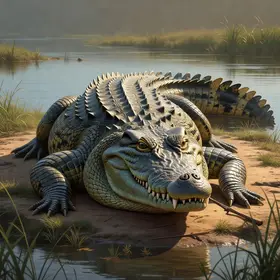
The mugger or marsh crocodile (Crocodylus palustris) is a medium-sized, broad-snouted crocodile of freshwater marshes, lakes, rivers and reservoirs from south-eastern Iran to India and Sri Lanka. It digs burrows to escape extreme heat and cold, has been seen using sticks to lure birds, and causes the third-most attacks on people of any crocodile.
- Habitat
- Slow, shallow freshwater: marshes, lakes, rivers, reservoirs and irrigation canals, up to about 420 m
- Size
- Males usually 3 to 3.5 m, females 2 to 2.5 m; rarely 5 m
- Diet
- Fish, snakes, turtles, birds and mammals up to the size of chital deer; also carrion
- Range
- India, Sri Lanka, Nepal, Pakistan and south-eastern Iran
- Breeding
- Digs a nest hole in sand; 8 to 46 eggs per clutch; both parents guard the young
- Status
- Vulnerable (IUCN)
Habitat & range
The mugger lives in southern Iran, Pakistan, Nepal, India and Sri Lanka, up to about 420 m above sea level. It prefers slow-moving, shallow freshwater such as lakes, rivers and marshes, and also does well in artificial reservoirs and irrigation canals. It barely enters brackish water, so it overlaps with the saltwater crocodile only in a few coastal areas. It is extinct in Bhutan apart from a few released captive-bred animals, considered locally extinct in Myanmar, and possibly gone from Bangladesh (Wikipedia). Mugger Crocodile appears as a Reptilia creature card in Wilder, a free browser collectible card game.
Diet & hunting
Hatchlings eat mostly insects such as beetles, plus crabs and shrimp. Adults take fish, snakes, turtles, birds and mammals including monkeys, otters and deer up to the size of chital, and they scavenge (Wikipedia). Muggers seize animals that come to the water's edge and drag them in. In Bardia National Park in Nepal, one was seen caching a chital kill under tree roots and coming back for it (Wikipedia). Muggers have also been recorded balancing sticks on their snouts during the bird nesting season, apparently to lure wading birds collecting nest material (Dinets et al. 2013).
Behavior & adaptations
The mugger has the broadest snout of any living crocodile, a rough head without ridges, and large neck scutes. Adults are dark olive to grey or brown (Wikipedia). It walks on land more than many crocodiles: in the hot dry season it travels overland at night to find water. Like all crocodilians it cannot control its body temperature internally, so it digs burrows up to 6 m deep where the temperature stays at about 19 to 29 °C (Wikipedia). Females dig nests in sand and lay up to two clutches of 8 to 46 eggs, and both parents protect the young for up to a year (Wikipedia).
Danger to people
According to CrocAttack, the mugger is responsible for the third-highest number of attacks on people each year, after the Nile crocodile and the saltwater crocodile, with an estimated 50 to 60 people killed a year in recent years, mostly in India. The highest numbers come from the Indian states of Gujarat and Uttar Pradesh (CrocAttack). Because muggers live in busy rivers, lakes and canals close to farms and villages, people and crocodiles meet often.
Conservation
The mugger has been listed as Vulnerable on the IUCN Red List since 1982. In 2013 fewer than 8,700 mature individuals were estimated to live in the wild (IUCN; Wikipedia). It is on CITES Appendix I and protected by law in India, Sri Lanka and Iran. Threats include habitat loss, drowning in fishing nets, killings in conflict with people, and road and rail accidents (Wikipedia).
Fun facts about Mugger Crocodile
- The English name comes from the Hindi word magar, meaning crocodile (Wikipedia).
- It is one of the first reptiles recorded using objects as lures, balancing sticks on its snout to attract nesting birds (Dinets et al. 2013).
- Bengal tigers sometimes fight muggers over prey and occasionally kill adults in Ranthambore National Park (Wikipedia).
- Nest temperature decides the sex of the hatchlings: constant 28 to 31 °C produces only females (Wikipedia).
Mugger Crocodile vs Tiger
On land the tiger usually wins; in the water, the mugger is the one to bet on.
This one really happens. In Ranthambore National Park in India, Bengal tigers occasionally fight mugger crocodiles off prey, and they have rarely been seen killing adult muggers (Wikipedia). In the water the mugger has the edge with its armour and bite, but on the bank a tiger is faster and more agile, and it can attack from the side or the back.
Read more about Tiger.
Common questions about Mugger Crocodile
How dangerous is the mugger crocodile to people?
It causes the third-most crocodile attacks in the world. Only the Nile crocodile and the saltwater crocodile attack more people. CrocAttack estimates about 50 to 60 people a year have been killed by muggers in recent years, mostly in India, with the highest numbers in Gujarat and Uttar Pradesh (CrocAttack).
Do mugger crocodiles really use sticks to hunt birds?
Yes, it has been recorded. Muggers in India were seen lying in shallow water with sticks balanced on their snouts during the bird nesting season, when wading birds collect sticks for nests. It is one of the first known cases of reptiles using objects as lures (Dinets et al. 2013).
How big does a mugger crocodile get?
Usually 3 to 3.5 m for males and 2 to 2.5 m for females. Muggers rarely reach 5 m. A 3 m male caught in Pakistan weighed 195 kg (Wikipedia). It is a medium-sized crocodile, far smaller than the saltwater crocodile, but it has the broadest snout of any living crocodile.
Where do mugger crocodiles live?
In fresh water from south-eastern Iran to India and Sri Lanka. It lives in India, Sri Lanka, Nepal, Pakistan and Iran, in slow, shallow lakes, rivers and marshes, and also in reservoirs and irrigation canals. It barely enters brackish water. It is extinct in Bhutan apart from released captive-bred animals, and possibly in Bangladesh (Wikipedia).
Is the mugger crocodile endangered?
It is listed as Vulnerable. The IUCN has rated it Vulnerable since 1982, and in 2013 fewer than 8,700 mature muggers were estimated to live in the wild. Habitat loss, fishing nets, conflict with people and road accidents are the main threats. International trade is banned under CITES Appendix I (IUCN; Wikipedia).
More Reptilia animals
Reptilia · Water · Cost 4