
Nile Crocodile
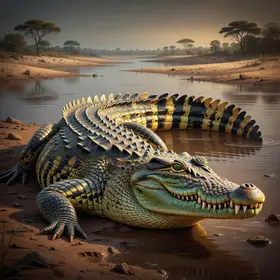
Crocodylus niloticus
Nile Crocodile: Africa's Largest Predator
The Nile crocodile (Crocodylus niloticus) is a large crocodile of rivers, lakes and swamps across sub-Saharan Africa and western Madagascar. It is the largest predator in Africa and the second-largest living reptile after the saltwater crocodile, and it is likely responsible for hundreds of human deaths a year.
- Habitat
- Rivers, lakes, swamps and marshes; sometimes deltas and brackish lakes
- Size
- Adult males usually 3.5 to 5 m and 225 to 750 kg; females about 30% smaller
- Diet
- Fish when young; adults also take antelope, zebra, wildebeest, birds and carrion
- Range
- Sub-Saharan Africa (26 countries) and western Madagascar
- Breeding
- Buries its eggs in sand; incubation about 90 days; mothers guard the young
- Status
- Least Concern (IUCN)
Habitat & range
The Nile crocodile lives in freshwater across sub-Saharan Africa, mostly in the east, south and centre of the continent, in lakes, rivers, swamps and marshes. It occasionally uses deltas and brackish lakes, and rarely salt water. An isolated population lives in western and southern Madagascar. It once ranged down the whole Nile, and Lake Turkana in Kenya still holds one of the largest undisturbed populations (Wikipedia). Crocodiles in West Africa that were once lumped in with it are now treated as a separate species, the West African crocodile (Crocodylus suchus) (Wikipedia). Nile Crocodile appears as a Reptilia creature card in Wilder, a free browser collectible card game.
Diet & hunting
Young Nile crocodiles eat insects and small fish. Adults are opportunists that take fish, birds and mammals, including large antelope, and they scavenge (Wikipedia). They hunt mainly by ambush: lying almost completely under water close to the bank, they lunge at animals that come down to drink or cross, grab them in their jaws and drag them under to drown. Groups sometimes cooperate, for example by forming a semicircle across a river to block migrating fish, and the most dominant crocodile eats first (Wikipedia). On land they also ambush prey at night along trails up to about 50 m from the water (Wikipedia).
Behavior & adaptations
Adults are dark bronze above with faded blackish spots and bands, yellowish-green flanks with oblique dark stripes, and green eyes; juveniles have bolder dark crossbands on the body and tail (Wikipedia). The snout is relatively long, about 1.6 to 2 times as long as it is broad. A bite force of about 22 kN (5,000 lbf) has been measured, yet the muscles that open the jaws are so weak that a person can hold them shut (Wikipedia). Females bury their eggs in sand near water. Incubation takes about 90 days, and nest temperature decides whether the hatchlings are male or female. Mothers dig out the hatchlings, carry them to the water in their mouths and guard them for up to two years (Wikipedia).
Danger to people
The Nile crocodile is one of the most dangerous crocodiles to people. CrocAttack, which collects attack records, says it is likely responsible for hundreds of human deaths every year, but that accurate figures are hard to get because many countries keep poor records (CrocAttack). Its own records from most of Africa are largely incomplete, so recorded totals are a floor (CrocAttack).
Conservation
The IUCN lists the Nile crocodile as Least Concern because it is widespread and common, with strong populations in many countries in eastern and southern Africa, despite regional declines (IUCN 2019; Wikipedia). It is farmed and ranched for its skin and meat in parts of Africa. Habitat loss, dams, pollution and conflict with people remain local threats (Wikipedia).
Fun facts about Nile Crocodile
- It is the largest predator in Africa: an average adult male, about 280 kg, far outweighs an average male lion, about 188 kg (Wikipedia).
- Despite its name, it is now rare in most of Egypt; it disappeared as a breeding species there in the 20th century and has returned locally around the Aswan Dam (Wikipedia).
- DNA shows that the Nile crocodile is more closely related to the crocodiles of the Americas than to the West African crocodile (Wikipedia).
- Only about 1% of hatchlings are thought to survive to adulthood (Wikipedia).
Nile Crocodile vs Hippopotamus
The hippopotamus usually wins: an adult is too big and too aggressive for a crocodile to take on.
Nile crocodiles and hippos really do share African rivers and lakes. A big hippo is far heavier than even the largest crocodile, has a thick hide and huge canine tusks, and is highly aggressive about its stretch of water (Wikipedia). The crocodile's best weapons are the ambush and its bite, which work on antelope and zebra. Adult hippos are simply too big for that. Crocodiles do gather in groups to feed on hippos that have already died (Wikipedia).
Read more about Hippopotamus.
Common questions about Nile Crocodile
How many people do Nile crocodiles kill each year?
Probably hundreds. CrocAttack, which collects attack records, says the Nile crocodile is likely responsible for hundreds of human deaths a year, but exact figures are hard to get because many African countries keep poor records (CrocAttack). It ranks alongside the saltwater crocodile as the most dangerous crocodile to people (Wikipedia; saltwater crocodile danger).
Is the Nile crocodile bigger than the saltwater crocodile?
No, it is a close second. Adult male Nile crocodiles are usually 3.5 to 5 m long and weigh 225 to 750 kg, with rare giants over 6.1 m and 1,000 kg. That makes it the largest predator in Africa and the second-largest living reptile, after the saltwater crocodile. Females are about 30% smaller than males (Wikipedia).
How strong is a Nile crocodile's bite?
About 22 kN (5,000 lbf), as measured in an adult by Brady Barr. Oddly, the muscles that open the jaws are very weak, so a person can hold a crocodile's mouth shut, and handlers tape the jaws closed (Wikipedia).
Do Nile crocodiles look after their babies?
Yes, for up to two years. The female buries her eggs in sand and guards the nest for about 90 days. When the young call from inside the eggs, she digs them out, carries them to the water in her mouth or throat pouch, and protects them. Neighbouring mothers sometimes form a crèche (Wikipedia).
Is the Nile crocodile the same species as the West African crocodile?
No. The two were long treated as one species, but DNA studies showed that the West African crocodile, Crocodylus suchus, is separate. The Nile crocodile turned out to be more closely related to American crocodiles than to the West African one (Wikipedia).
Featured in the Field Journal
More Reptilia animals
Reptilia · Water · Cost 5