Why Are Greater Flamingos Pink — and Why Stand on One Leg?
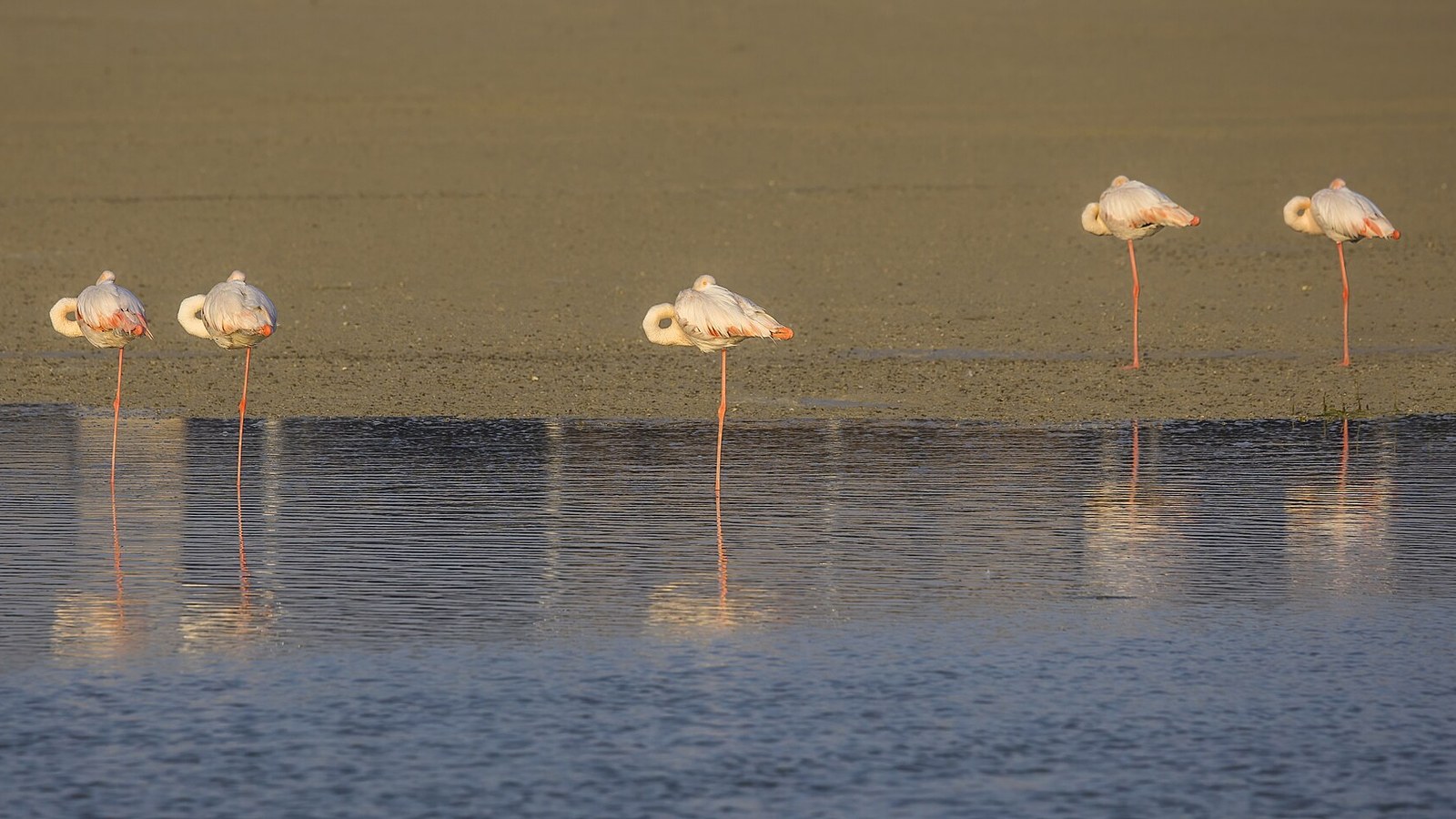
Species deep dive · greater flamingo
Why are flamingos pink? They are what they eat. Greater Flamingos (Phoenicopterus roseus) load their feathers, skin and beak with carotenoid pigments from algae and from the tiny crustaceans — especially brine shrimp — that feed on those algae. Birds break the pigments down and deposit them in growing feathers; cut the carotenoids from a captive diet and the pink fades toward white or gray (Smithsonian's National Zoo). Chicks hatch a dull gray-brown and only blush as they start feeding themselves on the same carotenoid-rich soup.
Why stand on one leg?
Two research lines give complementary answers. In 2017, Chang and Ting showed that flamingo cadavers can hold a stable one-legged pose with little active muscle force: a passively engaged gravitational stay in the proximal hip and knee locks the limb when the foot sits under the body and the leg angles inward — more like a doorstop than a clenched muscle (Biology Letters). Live birds standing quietly keep their centre of pressure under the distal joint, which also cuts the need for constant torque.
Earlier zoo work by Anderson and Williams found Caribbean flamingos rested on one leg more often in water than on land, and less often as temperature rose — consistent with heat conservation by tucking one bare leg up against the warm body (Zoo Biology 2010). So the posture can save muscular energy and reduce heat loss; neither explanation needs to wipe out the other.
Filter feeding upside-down
The greater flamingo's bill is a precision sieve. The bird drops its head upside-down between its feet and pumps water through rows of lamellae that trap algae, diatoms and small invertebrates — classic filter feeding first mapped in detail by Jenkin in the 1950s (Royal Society archive). Flocks work shallow saline lakes, lagoons and mudflats from Africa and southern Europe through the Middle East into South Asia.
Parents feed chicks a nutrient-rich secretion often called crop milk — produced in the upper digestive tract, not a true mammalian milk — until the young bill is curved and lamellated enough to filter alone (Stanford Birds essay on bird milk; WWT Slimbridge).
Conservation snapshot
Globally the greater flamingo is listed as Least Concern on the IUCN Red List — widespread and still numerous — though local colonies depend on undisturbed saline wetlands that face drainage, pollution and disturbance. Seeing a pink flock is common; keeping the wetlands that manufacture that pink is the harder job.
How the greater flamingo plays in Wilder
In Wilder TCG the Greater Flamingo is a Cost 3 Aves Water Uncommon (ATK 2 / HP 5) with Flock. Flock rewards packing more of the same bird — a nod to the dense, synchronized colonies that filter-feed and nest together. Flavor text: "One leg, endless patience, and a bill that sifts dinner from soup." For more Water Aves and wetland neighbors, browse the Field Journal and the animal field guides.
Play Wilder free in your browser. No signup needed.
Photo credit
Hero photograph: Charles J. Sharp, "Greater flamingos (Phoenicopterus roseus) resting", greater flamingos resting on one leg in the Dohat Arad Lagoon, Muharraq, Bahrain (Wikimedia Commons), CC BY-SA 4.0. Cropped for the Field Journal hero.

Questions people ask
Are flamingos born pink?
No. Greater flamingo chicks hatch gray-brown and only gain pink as they ingest carotenoid-rich food. Without those pigments in the diet, adult color fades (Smithsonian's National Zoo).
Does standing on one leg save flamingos energy?
It can. Chang and Ting (2017) showed a passive gravitational stay can support body weight on one leg with little active muscle force, and quiet birds keep balance with tiny sway (Biology Letters). Heat conservation is a separate, supporting explanation (Anderson & Williams).
What is flamingo crop milk?
A nutrient-rich secretion from the upper digestive tract that both parents regurgitate to chicks until the young bill can filter-feed. It is analogous to pigeon "crop milk," not mammalian milk (Stanford Birds; WWT).
How do greater flamingos filter-feed?
Upside-down. They dunk the curved bill between their feet and pump water through lamellae that trap algae, diatoms and small invertebrates (Jenkin 1957). See the Greater Flamingo field guide.
Are greater flamingos endangered?
Globally, no — IUCN lists them as Least Concern because they are widespread and still numerous. Local colonies still need intact saline wetlands free from heavy drainage, pollution and disturbance (IUCN Red List).
Sources
- Smithsonian's National Zoo — Why are flamingos pink and other flamingo facts
- Chang & Ting (2017) Mechanical evidence that flamingos can support their body on one leg with little active muscular force. Biology Letters.
- Anderson & Williams (2010) Why do flamingos stand on one leg? Zoo Biology.
- Jenkin (1957) The filter-feeding and food of flamingoes (Phoenicopteri). Philosophical Transactions of the Royal Society B.
- Stanford Birds — Bird milk
- WWT Slimbridge — Flamingos are flamtastic mothers
- IUCN Red List — Phoenicopterus roseus (Greater Flamingo)
- Wilder TCG — Greater Flamingo field guide