Whale Shark: Is the World's Biggest Fish Really an Omnivore?
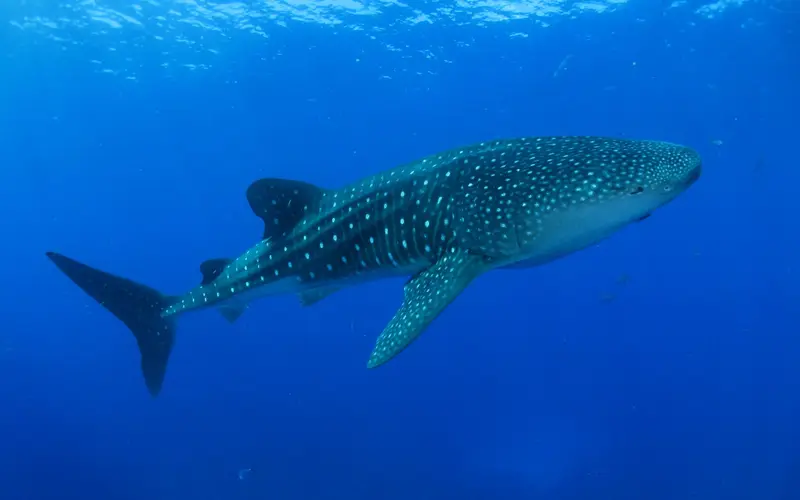
Probably. Skin chemistry suggests Ningaloo's whale sharks digest floating Sargassum seaweed as well as krill, making them the largest known omnivore.
Play Whale Shark in Wilder, free in your browser
Species deep dive · whale shark Play this card, antarctic krill Play this card
Probably, yes. Whale sharks swallow plants as well as animals, and the best evidence says they digest some of them. In a 2022 study of whale sharks at Ningaloo Reef in Western Australia, scientists found chemical traces of floating Sargassum seaweed built into the sharks' own tissue. They concluded that the whale shark is the world's largest known omnivore (Meekan et al. 2022; AIMS). Not every shark scientist is convinced the plants are on purpose, but the idea of a strictly meat-eating filter feeder no longer fits the data.
The study has been doing the rounds again in November 2026 (Earth.com), so here's what the scientists actually measured, what the doubters say, and what it changes.
What whale sharks eat
The whale shark is a filter feeder, but not a fussy one. The Florida Museum lists planktonic and larger free-swimming prey: small crustaceans, fish eggs, schooling fish and occasionally tuna and squid. It also notes that phytoplankton and larger seaweeds "may form a component of the diet." Unlike most plankton-feeding animals, the whale shark doesn't rely on swimming slowly forward to filter. It uses suction, drawing water into its mouth at speed (Florida Museum).
Seaweed had turned up before in the stomachs of stranded whale sharks. Because they feed by swimming through food with their mouths open, most researchers assumed it was swallowed by accident and passed straight through (Science News).
How scientists tested it
At Ningaloo, whale sharks gather each year to feed, and they've long been watched eating krill there. In 2017, Mark Meekan of the Australian Institute of Marine Science and colleagues spotted surfacing whale sharks from a plane, reached them by boat, and took small skin samples from 17 sharks. They also sampled the possible foods on the reef, from plankton to large seaweeds (Science News; AIMS).
Then they compared the chemistry. What an animal swallows can simply pass through its gut, but the chemical building blocks it digests end up in its body. That makes tissue a record of what an animal actually uses for energy and growth, not just what goes in its mouth (AIMS). Two tests pointed the same way:
| Test | Whale sharks | Comparison | What it suggests |
|---|---|---|---|
| Food-chain level (amino acid isotopes) | Average 2.0 | Krill from the same reef: 2.4 | If the sharks ate mostly krill, they should sit about one level above krill, not level with them |
| A fatty acid rare in most fish | 16% of fatty acids in shark skin | Sargassum: 10%; krill: 3–5% | Sargassum is the more likely source |
Figures as reported from the paper by Earth.com; study: Meekan et al. 2022.
The fatty acid is arachidonic acid, which the sharks can't make themselves (Science News). The team also netted whale shark droppings, which did contain krill. "The poo did show that they were eating krill," said Patti Virtue of the University of Tasmania. "But they're not metabolising much of it" (AIMS).
An earlier, independent study had already found plant nutrients in the skin of whale sharks off Japan, so Ningaloo isn't a one-off (Science News; Wyatt et al. 2019).
The doubters have a point
Swallowing plants isn't the same as choosing them. Shark biologist Robert Hueter of Mote Marine Laboratory told Science News that whale sharks take in plenty of things besides the food they're targeting: "This is a bit like saying that cows are omnivores because they eat insects while feeding on grass." Meekan agrees he can't say for sure the sharks seek out Sargassum, but argues the amount they use is too large to be incidental (Science News).
The paper has other limits too. Skin samples can't show digestion directly, and some of the signal might come from small animals and algae living on the seaweed, or from seafloor organisms passed along by krill. All 17 sharks also came from one reef (Earth.com). A feeding experiment, or samples from other aggregation sites, would settle a lot.
Why it matters
If the result holds, the title of world's largest omnivore moves from land to sea. The previous holder was the Kodiak brown bear, at about 2.5 m long. The average whale shark is about 12 m (Science News). "On land, all the biggest animals have always been herbivores," Meekan said. "Turns out that maybe the system of evolution on land and in the water isn't that different after all" (AIMS).
It also matters for conservation. Knowing that whale sharks can get energy from floating seaweed changes how scientists think about what they're doing far out in the open ocean, where they spend most of their lives (AIMS; Science News). Compare that with the blue whale, which depends almost entirely on krill: see how much krill a blue whale eats, and the Antarctic krill card.
What baby whale sharks eat is still a mystery
Even less is known about the smallest whale sharks. A live pup taken from its dead mother and kept in Japan didn't eat for its first 17 days, which suggests newborns carry big energy reserves (Florida Museum).
New sightings may help. In Saleh Bay, on Sumbawa in Indonesia, fishers have reported 5 sightings of very small whale sharks, 1.2 to 1.5 m long, since August 2024. Only 33 whale sharks under 1.5 m had been reported in previous scientific papers. Konservasi Indonesia says the bay may be a pupping ground, which would be the first documented anywhere, but stresses the evidence is preliminary. Its July 2026 assessment identified 174 individual whale sharks in the bay, and a proposed marine protected area would cover 90% of known hotspots (Mongabay).
For the whale shark's size, feeding mechanics and why it's endangered, read whale shark: largest fish, filter feeder, and why it's endangered and the largest fish in the world, ranked.
How the whale shark plays in Wilder
The Whale Shark (Rhincodon typus) is a Common Pisces card in the Water element. It costs 7 Energy, with Attack 2 and a huge 11 Health, and has Resilient and Guardian: a slow, gentle wall rather than a hunter, which suits an animal that eats some of the smallest food in the sea. Flavour text: "Gentle giant that filters oceans, not fears."
Wilder is a free browser collectible card game about real animals, and you can play it free in your browser with no signup.
Photo credit
Hero photograph: Ryan Eckert/NOAA, "FGBNMS -- Whale Shark" (whale shark at Flower Garden Banks National Marine Sanctuary, Gulf of Mexico, 21 August 2011), Wikimedia Commons, public domain (work of the US government, NOAA). Cropped for the Field Journal hero.

Play Whale Shark in Wilder, free in your browser
Questions people ask
Are whale sharks whales?
No. The whale shark is a shark, which makes it a fish. It belongs to the carpet shark order, Orectolobiformes, in the family Rhincodontidae. The "whale" in its name refers to its size: it is the largest living fish (Florida Museum).
How deep can whale sharks dive?
At least 1,928 m (6,325 ft). Studies have recorded whale sharks reaching that depth, even though they're best known for feeding at the surface. They prefer warm water, with surface temperatures of about 21–30 °C (Florida Museum).
How long do whale sharks live?
Nobody knows for sure, but probably many decades. The Florida Museum says age estimates run as high as 60 years (Florida Museum), and conservationists quoted by Mongabay say they often live to 80 and don't mature until about 30 (Mongabay). Slow growth is one reason fishing hits them so hard.
How many whale sharks are left in the world?
Roughly 119,000 to 238,000, by one estimate. The Indo-Pacific population, about three-quarters of the total, has fallen by 63% over 75 years, and the Atlantic population by about 30%. Fishing, bycatch and ship strikes are the main threats (Mongabay). The IUCN lists the species as Endangered (IUCN Red List).
Sources
- Meekan et al. (2022) The world's largest omnivore is a fish. Ecology 103(12): e3818
- Australian Institute of Marine Science: World's largest omnivore is a fish (25 Jul 2022)
- Science News: Whale sharks may be the world's largest omnivores (1 Aug 2022)
- Earth.com: Whale sharks actually eat and digest plants (17 Nov 2026)
- Wyatt et al. (2019) Enhancing insights into foraging specialization in the world's largest fish using a multi-tissue, multi-isotope approach. Ecological Monographs 89
- Florida Museum of Natural History: Whale shark (Rhincodon typus) species profile
- Mongabay: Plans for a new marine protected area boost whale shark conservation in Indonesia's Saleh Bay (17 Nov 2026)
- IUCN Red List: Rhincodon typus (Whale Shark), Pierce & Norman 2016