Mugger Crocodile: How Dangerous Is It to People?
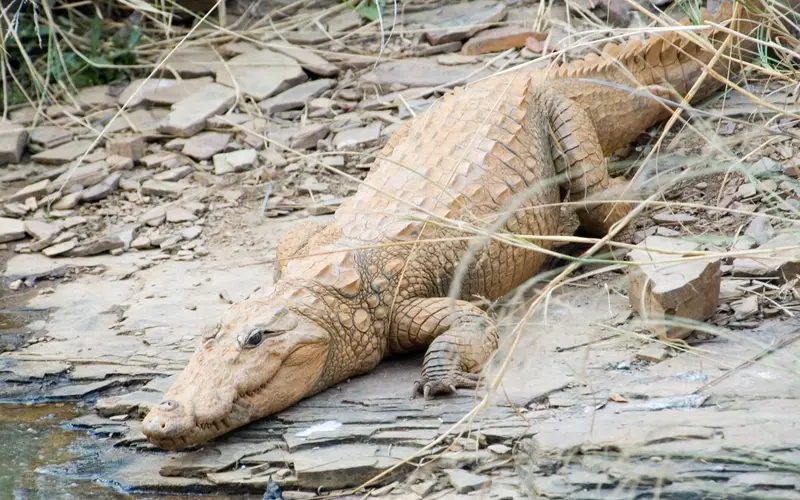
The mugger causes the third-most crocodile attacks on Earth, killing an estimated 50 to 60 people a year, mostly in India's Uttar Pradesh and Gujarat.
Play Mugger Crocodile in Wilder, free in your browser
Species deep dive · mugger crocodile Play this card
Very dangerous, by crocodile standards. The mugger causes the third-most crocodile attacks in the world, after the Nile and saltwater crocodiles. CrocAttack, the global crocodile attack database, estimates that muggers have killed around 50 to 60 people a year in recent years, mostly in India, with the highest numbers in Uttar Pradesh and Gujarat (CrocAttack). It is a medium-sized crocodile, usually 3 to 4 m long, so it is not dangerous because it is huge. It is dangerous because it lives right where people do.
Here is where mugger attacks happen, why they happen, and why this Vulnerable crocodile is spreading back into cities.
Where mugger attacks happen
India recorded 768 crocodile attacks, 317 of them fatal, from 2015 to 2024. India has both muggers and saltwater crocodiles, but CrocAttack says the mugger is responsible for more of those attacks, because saltwater crocodiles only live along a small part of India's coast (CrocAttack 2015–2024 statistics).
Some regions can be pinned on the mugger alone. These rows come from CrocAttack's 2015–2024 table, where the database assigns every case to Crocodylus palustris:
| Region | Attacks, 2015–2024 | Fatal | Source |
|---|---|---|---|
| Uttar Pradesh, India | 223 | 68 | CrocAttack |
| Gujarat, India | 111 | 56 | CrocAttack |
| Madhya Pradesh, India | 64 | 31 | CrocAttack |
| Rajasthan, India | 61 | 31 | CrocAttack |
| Nepal | 20 | 6 | CrocAttack |
Uttar Pradesh had more recorded crocodile attacks than any other province or state in the world over that decade, ahead of every region of Papua New Guinea and Indonesia, where saltwater crocodiles live (CrocAttack 2015–2024 statistics). The attacks keep coming: in 2023 alone, at least 35 people were attacked in Uttar Pradesh (13 fatally) and 15 in Gujarat (11 fatally). CrocAttack names the Vishwamitri River in Vadodara and the waterways around Katarniaghat Wildlife Sanctuary as major hotspots (CrocAttack).
These are recorded cases only, so treat them as a minimum.
A crocodile that lives in cities
The mugger is not fussy about where it lives. Besides rivers and marshes, it uses dams, canals, man-made reservoirs (called tanks in Sri Lanka) and city lakes. CrocAttack lists Lake Powai in Mumbai among its important sites, and says muggers in Gujarat and Uttar Pradesh are often found in densely populated areas, including towns and cities (CrocAttack).
Vadodara in Gujarat is the best-known example. A census along a 25 km stretch of the Vishwamitri River, which runs through the city, counted 212 crocodiles in 2020. A preliminary count on 7 February 2026 found about 417, with 103 in a single stretch between Kalaghoda and Narhari Hospital (DeshGujarat).
Why muggers attack
The best long-term study comes from Gujarat. Raju Vyas and Colin Stevenson compiled 64 mugger attacks in the state from 1960 to 2013, 33 of them fatal. More than two-thirds of the victims were men, and 52 of the attacks happened in central Gujarat, 41 of them in the Vishwamitri–Dhadhar river system that runs through Vadodara (Vyas & Stevenson 2017).
Timing matters. Most attacks happened between April and September and peaked in May, with 14 attacks. That is the mugger's breeding season in Gujarat. The authors pointed to a lack of basic facilities in rural areas, poverty and illiteracy, and adult crocodiles living close to settlements. They also blamed poor management: few preventive measures, no protocols for rescuing muggers, and "haphazard release" of problem animals somewhere else (Vyas & Stevenson 2017).
CrocAttack makes the same point for crocodile attacks in developing regions in general. Many people rely on local rivers and lakes for their livelihoods and basic household needs because they lack plumbing or safe access to fresh water, so the risk can't be removed entirely. It can be cut with warning signs, crocodile exclusion enclosures (fenced-off safe water points) and safety education (CrocAttack).
How it compares with the Nile and saltwater crocodiles
The mugger sits a long way behind the two giants. The Nile crocodile probably kills hundreds of people a year across Africa, though most attacks there go unrecorded (read how many people Nile crocodiles kill). The saltwater crocodile has the highest well-documented toll, mostly in Indonesia and Papua New Guinea (see how dangerous saltwater crocodiles are).
Size is part of the difference. Muggers usually reach 3 to 4 m, with a maximum of probably around 4.5 m (CrocAttack), while saltwater crocodiles are the largest reptiles alive (see the largest reptiles in the world, ranked). In the mugger-only Indian rows above, the fatal share ranges from about a third (Uttar Pradesh) to about half (Gujarat, Madhya Pradesh and Rajasthan).
A clever predator, still Vulnerable
The mugger is also one of the few reptiles known to use tools. In India, muggers were seen lying in shallow water with sticks balanced on their snouts during the bird nesting season, when wading birds collect sticks for their nests (Dinets et al. 2013).
It is still a threatened species. Hunting shrank its range drastically until the 1970s, and today its population is fragmented and threatened mainly by habitat loss and the side effects of conflict with people. The IUCN lists it as Vulnerable (Bors et al. 2024; IUCN Red List). Vadodara's rising count shows that muggers can come back when they are protected. Keeping that comeback safe for people depends on the fixes the Gujarat study and CrocAttack point to: safe water access, warning signs and enclosures at hotspots, and proper rescue instead of random releases.
How the mugger crocodile plays in Wilder
The Mugger Crocodile (Crocodylus palustris) is an Uncommon Reptilia card in the Water element. It costs 4 Energy, with Attack 4 and Health 5, and has Basking, Ambush and Resilient. Flavour text: "Balances sticks on its snout to lure nesting birds, and digs a burrow to wait out the heat."
A ranked list of the most dangerous reptiles is coming to the Field Journal soon. Until then, compare the mugger with the Nile crocodile, the saltwater crocodile and the American crocodile.
Wilder is a free browser collectible card game about real animals, and you can play it free in your browser with no signup.
Photo credit
Hero photograph: Paul Asman and Jill Lenoble, "mugger crocodile Crocodylus palustris" (6 December 2007), Wikimedia Commons, CC BY 2.0. Cropped for the Field Journal hero.

Play Mugger Crocodile in Wilder, free in your browser
Questions people ask
Are there crocodiles in Mumbai?
Yes, mugger crocodiles. CrocAttack lists Lake Powai in Mumbai among the mugger's important sites in India, alongside rivers such as the Chambal and Narmada and many dams and lakes (CrocAttack). Muggers do well in reservoirs and city lakes, which is why they meet people so often.
How many people do mugger crocodiles kill in Sri Lanka?
Dozens over the past decade. CrocAttack counts 54 attacks and 37 deaths in Sri Lanka in which the mugger was the confirmed or most likely culprit, making it second only to India for mugger attacks, and says some incidents probably went unreported. Muggers live across most of the island except the western and south-western coasts, where saltwater crocodiles take over (CrocAttack).
Are there mugger crocodiles in Pakistan and Iran?
Yes, but only in small areas. In Iran they live only in Sistan and Baluchestan Province, around the Sarbaz River and Pishin Dam, where 8 attacks and 1 death were reported between 2012 and 2021. In Pakistan they survive in Sindh Province, at places such as the Nara Canal, Chotiari Reservoir and Haleji Lake, and fatal attacks there are rare (CrocAttack).
Is the mugger crocodile extinct in Bangladesh?
It is considered extinct there, but wanderers keep turning up. Single crocodiles have been seen or caught on the Padma River in Rajshahi and the Nagri River in Rangpur, probably drifting in from West Bengal in India. A small, semi-wild group also lives in the lagoon at the Khan Jahan Ali shrine in Bagerhat (CrocAttack).
Sources
- CrocAttack: Mugger crocodile (Crocodylus palustris) species profile
- CrocAttack: 2015-2024 attack statistics (worldwide crocodilian attack database, Brandon Sideleau)
- Vyas & Stevenson (2017) Review and analysis of human and Mugger Crocodile conflict in Gujarat, India from 1960 to 2013. Journal of Threatened Taxa 9(12)
- Bors, Shankar & Gruszczyńska (2024) Current State of Mugger Populations. Animals 14(5): 691
- DeshGujarat: 417 crocodiles recorded in Vishwamitri River stretch in Vadodara (11 Feb 2026)
- Dinets, Brueggen & Brueggen (2013) Crocodilians use tools for hunting. Ethology Ecology & Evolution
- IUCN Red List: Crocodylus palustris (Mugger)
- CrocAttack: Crocodilian attack mitigation