Nile Crocodile: How Many People Do Nile Crocodiles Kill?
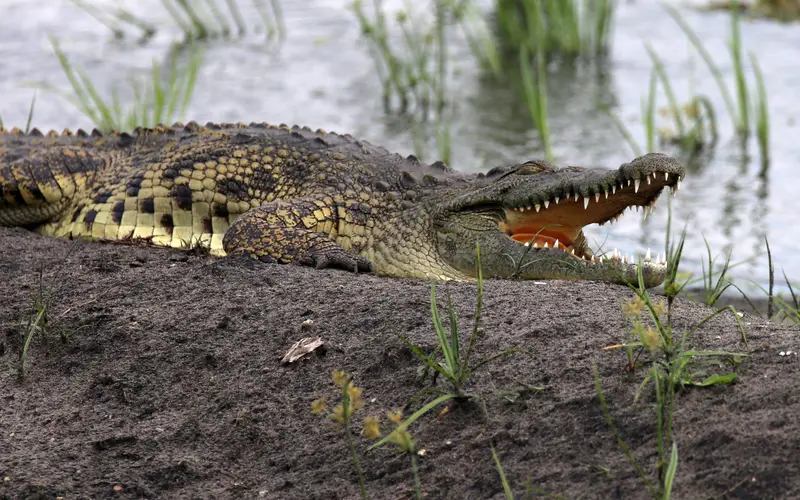
Probably hundreds a year. Records from 2015-2024 list 116 deaths in Zambia and 107 in Zimbabwe alone, and most African attacks are never recorded.
Play Nile Crocodile in Wilder, free in your browser
Species deep dive · nile crocodile Play this card
Probably hundreds of people a year, but nobody knows the exact number. CrocAttack, the database that tracks crocodile attacks worldwide, says the Nile crocodile is "likely responsible for hundreds of human deaths annually," and that good estimates are hard to make because many African countries keep poor records or none at all (CrocAttack). The recorded numbers are already high. In the ten years from 2015 to 2024, Zambia alone logged 179 Nile crocodile attacks and 116 deaths, and Zimbabwe 167 attacks and 107 deaths (CrocAttack).
The Nile crocodile (Crocodylus niloticus) lives in rivers, lakes, swamps and estuaries in 26 countries across eastern, central and southern Africa and Madagascar (IUCN Red List). Adults are usually 4–5 m long (CrocAttack), and they wait in the same places where people fish, wash and fetch water every day.
The recorded toll, country by country
CrocAttack's table for 2015–2024 (retrieved 27 November 2026) lists these countries with the most recorded Nile crocodile attacks (CrocAttack):
Zambia: 179 attacks, 116 fatal
Zimbabwe: 167 attacks, 107 fatal
Mozambique: 101 attacks, 71 fatal
Malawi: 97 attacks, 73 fatal
DR Congo: 96 attacks, 66 fatal
Angola: 92 attacks, 62 fatal
Tanzania: 91 attacks, 71 fatal
Kenya: 85 attacks, 66 fatal
Uganda: 83 attacks, 69 fatal
Two provinces made the database's list of the 20 busiest attack hotspots anywhere in the world: Southern Province in Zambia (63 attacks, 41 fatal) and Southern Region in Malawi (54 attacks, 40 fatal) (CrocAttack). The database has since been updated with reports through September 2025, but the decade table above is the latest published breakdown.
Look at the second number in each row. In most of these countries, more than half of recorded attacks were fatal.
Why the real number is higher
These are floors, not totals. CrocAttack warns that "a large proportion of the attacks that have occurred in Africa were not recorded." Records from Namibia and South Africa are thought to cover most incidents, but in most other countries "a very high number of incidents" probably went unrecorded (CrocAttack). Some authorities count incidents without collecting the details a database needs, and many keep no records at all (CrocAttack).
Country notes make the gap plain. In Mozambique "large numbers are reported, possibly some of the most in all of Africa," but details are hard to get. In Tanzania it has been confirmed that many attacks go unreported, and in Uganda numerous incidents, especially non-fatal ones, probably go unreported too (CrocAttack).
That is also why the saltwater crocodile can look deadlier on paper. Asia and Australia are much better documented than Africa, so recorded saltie deaths in places like Indonesia and Papua New Guinea are closer to the truth (CrocAttack). Read how dangerous saltwater crocodiles are to people for that side of the story.
Who gets attacked, and why
Most victims are not tourists. They are people who need the water. In Zambia, 36.1% of recorded 2015–2024 victims were doing water, sanitation and hygiene tasks such as washing, bathing or collecting water, and 34% were fishing (CrocAttack).
A study around Murchison Falls and Lake Victoria in Uganda found 115 recorded attacks between 2012 and 2017. 84.3% were fatal, and 93.1% happened while victims were fishing or fetching water (Ashepet et al. 2023).
In South Africa and eSwatini, researchers pieced together 214 attacks from 1949 to 2016. Most victims were swimming or bathing, others were fishing, doing domestic chores or crossing rivers. Children under 16 made up 51% of victims and were more likely than adults to die, and teenage boys were the largest single group (Pooley et al. 2020). Attacks in dams have increased there since 2000.
What actually reduces attacks
The fixes are mostly about safe access to water, not killing crocodiles. The South Africa and eSwatini study recommends safe river crossings, safe places to swim near rural schools, and alternatives to the river for daily needs: water tanks, piped water and fenced-off enclosures (Pooley et al. 2020). CrocAttack makes the same point: in developing regions people rely on rivers and lakes for basic needs, so the risk can't be eliminated, but it can be cut with warning signs, crocodile exclusion enclosures and safety education (CrocAttack).
Enclosures only work if they are maintained. In Uganda, communities ranked crocodile exclusion enclosures as their favourite solution, but the researchers found one cage left dry when the lake level dropped and another broken by strong winds (Ashepet et al. 2023).
How the Nile crocodile plays in Wilder
The Nile Crocodile (Crocodylus niloticus) is a Rare Reptilia card in the Water element. It costs 5 Energy, with Attack 5 and Health 7, and has Ambush and Basking. Its ability Death Roll costs 3 Energy and deals 2 damage to an enemy creature, after the spinning roll crocodiles use to tear apart large prey. Flavour text: "Africa's largest predator waits at the river crossing, mostly under water, for whatever comes down to drink."
Compare it with the saltwater crocodile and the mugger crocodile, India's most frequent attacker, and see how the big crocs stack up in the largest reptiles in the world, ranked. A ranked list of the most dangerous reptiles is coming to the Field Journal soon.
Wilder is a free browser collectible card game about real animals, and you can play it free in your browser with no signup.
Photo credit
Hero photograph: flowcomm, "Nile crocodile, Chobe" (a wild Nile crocodile basking with its jaws open on a riverbank in Chobe, Botswana, 6 February 2022), Wikimedia Commons, CC BY 2.0. Cropped for the Field Journal hero.

Play Nile Crocodile in Wilder, free in your browser
Questions people ask
Are Nile crocodiles endangered?
No. The IUCN lists the Nile crocodile as Least Concern (assessed 2017), with an estimated 50,000 to 70,000 mature adults and a stable overall trend. Hunting depleted many populations between the 1940s and 1960s, and protection let them recover. Some local populations are still declining, and retaliatory killing after attacks is a growing threat (IUCN Red List).
Do crocodiles or hippos kill more people in Africa?
Where it has been measured, crocodiles. Official records in Mozambique showed wildlife killed 265 people between July 2006 and September 2008. Crocodiles caused 66% of the deaths, far more than lions, elephants or hippos, and over half of the crocodile deaths were along Lake Cahora Bassa and the Zambezi River (Dunham et al. 2010).
Was Gustave the man-eating crocodile real?
There was a big crocodile, but the legend has little evidence behind it. Gustave, from Burundi, is said to have killed around 300 people. CrocAttack found most photos said to show him actually show several different, ordinary-sized crocodiles, and surveys of the Rusizi River delta in the mid-2010s found only two crocodiles, both about 2 m long (CrocAttack).
Are there Nile crocodiles in Florida?
A few have been caught there. University of Florida scientists used DNA to confirm that young crocodiles caught in South Florida between 2000 and 2014 included Nile crocodiles related to South African ones. One was recaptured two years after release, having grown about 40 cm a year. There is no sign of a breeding population, and the pet trade is the likely source (Rochford et al. 2016; UF News).
Sources
- CrocAttack: 2015-2024 attack statistics (worldwide crocodilian attack database, Brandon Sideleau)
- CrocAttack: Nile crocodile (Crocodylus niloticus) species profile
- Ashepet et al. (2023) The state and perceptions of human-crocodile interactions around Murchison Falls Conservation Area, Uganda. Human Dimensions of Wildlife
- Pooley, Botha, Combrink & Powell (2020) Synthesizing Nile crocodile attack data and historical context to inform mitigation efforts in South Africa and eSwatini. Oryx 54(5)
- Dunham et al. (2010) Human-wildlife conflict in Mozambique: a national perspective, with emphasis on wildlife attacks on humans. Oryx
- IUCN Red List: Crocodylus niloticus (Nile Crocodile), Isberg et al. 2019
- Rochford et al. (2016) Molecular analyses confirming the introduction of Nile crocodiles in southern Florida. Herpetological Conservation and Biology 11(1)
- University of Florida News: Man-eating monster crocodile may be Florida's newest invasive species (May 2016)
- CrocAttack: Crocodilian attack mitigation