Orca: Do Killer Whales Attack Humans?
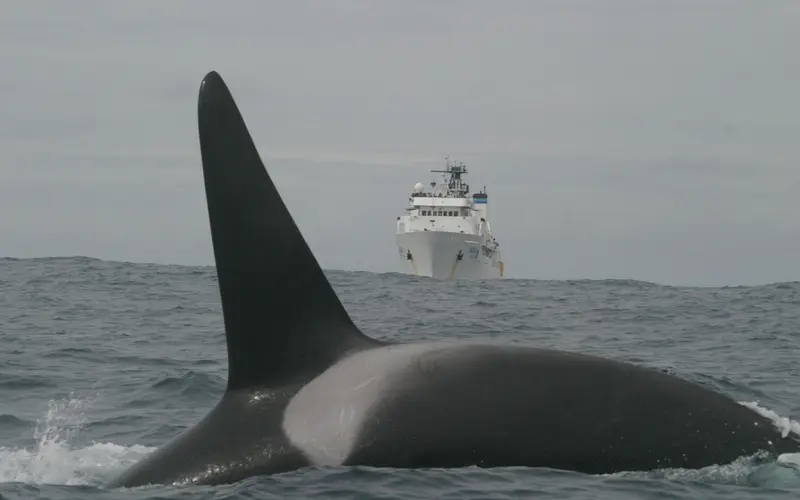
Almost never in the wild. Only one confirmed bite on a person is known, while captive orcas have killed trainers and Iberian orcas ram boat rudders.
Play Orca in Wilder, free in your browser
Species deep dive · orca Play this card
Almost never, in the wild. Orcas are the ocean's top predator, but they have essentially no record of hunting people. The one confirmed wild bite on a person is a surfer off California in 1972, and the orca quickly let go (Live Science). The dangerous encounters happen elsewhere: with orcas kept in captivity, which have killed people, and with a small group off Spain and Portugal that rams sailing boats but doesn't go after the sailors.
The killer whale, or orca (Orcinus orca), is the largest member of the dolphin family and lives in every ocean (NOAA Fisheries). In November 2026 a viral post asking why orcas never hunt humans got people talking again, so here is what the evidence actually says.
Why wild orcas leave people alone
Orcas are picky eaters, and their menus are learned. Each population, or ecotype, has its own hunting culture. In the U.S. Pacific Northwest, resident killer whales eat only fish, mostly salmon, while Bigg's (transient) killer whales in the same waters eat mainly marine mammals and squid (NOAA Fisheries).
Erich Hoyt of Whale and Dolphin Conservation told Live Science that orcas are "fussy eaters, really conservative in terms of whatever they learned from their mothers and from their pod about what constitutes food" (Live Science). People have never been on that list, so a swimmer isn't a meal an orca has learned to take.
Mistaken identity is less likely too. A shark may bite a surfer it took for a seal, but orcas hunt with echolocation as well as sight, so they can tell a person from a seal or sea lion (PBS Nature).
The rare exceptions
1972, California: a killer whale bit a surfer and quickly let go. The researcher who interviewed him later said he may well have looked like a seal (Live Science).
1950s, Canadian Arctic: the only report of a wild orca killing a person comes from two Igloolik Inuit elders, who told researchers decades later that a young man died after going out on thin ice near orcas trapped by sea ice (Live Science).
Captive orcas are a different story
There have been dozens of violent incidents between people and captive orcas. The best known is Tilikum, who was involved in the deaths of three people, including SeaWorld trainer Dawn Brancheau in 2010 (Live Science). Scientists aren't sure what triggers these attacks. Hoyt compares captivity to living in a tiny jail cell (Live Science).
The orcas that ram boats
Since 2020, orcas off Spain, Portugal and Morocco have been touching, pushing and even turning boats, mostly sailing boats, often breaking their rudders. The Atlantic Orca Working Group recorded 52 interactions from July to November 2020 and 207 in 2022 (Orca Ibérica), and more than 700 since 2020 by mid-2026. At least eight boats have sunk. When the pleasure craft Idem went down off northern Galicia in July 2026, after orcas destroyed its rudder, both people on board were rescued (Live Science).
The whales go for the boat, not the people. A 2022 study found they mostly targeted sailing boats and often lost interest once the rudder was hit and the boat stopped (Esteban et al. 2022; Live Science). Only about 15 whales are thought to be involved, and the habit seems to spread as young orcas copy each other. Sailors heading in and out of the Mediterranean have cut their risk by following a shallow-water route along the south coast of Spain (Cruising Association).
Orcas that offer people food
Some orcas seem curious about us instead. A study by Jared Towers, Ingrid Visser and Vanessa Prigollini described 34 cases from 2004 to 2024 of wild killer whales offering prey or other items to people on boats (21), in the water (11) and on shore (2) in four oceans. They offered 18 species, including fish, seabirds, a seal pup and a strand of seaweed, and in almost every case they waited to see how the person would react (Towers et al.; Smithsonian Magazine). The authors suggest the whales may be exploring human behaviour, or even showing a kind of altruism across species.
None of this makes an orca a pet. It is a top predator weighing up to about 10 tonnes (11 tons) (NOAA Fisheries), and keeping your distance protects both you and the whales.
How the orca plays in Wilder
The Orca (Orcinus orca) is a Rare Mammalia card in the Water element. It costs 7 Energy, with Attack 6 and Health 8, and has Ambush and Relentless, a nod to a predator that closes in from the deep with teamwork rather than a fair chase. Flavour text: "Ruler of the waves, striking from the deep with pod precision." See how it does against the ocean's most famous shark in orca vs great white shark, and read about the family pods and hunting culture behind those learned diets.
Wilder is a free browser collectible card game about real animals, and you can play it free in your browser with no signup.
Photo credit
Hero photograph: Shannon Rankin, NOAA/NMFS/SWFSC, "A killer whale crossing the bow of the NOAA Ship McARTHUR II" (tropical Pacific Ocean, 2010), NOAA Photo Library anim1083, Wikimedia Commons, public domain (US federal government work). Cropped for the Field Journal hero.

Play Orca in Wilder, free in your browser
Questions people ask
Are the orcas that ram boats off Spain endangered?
Yes. The IUCN lists the Strait of Gibraltar killer whale subpopulation as Critically Endangered. Photo-identification counted only 39 whales alive in 2011, 31 of them adults, and overfishing of their main prey, Atlantic bluefin tuna, is seen as the main reason they are so few (IUCN Red List; ACCOBAMS re-assessment).
How many killer whales are there in the world?
Around 50,000, according to NOAA Fisheries. About 2,500 live in the eastern North Pacific, home to the best-studied populations. Some are in trouble: the Southern Residents of the Pacific Northwest are listed as endangered in the United States (NOAA Fisheries).
How big is an orca?
Up to about 9.8 m (32 ft) long and 10 tonnes (11 tons), according to NOAA Fisheries. That makes the orca the largest member of the dolphin family, which also includes the pilot whales (NOAA Fisheries).
How long do orcas live?
Roughly 30 to 90 years, according to NOAA Fisheries. Females can live well past their breeding years: killer whales are one of the few animals, along with humans, known to go through menopause (NOAA Fisheries).
How close can you legally get to orcas?
It depends where you are. NOAA asks people to watch whales from at least 91 m (100 yd). In Washington State's inland waters it is federally prohibited to approach any killer whale within 183 m (200 yd), and Washington State law keeps boats 914 m (1,000 yd) from endangered Southern Resident killer whales (NOAA Fisheries).
Sources
- NOAA Fisheries: Killer whale (Orcinus orca) species profile
- Live Science: How often do orcas attack humans? (15 Oct 2023)
- PBS Nature: How the killer whale avoids eating people
- Towers, Visser & Prigollini: Testing the waters: Attempts by wild killer whales (Orcinus orca) to provision people (Homo sapiens). Journal of Comparative Psychology
- Smithsonian Magazine: Orcas appear to be sharing their prey with humans (1 Jul 2025)
- Esteban et al. (2022) Killer whales of the Strait of Gibraltar, an endangered subpopulation showing a disruptive behavior. Marine Mammal Science 38(4)
- Live Science: Killer whales sink another boat off the coast of Spain (28 Jul 2026)
- Orca Ibérica / Atlantic Orca Working Group (GTOA): Interactions background
- Cruising Association: Iberian orca interactions 2025, what have we learned? (18 Dec 2025)
- IUCN Red List: Orcinus orca, Strait of Gibraltar subpopulation
- ACCOBAMS: Re-assessment of the IUCN status of killer whales in the Strait of Gibraltar (MOP7 Inf40, 2019)