Whale Shark: Largest Fish, Filter Feeder, and Why It's Endangered
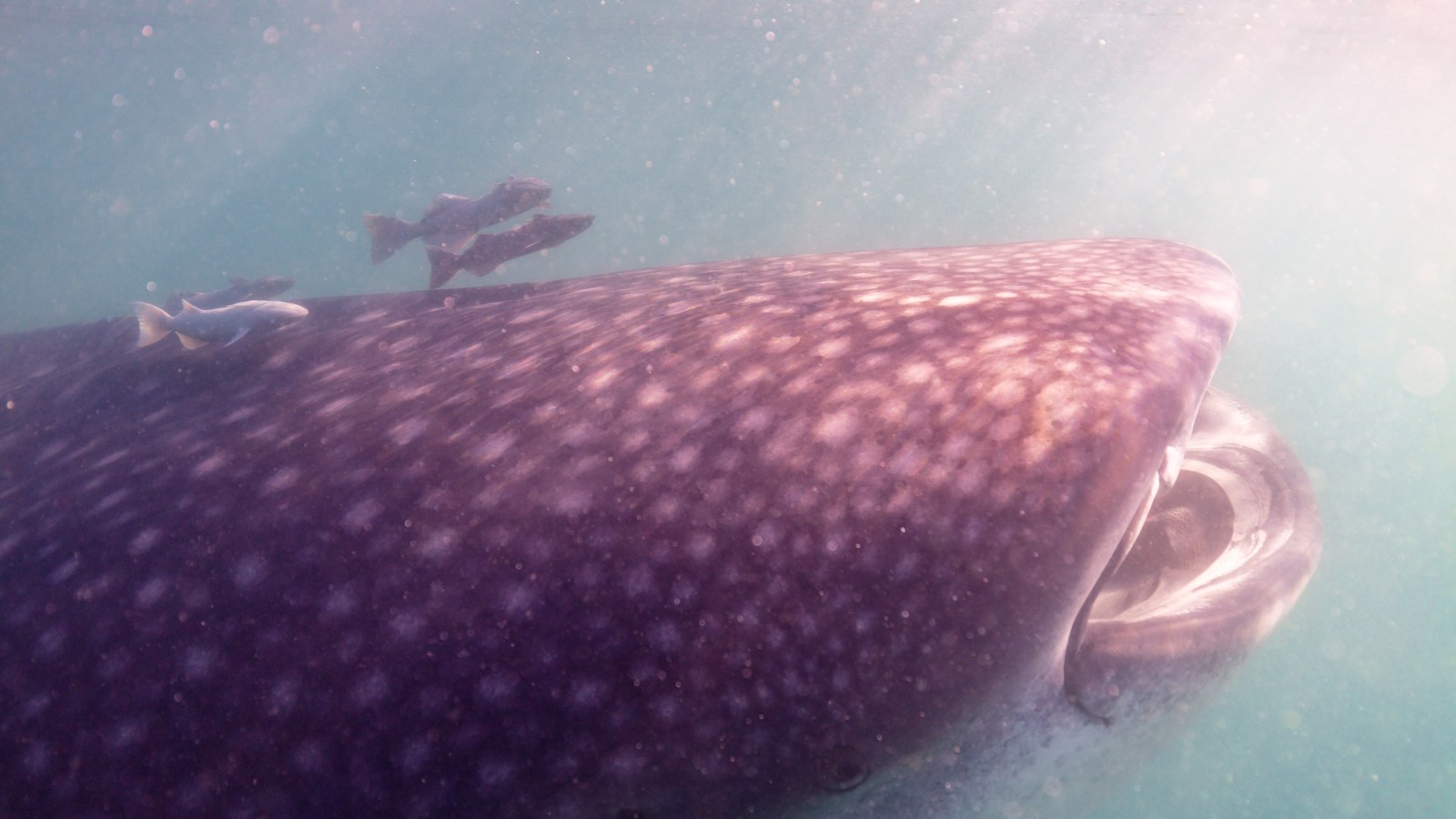
Species deep dive · whale shark
Are whale sharks dangerous? No — not in the way people fear sharks. Rhincodon typus is Earth's largest living fish, but it is a filter feeder: it strains plankton, fish eggs, small crustaceans, and schooling baitfish through specialized gill screens. Divers and snorkelers routinely share water with them at places like Ningaloo Reef and the Yucatán; Florida Museum of Natural History and NOAA both describe the species as generally docile and approachable (give them space, and never ride or chase them). The real risk story runs the other way: boats and nets injure sharks more often than sharks injure people.
Why are they endangered? The IUCN moved whale sharks to Endangered in 2016 after assessing steep declines — global numbers inferred down by at least about 50% over roughly three generations (~75 years), driven especially by the Indo-Pacific subpopulation. Targeted fisheries, bycatch in tuna fleets, and ship strikes on surface-feeding animals piled on a slow-breeding life history.
Largest fish, not a whale
Despite the name, whale sharks are sharks (order Orectolobiformes, family Rhincodontidae) — carpet-shark relatives that went pelagic. NOAA Ocean Service notes lengths commonly discussed around 40 feet (~12 m) with some estimates higher; animals much longer than about 39 feet are uncommon. Reliable field aggregations (Ningaloo photo-ID work) mostly see sharks in the 3–10 m range. A broad, flat head, a near-terminal mouth that can gape more than a meter wide, three lateral ridges, and a checkerboard of pale spots and stripes on a dark back make the species unmistakable.
Those spots are more than decoration. Researchers treat the pattern behind the last gill slit and ahead of the dorsal fin like a fingerprint, combining it with scars for long-term photo-identification. A Marine Ecology Progress Series study at Ningaloo Reef (1992–2004) identified 159 individuals from hundreds of photos and estimated a visiting super-population on the order of roughly 300–500 sharks — with some individuals resighted more than a decade apart.
How a gentle giant eats
Whale sharks do not need to ram-filter like basking sharks. They can suction-feed, opening the mouth, drawing water in at high velocity, then flushing it over sieve-like gill rakers that retain particles only a few millimeters across. Surface feeding near plankton blooms and fish-spawn events draws tourism at Ningaloo (Western Australia), Yucatán (Mexico), Mozambique, the Philippines, and other hotspots. The Wilder card's "polka-dot bus that never bites" line is biology, not marketing: tiny teeth are not the hunting tool.
Reproduction matches the "slow" conservation profile. Whale sharks are ovoviviparous livebearers. A famous 1995 Taiwanese female carried on the order of 300 embryos — among the largest litter counts recorded for any shark — with pups roughly 55–64 cm at birth.
Why the Red List matters
IUCN's 2016 reassessment flagged unfinished domestic protection even where CITES regulates international trade. Large-scale fisheries closed or banned in places such as India, the Philippines, and Taiwan still left pressure elsewhere, plus incidental capture where sharks and tuna schools overlap. Vessel strikes scar many photo-ID catalogs. Because individuals migrate across national waters, local protection alone cannot rebuild a global stock that matures slowly and lives for decades (life-span estimates often span roughly 60–100 years, though exact ages remain uncertain).
On the Wilder card
*Whale Shark (Rhincodon typus)* is Wilder's Pisces gentle giant — Resilient bulk on a filter-feeding predator that still ranks as the ocean's largest fish. Pair this Journal piece with the card when you want the Endangered status, spot photo-ID science, and the "dangerous?" answer in one place.
Photo credit
Hero photograph: Diego Delso — whale shark (Rhincodon typus), La Paz, Baja California, Mexico, 20 December 2024 (Wikimedia Commons), CC BY-SA 4.0. Credit: Diego Delso, delso.photo, License CC BY-SA. Cropped for the Field Journal hero.

Questions people ask
Are whale sharks dangerous to humans?
No — they are filter feeders that strain plankton and small prey, and are generally considered harmless and docile around divers. Give them space; vessel strikes and harassment are the bigger human–shark conflict (Florida Museum; NOAA).
Why is the whale shark endangered?
IUCN listed Rhincodon typus as Endangered in 2016 after inferring a global decline of at least ~50% over about 75 years, mainly from fishing, bycatch, and ship strikes on a slow-breeding species (IUCN).
How big do whale sharks get?
They are Earth's largest living fish. NOAA cites lengths up to about 40 feet (~12 m) (longer animals are uncommon); photo-ID work at Ningaloo mostly records sharks about 3–10 m total length (NOAA; Meekan et al. 2006).
How do scientists identify individual whale sharks?
By the unique spot-and-stripe pattern on the flank (especially behind the last gill slit) plus scars — treated like a fingerprint. Ningaloo researchers matched some individuals across more than a decade of photos (Meekan et al. 2006).
What do whale sharks eat?
Plankton, fish eggs, small crustaceans, schooling baitfish, and occasionally squid or similar nekton, strained through sieve-like gill rakers while ram- or suction-feeding (NOAA; Florida Museum). See Wilder's Whale Shark card.
Sources
- IUCN — Whale sharks slide towards extinction (2016 Red List news)
- NOAA Ocean Service — What is the biggest fish in the ocean?
- Florida Museum of Natural History — Whale Shark species profile
- Meekan et al. 2006 — Population size and structure of whale sharks at Ningaloo Reef
- Joung et al. 1996 — Whale shark is a livebearer (300 embryos)
- CMS — Rhincodon typus fact page
- Wilder — Whale Shark card