Largest Fish in the World, Ranked: The Whale Shark Is No. 1
Showdown · whale shark, great white shark, ocean sunfish
The whale shark is the largest fish alive. The longest one reliably measured was 18.8 metres, from the Arabian Sea off India (McClain et al. 2015, PeerJ). The basking shark comes second at up to about 12 metres, then the ribbon-shaped giant oarfish, and then the great white shark and the Greenland shark at about 6.4 metres each. The heaviest bony fish is a different animal again: a 2,744 kg bump-head sunfish found off the Azores in 2021.
This is the Field Journal's weekly Thursday showdown. After the largest birds and the largest reptiles, it's the fishes' turn.

How we ranked them
Fish are measured by length, because almost nobody gets a crane and a scale to a 10 m shark. So we ranked by the longest specimen that scientists consider reliably measured, using one consistent review: "Sizing ocean giants" by Craig McClain and colleagues, which went through the records for the biggest marine animals and threw out the shaky ones (McClain et al. 2015). Where a museum or FishBase gives a different figure, we show it too. Weights come from FishBase's "max. published weight", which is often a single old record, so treat them as rough.
Two things to keep in mind:
- Record sizes are rare. Most individuals are far smaller than the record holders. McClain's team found this for almost every species they looked at.
- Heaviest isn't the same as longest. A long, thin fish can be light, and a short, round one can be enormous. That's why the bony fish get their own ranking by weight below.
The largest fish, ranked by length
| Rank | Fish | Scientific name | Longest reliable length (source) | Heaviest published weight (FishBase) | Wilder card |
|---|---|---|---|---|---|
| 1 | Whale shark | Rhincodon typus | 18.8 m (McClain et al. 2015) | 34 t | Whale Shark |
| 2 | Basking shark | Cetorhinus maximus | 12.27 m, Bay of Fundy, 1851 (McClain et al. 2015) | 4 t | Not yet carded |
| 3 | Giant oarfish | Regalecus glesne | Just under 8 m (McClain et al. 2015, citing Roberts 2012) | 272 kg | Not yet carded |
| 4 | Great white shark | Carcharodon carcharias | About 6 m, possibly 6.4 m (Florida Museum); disputed reports over 7 m | Not given | Great White Shark |
| 5 | Greenland shark | Somniosus microcephalus | 6.4 m (McClain et al. 2015; Florida Museum) | Not given | Not yet carded |
And the heaviest bony fish, ranked by weight:
| Rank | Fish | Scientific name | Heaviest weighed (source) | Wilder card |
|---|---|---|---|---|
| 1 | Bump-head sunfish | Mola alexandrini | 2,744 kg, Azores, 2021 (Gomes-Pereira et al. 2023) | Not yet carded |
| 2 | Ocean sunfish | Mola mola | 1.3 t (FishBase) | Ocean Sunfish |
Numbers are rounded and come from the sources linked in each section below.
1. Whale shark: the biggest fish on Earth
The whale shark is a filter-feeding shark of warm seas worldwide, and the Florida Museum calls it the largest living fish (Florida Museum). Plenty of websites say it reaches 20 metres. McClain's team looked at where those figures came from. The only fish "approximately" 20 m long, which was said to weigh 34 tonnes, was reported from a Taiwanese fish market and wasn't measured carefully. The best-supported record is an 18.8 m whale shark from the fishery off India in the Arabian Sea (McClain et al. 2015). FishBase still lists 34 t as the heaviest published weight (FishBase).
Whale sharks are thought to mature at about 9 m. They sift plankton, fish eggs and small fish through filtering pads at the back of the mouth, and they're considered harmless to people (Florida Museum). For the whale shark's feeding and why it's endangered, read Whale shark: the largest fish, a gentle filter feeder.
2. Basking shark: the giant that swims with its mouth open
The basking shark is the second-largest fish and the biggest one in cool temperate seas. The largest ever recorded was 12.27 m long and got tangled in a herring net in the Bay of Fundy, Canada, on 6 August 1851 (McClain et al. 2015). Typical adults are 6.7–8.8 m (Florida Museum), and FishBase gives a heaviest published weight of 4 tonnes (FishBase).
Like the whale shark, it eats plankton. But it's the only one of the three giant filter-feeding sharks that just swims forward with its mouth open and lets the water flow through, and its gill rakers can strain up to 2,000 tonnes of water an hour (Florida Museum).
3. Giant oarfish: the longest bony fish
The giant oarfish is a silvery ribbon of a fish with a crimson fin along its back, and it is the longest bony fish alive. Reports of 10–11 m oarfish are common, but the ichthyologist Tyson Roberts found that the largest museum specimens are just under 8 m. The longer figures come from adding guessed lengths for tails that had broken off (McClain et al. 2015, citing Roberts 2012). Most adults in Roberts' records were about 4 m.
Length is where its size ends. The heaviest published oarfish weighed 272 kg (FishBase), less than a tenth of a big basking shark. It feeds on krill and other small animals that it strains from the water (Florida Museum), and healthy oarfish are rarely seen alive, because most measurements come from dead or dying fish that washed ashore (McClain et al. 2015).
4. Great white shark: the biggest predatory fish
The great white is the largest fish that hunts big prey. Its record size is one of the most argued-about numbers in fish science. Modelling suggests a maximum length of about 6 m, possibly up to 6.4 m (Florida Museum). Two sharks caught in 1987, one near Kangaroo Island in Australia and one off Malta, were estimated at over 7 m. Later checks of those estimates gave ranges of 5.3–8.2 m and 4.6–7.0 m. A famous "8 m" shark from Mallorca in 1969 was probably 6.00–6.42 m (McClain et al. 2015).
Great whites may live to 70 years or more, going by bomb-carbon dating (Florida Museum). See how they hunt in Great white shark: the apex ambush hunter, and what happens when an orca turns up in Orca vs great white shark.
5. Greenland shark: the slow giant of the Arctic
The Greenland shark lives in the cold, deep water of the North Atlantic and the Arctic. Its maximum reported length is 6.4 m (McClain et al. 2015), and the Florida Museum says it may reach 7.3 m, though most are 2.4–4.3 m long (Florida Museum). On the best figures it's level with the great white, so treat ranks 4 and 5 as a tie. We put the great white first only because the disputed 7 m reports, if they're right, would put it ahead.
It is ranked as the slowest-swimming fish, and it grows only 0.5–1.1 cm a year (McClain et al. 2015). Greenland sharks have been found with seals, porpoises and even a whole reindeer in their stomachs (Florida Museum).
The heaviest bony fish: the sunfishes
Sharks and rays have skeletons of cartilage. Among fish with real bones, the heaviest are the sunfishes. The record is a dead bump-head sunfish (Mola alexandrini) found off Faial Island in the Azores on 9 December 2021. It weighed 2,744 kg, and it was 3.25 m long (Gomes-Pereira et al. 2023, Journal of Fish Biology; Guinness World Records).
For years the record was credited to the ocean sunfish, Mola mola. A 2022 review found that the old 2,300 kg record fish from Kamogawa, Japan (1996) was really a misidentified bump-head sunfish. Of 15 sunfish reported at over 2,000 kg, the authors identified 14 as bump-heads and only five had actually been weighed (Sawai & Nyegaard 2022, Journal of Fish Biology). The heaviest published Mola mola is 1.3 t, and it reaches 3.33 m long (FishBase).
What about the beluga sturgeon? Old records credit it with up to 8 m and 3.2 t (FishBase). The 2022 review couldn't confirm any bony fish other than the bump-head sunfish over 2,000 kg, so we've left the beluga out of the ranking (Sawai & Nyegaard 2022).
Why don't bony fish grow as big as the giant sharks? One leading idea is that it comes down to the gills. A big bony fish has to pump enough water over its gills to fuel a faster metabolism than a shark's, and that sets a ceiling (McClain et al. 2015, citing Freedman & Noakes 2002).
How the biggest fish play in Wilder
Three fish from these lists have Wilder cards, and they play very differently.
- The Whale Shark (Rhincodon typus) is a Common Pisces card in the Water element. It costs 7 Energy, with Attack 2 and a huge Health of 11, plus Resilient and Guardian. Its ability Filter Feed costs 2 Energy and restores 2 Life to your Den. It's a wall, not a hitter. Flavour text: "Gentle giant that filters oceans, not fears."
- The Great White Shark (Carcharodon carcharias) is a Rare Water card that costs 6 Energy, with Attack 6, Health 5, Ambush and Relentless. Flavour text: "Silent hunter of the blue, jaws born from nightmares."
- The Ocean Sunfish (Mola mola) is an Uncommon Water card that costs 5 Energy, with Attack 3, Health 7, Basking and Guardian. Flavour text: "It dives 200 m to hunt jelly-like prey in the cold, then lies at the surface to warm up."
The basking shark, giant oarfish, Greenland shark and bump-head sunfish don't have cards yet. For the land giants, see the heaviest land mammals, ranked, and for the cats, the biggest cats in the world, ranked.
Wilder is a free browser collectible card game about real animals, and you can play it free in your browser with no signup.
Photo credit
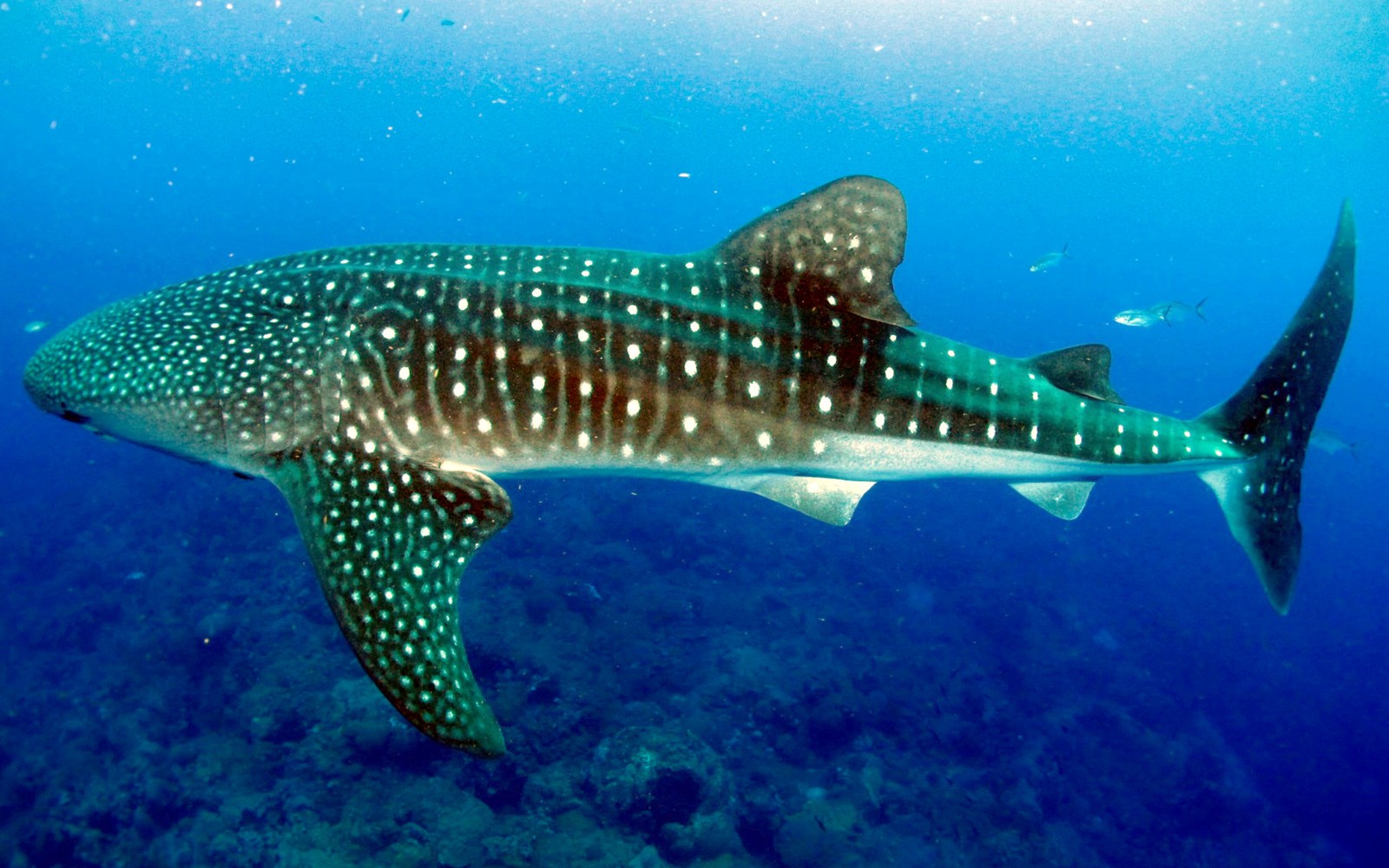
Hero photograph: FGBNMS/Eckert (NOAA Flower Garden Banks National Marine Sanctuary), "Rhincodon typus fgbnms" (a whale shark at the Flower Garden Banks National Marine Sanctuary, Gulf of Mexico, 2011), Wikimedia Commons, public domain (work of the US federal government). Cropped for the Field Journal hero.

Questions people ask
What is the largest freshwater fish in the world?
A giant freshwater stingray. In June 2022 a fisher in Cambodia's Mekong River hooked a female that weighed 300 kg and measured almost 4 m from snout to tail, and scientists released her with a tag. The previous record was a 293 kg Mekong giant catfish caught in Thailand in 2005 (University of Nevada, Reno).
How long can a Greenland shark live?
At least 272 years. Radiocarbon dating of the eye lenses of 28 female Greenland sharks put the largest, a 5.02 m female, at about 392 ± 120 years old, which makes it the longest-lived vertebrate known. Females don't seem to mature until they're at least about 156 years old (Nielsen et al. 2016, Science).
Are basking sharks dangerous to humans?
No, not to a passive observer. Basking sharks are plankton feeders and are generally tolerant of divers and boats. Their size and power still deserve respect, and their skin is covered in large, rough denticles that have injured divers and scientists who touched them (Florida Museum).
What is the biggest ray in the world?
The giant manta ray. NOAA Fisheries gives it a wingspan of up to about 7.9 m (26 ft) and a weight of up to about 2,400 kg (5,300 lb). Like the whale shark and basking shark, it's a filter feeder that eats mostly zooplankton (NOAA Fisheries).
Sources
- McClain et al. (2015) Sizing ocean giants: patterns of intraspecific size variation in marine megafauna, PeerJ 3:e715
- Florida Museum: Whale shark (Rhincodon typus)
- FishBase: Rhincodon typus
- Florida Museum: Basking shark (Cetorhinus maximus)
- FishBase: Cetorhinus maximus
- Florida Museum: Oarfish (Regalecus glesne)
- FishBase: Regalecus glesne
- Florida Museum: White shark (Carcharodon carcharias)
- Florida Museum: Greenland shark (Somniosus microcephalus)
- Gomes-Pereira et al. (2023) The heaviest bony fish in the world: a 2744-kg giant sunfish Mola alexandrini, Journal of Fish Biology
- Guinness World Records: Heaviest bony fish
- Sawai & Nyegaard (2022) A review of giants: species identities of the world's heaviest extant bony fishes, Journal of Fish Biology
- FishBase: Mola mola
- FishBase: Huso huso
- Nielsen et al. (2016) Eye lens radiocarbon reveals centuries of longevity in the Greenland shark, Science
- University of Nevada, Reno: World's largest freshwater fish found, released in the Cambodian Mekong River (2022)
- NOAA Fisheries: Giant manta ray