Binoculars for Bird Feeder Watching: Christmas Picks for the Window or Garden
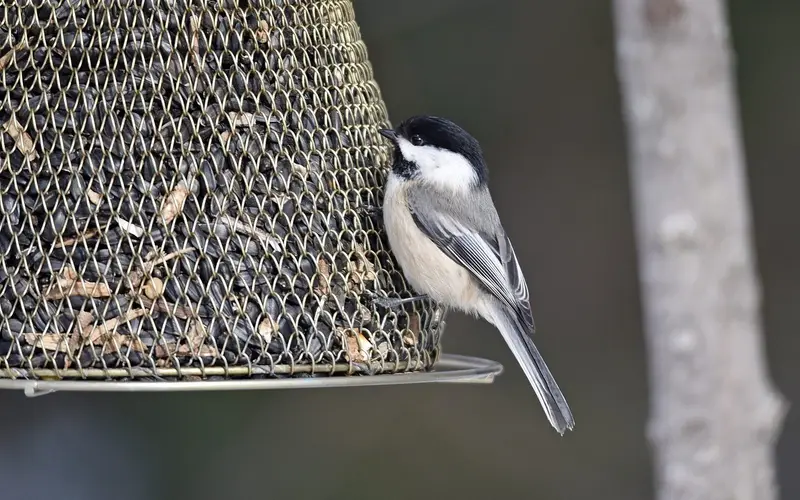
Five binoculars for watching feeder birds from a window or garden, with close focus explained, plus feeders, field guides and a FeederWatch gift.
Play Rock Dove in Wilder, free in your browser
Species deep dive · rock dove Play this card, eastern gray squirrel Play this card, peregrine falcon Play this card
The best binoculars for watching a bird feeder are not the most powerful ones: they are the pairs that focus close, show a wide view and are light enough to pick up the moment a bird lands. A feeder in the garden or on the window is the easiest birdwatching there is. The birds come to you, every day, all winter. Through binoculars, a grey blob on the seed tube turns into a great tit's yellow chest, a house finch's red cap or the striped face of a chickadee. This guide explains what actually matters when the birds are only a few metres away, picks five pairs we checked, and adds a few things that go well with them: a feeder or two, a field guide for your part of the world, and a gift that turns all that watching into real science.
As an Amazon Associate, Wilder earns from qualifying purchases. Other links are plain links with no commission. See our affiliate disclosure.
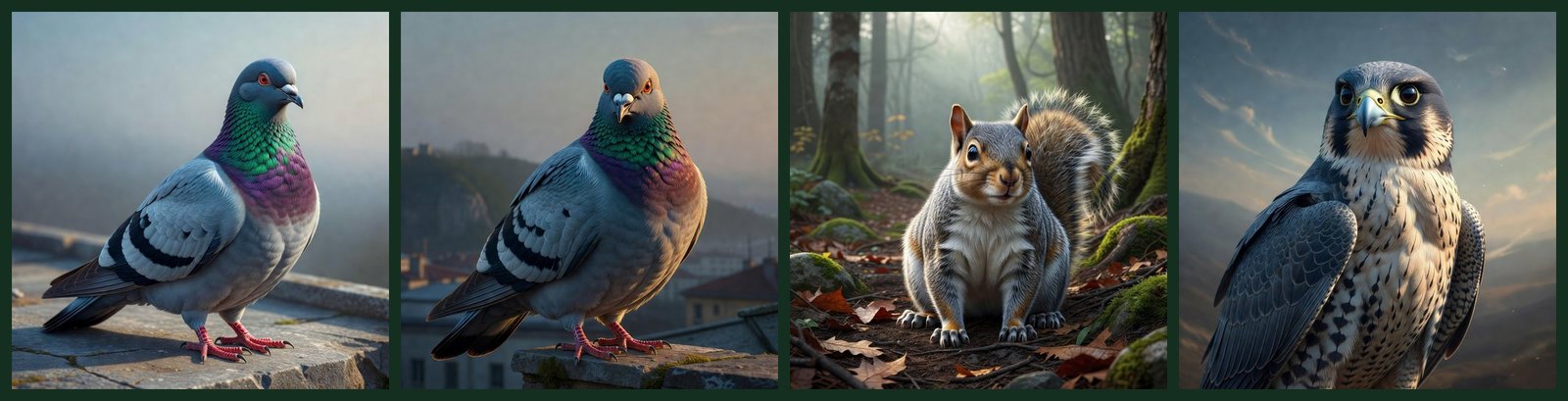 Wilder card art for the rock dove, the eastern gray squirrel and the peregrine falcon: the pigeon that turns up at every feeder, the squirrel that raids it, and the falcon that hunts pigeons in cities.
Here are 12 ideas we checked on 27 November 2026. Most links go to Amazon and use our Associates tag; the rest are plain links to the maker or the Cornell Lab, with no commission. Prices are what each page showed that day and will change. Most of the shops are in the US, so check shipping to your country before you order, and order soon if it needs to arrive before Christmas.
First: how far away is the feeder?
This one number decides which binoculars make sense. Every pair has a close focus distance, the nearest point it can show sharply. Anything closer is a blur, however good the glass. Many full-size binoculars can't focus closer than 3 to 4 m (10 to 13 ft), which is fine for a feeder at the bottom of the garden but useless for one on the window frame.
Where you put the feeder matters for the birds too. The American Ornithological Society advises hanging feeders either closer than 1 m (3 ft) to a window or more than 10 m (30 ft) away. Close to the glass, a bird can't build up enough speed to hurt itself if it hits the window; far away, it is less likely to be confused by the reflections (American Ornithological Society). So in practice there are two kinds of feeder watching:
A feeder on or next to the window, under 1 m (3 ft) from the glass. You need binoculars that focus very close, like pick 1 below, or none at all.
A feeder out in the garden, 10 m (30 ft) or more from the house. Almost any good pair focuses that far, so look at the view, weight and price instead.
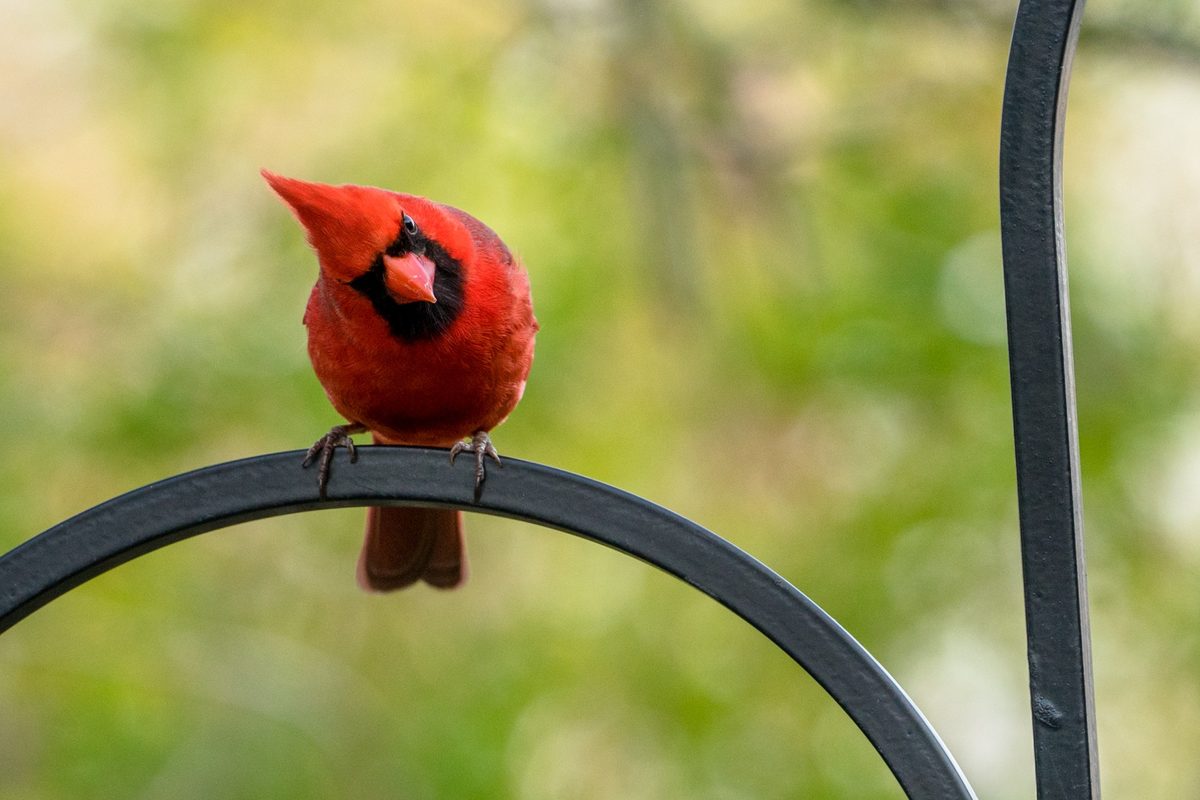 A male northern cardinal on a backyard feeder in Rockville, Maryland. Photo: John Brighenti, Wikimedia Commons, CC BY 2.0.

What else matters for watching garden birds
8x or 10x? For feeder birds, 8x is the better choice. A higher magnification shows more detail but also magnifies every tremble of your hands, and it narrows the view, so a bird that hops is easier to lose. You can see the trade-off in the makers' own numbers: Celestron's Nature DX shows a 7.4° field of view at 8x and only 5.8° at 10x (Celestron; Celestron). At feeder distances you don't need the extra reach.
Field of view. This is how wide a slice of the world you see, given in degrees or as metres at 1,000 m (feet at 1,000 yards). Around 7° or more makes it easy to find a bird quickly and to keep the whole feeder in view. All five pairs below are between 7° and 7.5°.
The 42 in 8x42. The second number is the width of the front lenses in millimetres. Bigger lenses gather more light, which helps on a dark December afternoon, but they add weight. A full-size 8x42 weighs around 600 g (21 oz); a compact 21 mm pair weighs half that and is dimmer in poor light.
Through the glass. You can watch through a closed window, but every pane, smear and reflection softens the view a little. Clean the glass, keep your eyes square to it and, when it's mild enough, open the window.
Budget. Good beginner binoculars for a garden start at around $90 to $100. Spending $150 to $300 buys sharper, brighter glass and closer focus, and past that the gains get smaller for a feeder a few metres away. Glasses wearers should look for long eye relief (about 15 mm or more) and twist-down eyecups.
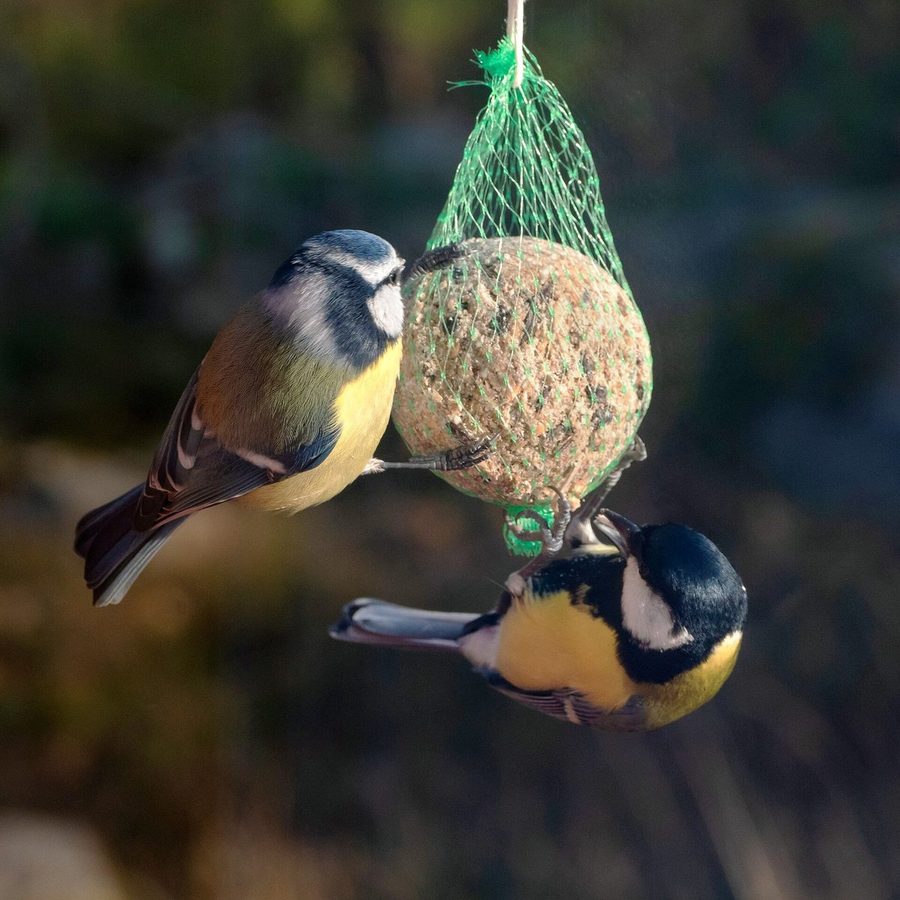 A blue tit and a great tit on a suet ball in Brastad, on the west coast of Sweden. Photo: W.carter, Wikimedia Commons, CC0.

The binoculars
1. Pentax Papilio III 6.5x21 WR. Our pick for a feeder on the window. It focuses down to about 50 cm (20 in), close enough to watch a tit on a window feeder or a butterfly on a flower, and Pentax's convergence system slides the front lenses inward as you focus close so the two eyes' views still line up comfortably. It's small and weighs about 295 g (10.4 oz), and the 7.5° field of view is wide (Ricoh Imaging). The trade-off is the small 21 mm lenses, which make the view dimmer at dusk than a full-size pair, and it is weather-resistant rather than fully waterproof. The 8.5x version is less forgiving of shaky hands; for the window, 6.5x is the one.
2. Celestron Nature DX 8x42. The all-rounder for a garden feeder and for walks. It focuses down to 2 m (6.5 ft), has a 7.4° field of view, is waterproof and fogproof, and weighs 629 g (22.2 oz) (Celestron). It does everything reasonably well for its price, which makes it an easy first pair, and Celestron lists it as tripod adaptable.
3. Nikon Prostaff P3 8x42. The budget pick from a big optics name, and the lightest full-size pair here at 575 g (20.3 oz). The field of view is 7.2°, it's waterproof, and the long 20.2 mm eye relief suits glasses wearers. Close focus is 3 m (9.8 ft), so it works for a feeder out in the garden, not one on the window (Nikon).
4. Vortex Diamondback HD 8x42. The step up. It focuses down to 1.5 m (5 ft), shows a 7.5° field of view and weighs 618 g (21.8 oz), and Vortex covers it with an unconditional lifetime warranty (Vortex). Vortex aims it at hunters, but close focus and wide view are exactly what a feeder watcher wants. The Amazon listings we found were from third-party sellers, so this link goes straight to Vortex, whose price is the list price; other dealers often sell it for less.
5. Celestron Outland X 8x42. The cheapest pair we'd consider. It is waterproof, has a 7° field of view and weighs 670 g (23.6 oz), but it only focuses down to 4 m (13.1 ft) (Celestron), so it's for a feeder well down the garden. About $88. Amazon: Celestron Outland X 8x42
Extras for the window seat
Nature's Hangout window bird feeder. A clear feeder that sticks to the outside of the glass with suction cups, which puts the birds well inside the "closer than 1 m" safe zone. It pairs perfectly with the Papilio, or with no binoculars at all. Sold on Amazon by Nature's Hangout itself. About $24. Amazon: Nature's Hangout window bird feeder
Brome Squirrel Buster Classic. For gardens with an eastern gray squirrel problem. When a squirrel climbs on, its weight pulls a spring-loaded wire shroud down over the four feeding ports; when it gives up, the ports open again for the birds. It holds 1.1 kg (2.4 lb) of seed, and Brome says to hang it at least 47 cm (18 in) from anything a squirrel could reach it from (Brome). Our piece on whether squirrels remember where they bury nuts explains why they are so good at finding food. About $79. Amazon: Squirrel Buster Classic
Celestron binocular tripod adapter. Watching from the same chair every morning? An L-shaped adapter screws into the socket at the front of the hinge of many full-size binoculars and onto any tripod with a standard 1/4"-20 thread, so the view stays rock-steady and your arms don't tire. Check that the binoculars have that socket (usually under a small cap) first: Celestron lists the Nature DX and Outland X as tripod adaptable. About $15. Amazon: Celestron binocular tripod adapter
A field guide for your part of the world
Binoculars show you the bird; a field guide tells you what it is. Pick the one for where the feeder is.
The Sibley Field Guide to Birds of Eastern North America, by David Allen Sibley (Knopf, second edition). David Sibley's own paintings of the region's birds, with the marks that tell look-alikes apart, in a paperback that sits happily on a windowsill. For anywhere east of the Rocky Mountains. About $13. Amazon: Sibley Field Guide to Birds of Eastern North America
Sibley Birds West, by David Allen Sibley (Knopf, second edition). The same guide for western North America. About $13. Amazon: Sibley Birds West
Birds of Europe, by Lars Svensson, Killian Mullarney and Dan Zetterström (Princeton, third edition). The classic guide to Europe's birds, published in Britain as the Collins Bird Guide. This is the US edition from Princeton University Press, so it's the one to order from Amazon.com. About $27. Amazon: Birds of Europe, third edition
A gift that turns feeder watching into science
Project FeederWatch. The Cornell Lab of Ornithology and Birds Canada run this winter count of the birds that visit feeders across North America, from November to April. Participants count whenever they like, as often or as rarely as they like, and scientists use the counts to track where winter birds are and how their numbers change; it's how the decline of Florida's wintering painted buntings was spotted. US participants pay $18 a season and get a poster of common feeder birds and digital access to Living Bird magazine; Canadians take part by donating any amount to Birds Canada (Project FeederWatch). The join page has a gift option, so it fits in a card.
In the UK, the free version is the RSPB's Big Garden Birdwatch: one hour of counting the birds in your garden, on a balcony or in a park, any time from 29 to 31 January 2027. Registration opens on 9 December 2026 (RSPB). A new pair of binoculars under the tree is a good reason to take part.
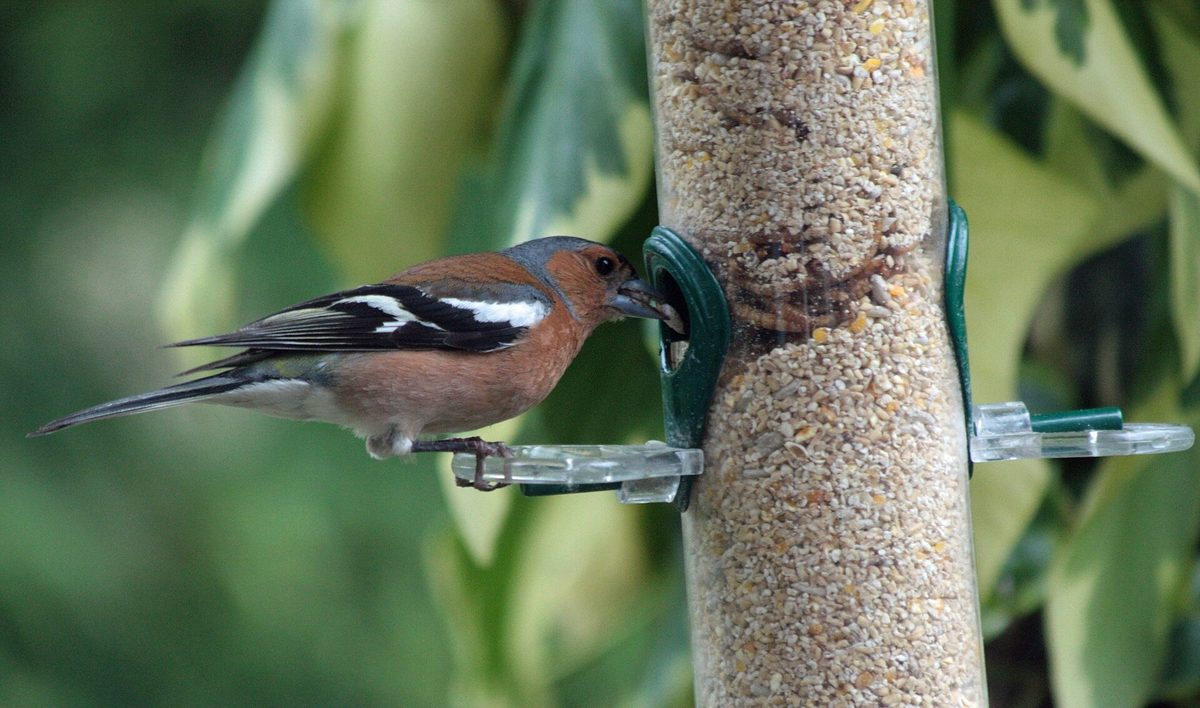 A male chaffinch at the feeder outside the photographer's kitchen window. Photo: Gareth Williams, Wikimedia Commons, CC BY 2.0.

One more for the bird lover
Wilder is a free collectible card game for all ages about real animals, and the regulars of a city feeder are in it. The rock dove is the wild ancestor of every street pigeon (read how the city pigeon came down from the cliffs), the eastern gray squirrel is the feeder raider, and the peregrine falcon, which now nests on city buildings and hunts pigeons, has its own story of the fastest dive on Earth and a comeback from DDT. If you know someone who'd rather watch the garden at night, our trail camera gift guide is the companion to this one. You can play Wilder free with no signup.
Photo credit
Hero photograph: Courtney Celley / U.S. Fish and Wildlife Service, "Black-capped chickadee visiting a bird feeder" (17 February 2023), Wikimedia Commons, public domain. Cropped for the Field Journal hero.

Card art: Wilder. The other photographs are credited under each picture.
Play Rock Dove in Wilder, free in your browser
Questions people ask
How far from a window should a bird feeder be?
Either closer than 1 m (3 ft) or more than 10 m (30 ft), says the American Ornithological Society. Close to the glass, a bird can't fly fast enough to hurt itself if it hits the window; far away, it is less likely to mistake reflections for open sky (American Ornithological Society). For a feeder under 1 m away you need binoculars that focus very close, such as the Pentax Papilio's 50 cm (20 in) (Ricoh Imaging).
What do the numbers on binoculars, like 8x42, mean?
The first number is the magnification and the second is the width of each front lens in millimetres. Divide the second by the first and you get the exit pupil, the beam of light that reaches your eye: 42 ÷ 8 gives about 5.25 mm, which Celestron lists for its Nature DX 8x42, while a compact 6.5x21 gives about 3.2 mm. A bigger exit pupil means a brighter view in dim light (Celestron; Ricoh Imaging).
Are 8x or 10x binoculars better for backyard birds?
Usually 8x. At feeder distances you don't need the extra reach, and 8x gives a wider, steadier view. Celestron's Nature DX shows 7.4° at 8x against 5.8° at 10x, and Nikon's Prostaff P3 8x42 has longer eye relief than the 10x42, 20.2 mm against 15.7 mm, which helps glasses wearers (Celestron; Nikon).
Can you join Project FeederWatch outside North America?
No. FeederWatch covers the United States and Canada, and you join for the country you live in (Project FeederWatch). In the UK, the RSPB's free Big Garden Birdwatch asks people to count garden birds for one hour between 29 and 31 January 2027, with registration opening on 9 December 2026 (RSPB).
Sources
- American Ornithological Society: Birds and Windows
- Ricoh Imaging: Pentax Papilio III WR
- Celestron: Nature DX 8x42
- Celestron: Nature DX 10x42
- Nikon USA: Prostaff P3 8x42
- Nikon: Prostaff P3 8x42/10x42 specifications
- Vortex: Diamondback HD 8x42
- Celestron: Outland X 8x42
- Brome: Squirrel Buster Classic
- Project FeederWatch: Project Overview
- Project FeederWatch: Join, Renew, or Donate
- RSPB: Big Garden Birdwatch
- RSPB: Big Garden Birdwatch 2027 how-to guide (PDF)