Why Do Ring-Tailed Lemurs Have Striped Tails? Sunbathing and Stink Fights
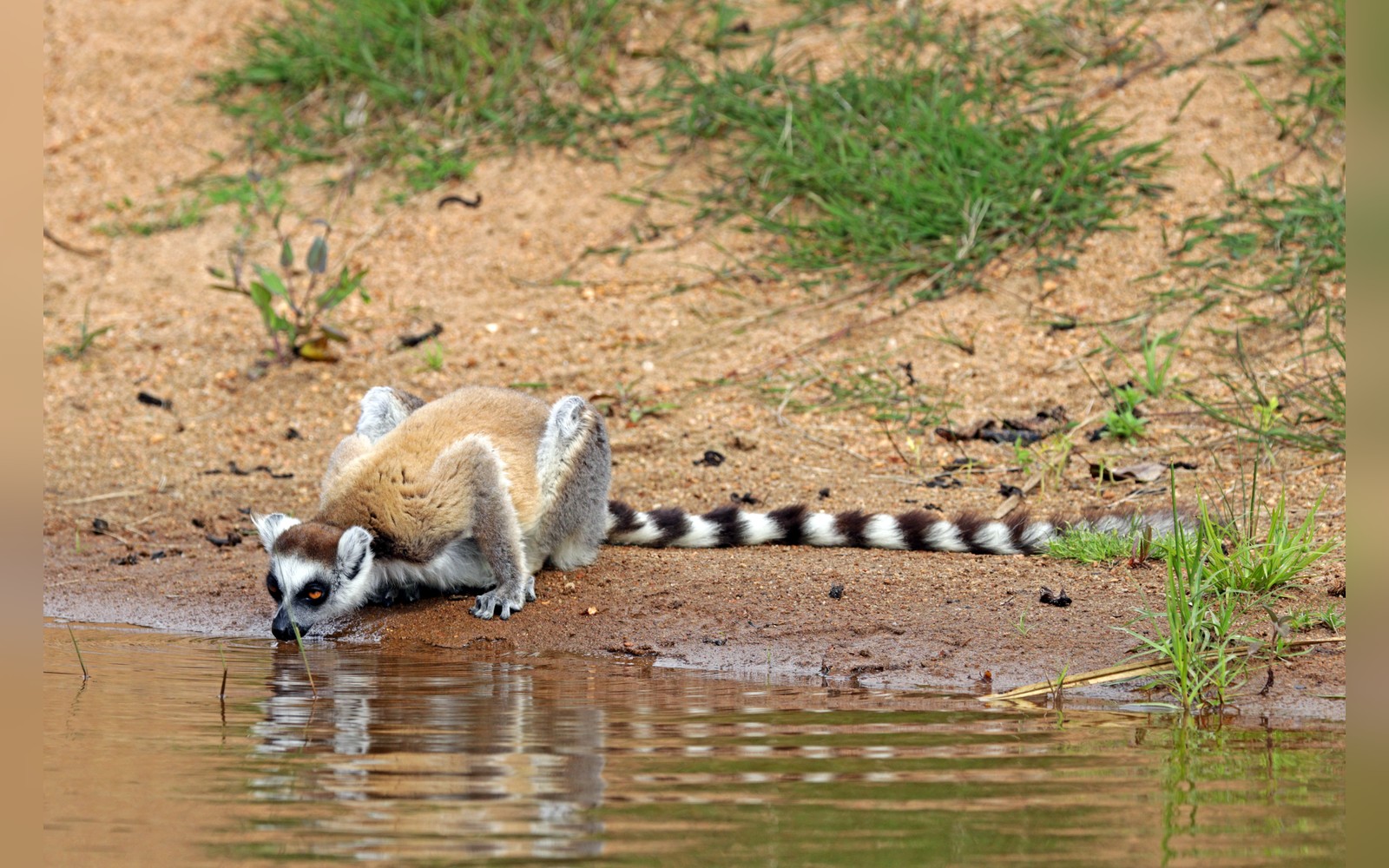
Species deep dive · ring tailed lemur
*Ring-tailed lemurs (Lemur catta) wear about 13 alternating black-and-white bands on a long flag of a tail* — a built-in banner for keeping the troop together, and, for males, a scent weapon in "stink fights" (Smithsonian's National Zoo; Duke Lemur Center).
A striped flag — and a stink weapon
When a troop moves, animals often hold that ringed tail upright so neighbours can track the group through dry forest and scrub. Olfaction does the rest: scent glands on the wrists and chest leave marks on foraging routes, and males can mix wrist (antebrachial) and chest (brachial) secretions, wipe them onto the tail, then wave the scented plume at a rival until one backs down (Smithsonian NZCBI; Duke Lemur Center).
Unlike most lemurs, ringtails are strongly terrestrial. Smithsonian's National Zoo puts time on the ground around 40%; the Duke Lemur Center describes them as the most ground-living lemur species, sometimes spending up to about half the day down among the leaf litter (Smithsonian NZCBI; Duke Lemur Center).
Sunbathing in a "yoga" pose
On cool Madagascan mornings, a troop may gather in a sunny clearing and sit upright with arms and legs spread — the so-called yoga position — so thinner belly fur soaks up warmth (Smithsonian NZCBI; Duke Lemur Center). It looks serene. It is thermoregulation.
Endangered, with a contested headcount
Lemur catta is Endangered on the IUCN Red List (2018 assessment by LaFleur and Gould, summarized by San Diego Zoo Wildlife Alliance's IELC). Drivers include habitat loss, bushmeat hunting, and the illegal pet trade. A reliable global wild total is still unknown; LaFleur and colleagues' multi-site work yields a cautious minimum of about 2,200 animals across 32 surveyed sites, with many other sites unsurveyed — so treat any single "how many left" number as incomplete (IELC population factsheet; LaFleur et al. 2016).
On the Wilder card
The ring-tailed lemur plays as a Common Mammalia card: Cost 2, Attack 2, Health 3, with Herd. That Herd keyword fits a troop animal that flags its neighbours with a striped tail. In the free browser collectible card game, the art shows the same Endangered Madagascan primate — not a cartoon pet.
If you only needed the short version: about thirteen black-and-white rings, used as a flag and a male scent weapon; sunbaths that look like yoga; IUCN Endangered with no precise global census.
Photo credit
Hero photograph: Charles J. Sharp — Ring-tailed lemur (Lemur catta) 2 — Wikimedia Commons, CC BY-SA 4.0. Padded to fit the Field Journal hero.

Questions people ask
Why do ring-tailed lemurs have striped tails?
The roughly 13 alternating black-and-white bands make a visual flag so troop members stay together, and males also anoint the tail with wrist and chest gland scent for stink fights (Smithsonian NZCBI; Duke Lemur Center).
Do ring-tailed lemurs really sunbathe in a yoga pose?
Yes. Troops sit upright with arms and legs spread — often called a yoga position — so thinner belly fur faces the sun and warms the body (Smithsonian NZCBI; Duke Lemur Center).
Are ring-tailed lemurs endangered?
Yes. Lemur catta is Endangered on the IUCN Red List (2018 assessment by LaFleur and Gould). Habitat loss, hunting and the pet trade drive declines (IELC; Duke Lemur Center).
How many ring-tailed lemurs are left in the wild?
A precise global total is unknown. LaFleur et al. report a minimum of about 2,200 animals at 32 surveyed sites, with many sites still unsurveyed — so that figure is a floor, not a census (IELC; LaFleur et al. 2016).
What does the Wilder ring-tailed lemur card do?
On Wilder it is a Common Mammalia card: Cost 2, Attack 2, Health 3, with Herd — flavour for a social troop animal that flags its neighbours with that striped tail.